



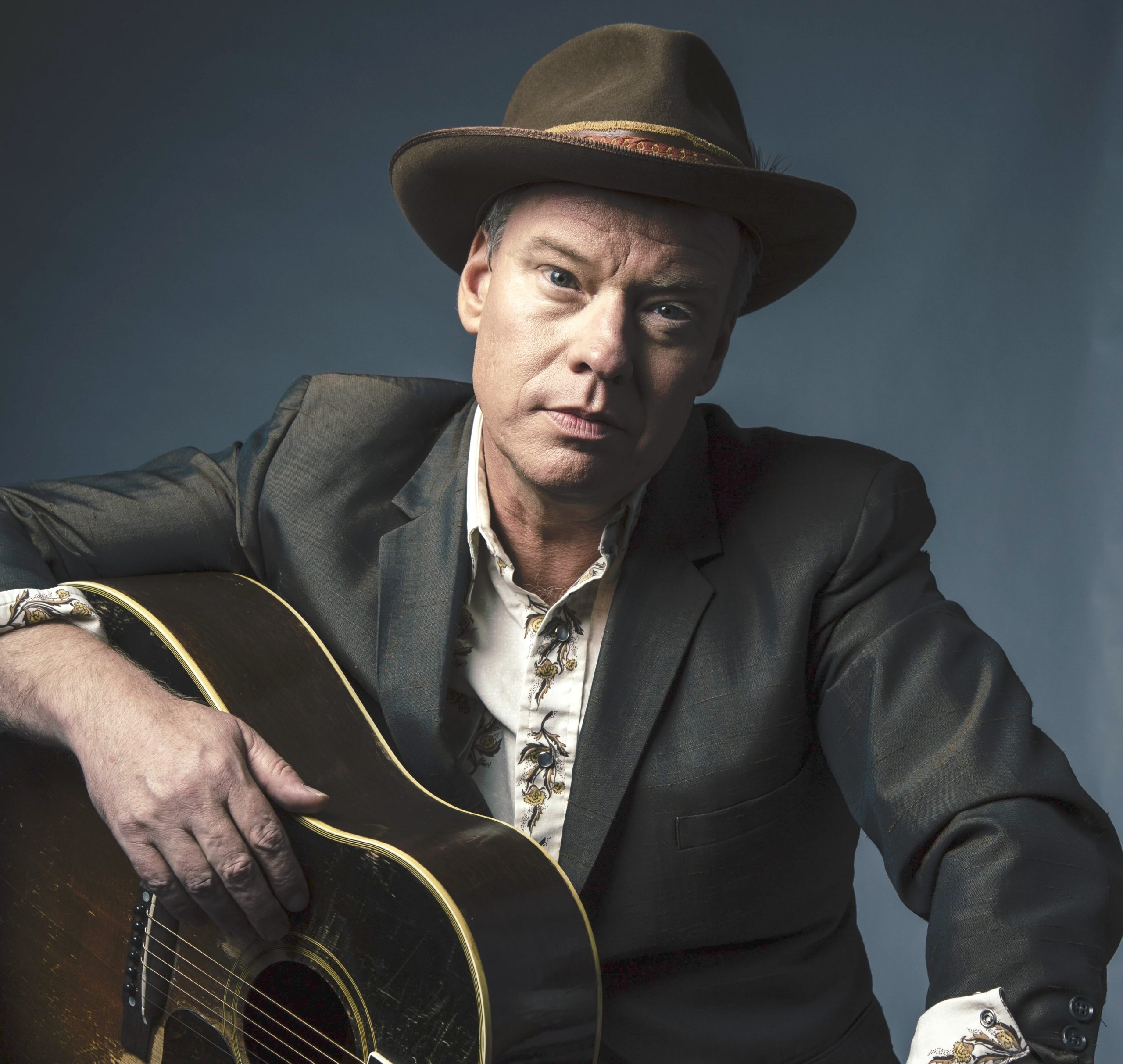
Photograph by David McClister
Shawn Mullins has spent more than 35 years touring the world with a guitar, a journal, and a keen eye for behavior that sits outside what might be considered normal but not necessarily aberrant or abhorrent. He has a catalog of catchy and thought-provoking tunes across 10 studio albums that include such hit songs as “Lullaby,” “California,” “Light It Up,” and “Beautiful Wreck.”
He’s visited his hero Kris Kristofferson’s home in Hawaii, shared the ocean-cruising Cayamo cruise with performers from John Prine and Lyle Lovett to Brandi Carlile and Emmylou Harris. He co-wrote the Jimmy Buffett-influenced “Toes” that was a No. 1 country hit for the Zac Brown Band in 2009.
In other words, Mullins is not a new kid on the block. Instead, he’s an enthusiastic troubadour who is still excited to play for a few hundred folks in a club like the Ludlow Garage, where he returns on May 6.
“What keeps me going is that reciprocity of energy in the room, the way we’re all taking in something, so it doesn’t feel like it’s really mine at all,” says Mullins, who was born and still lives in Atlanta. “It’s like a really beautiful experience, very spiritual, if it’s right.”
How deep into your career were you when “Lullaby” became a radio hit in 1998?
I was 29 and had been playing for almost 10 years, starting in college. Once I got out of my U.S. Army Reserve once-a-month commitment, I hit the road. So between 1992 and ’98 I did about seven years full-on. Of course, just like everyone, I had to take little side jobs here and there. I never really had a full-time day job. I worked as a pet sitter at one point. If I wanted to stay home, I would play local gigs and do a little pet-sitting or something like that. But for the most part I really worked the road. I loved it.
During that period, were you playing solo or did you have a band?
I was playing solo, and then I got a little band together in college (North Georgia College, now the University of North Georgia). We played from Auburn, Alabama, to Greenville, South Carolina, and all over Georgia and a little bit in Florida. Starting in the late ’80s, I was playing regionally with my band, and then about ’94 I focused more on being a singer-songwriter. The band kind of busted up, but not in a bad way. People just moved on. And I didn’t have another band until ’98. Most of those years were pretty hardcore, living in the van, building character. And building back problems (laughs).
The last time you played here, you told a story about your dad, who worked part time in the music department of Rich’s department store in Atlanta. He would bring home the new records of the day. How old were you, and how much of an influence were those records?
I was probably 3 or 4. All of my first music memories are based on that music. And it was all over the place as it was, I think, for people back then. I think for people who really loved music it was a time for minds to be open to a lot of stuff. And my dad being about 32 or 34, he was kind of a weekend hippie. He grew his hair and beard out a bit, and it was a little controversial. He was riding a motorcycle to work and had feathers in his hair (laughs). He was a trip.
It was the later years of Vietnam. I was born in 1968, so by ’72 I’m hearing all this music and seeing it on TV. Some of it’s about trying to create peace again, and some of it’s about liberation and freedom and civil rights and all that. I heard Utah Phillips say years ago that California would pry you open to all those things, but Atlanta’s like that too. It’s a very open-minded city, very international, very “Don’t hurt one another and you’re good.”
Was there one album or one artist that convinced you pick up an instrument and start playing music?
Kris Kristofferson. His song “To Beat the Devil” was the pivotal moment when I was a kid. I remember not even really knowing what it was about but being so attached to that song and knowing that it was somehow gonna be about me. It’s a weird thing when that happens because it’s almost like I knew that song was my song.
I got to tell Kris that at one point. He was like, “Really?” I was like, “Yeah. I gotta tell you, I’ve lived that.”
And from the time I was a little kid and the album first came out (Kristofferson was released in 1970) I didn’t know what it was talking about, but I knew it was my song. It was his voice and his way of communicating. It was the sound of the guitar, the kind of raw nature of that recording in particular.
I also loved the speaking half of the song and singing the other half. That’s become something I’ve done from since the mid-’90s for sure, even before “Lullaby.” I loved that, so why not bring it back? Spoken-word stuff was very influential on me, like Isaac Hayes too. My dad had those records. And, oddly enough, Gil Scott-Heron. You wouldn’t think that, but he did. And comedy records, great ones like Richard Pryor and George Carlin. Jerry Clower (The Mouth of Mississippi) was played in my grandfather’s house a lot. He was a great storyteller.
Somewhere in your teenage years you ran into Amy Ray before she was an Indigo Girl. Georgia is fertile ground for musicians. Were there any other folks who also made it from your crowd?
First of all, the Indigo Girls are four years older than me (laughs). I met her when I was in the ninth grade and she was a freshman at Emory University. She came and sang some songs at my school. It was some kind of elective class I was taking, and she came in and just blew everybody away. She was 19 years old or something. She did “Romeo and Juliet” and then “Blood and Fire.” Wow, those two songs. It was like the Memorex commercial where everyone’s just looking like their minds are blown.
She was a huge influence, and so was Emily Saliers. Once I met her, it was a whole other type of personality that’s also very alluring. They really are wonderful, good people. Amy is the kind of person that when someone says, “I love that song” or “You did a great job tonight” or whatever, she looks you right in the eye and says, “Thank you, that makes me feel so good. Thank you so much.” And that is a difficult thing for us to do because most of us don’t think we just did well or we don’t like that song that we did. But for the sake of the audience, for the sake of that listener, that fan, she has the ability to make them feel good.
I love that about Amy. That’s how you treat a fan. I’ve tried to do that, but I don’t know if I’ve always been successful. Once in a while, I’ve screwed up because I’ve been in a bad mood, but I’ve tried.
You were part of a one-off album and tour with Matthew Sweet and Pete Droge in 2002 called The Thorns. There were some solid songs on that record. What do you remember about that project?
We enjoyed it. It was a fun project. We toured all over the world. It didn’t really make as much of a splash as anyone wanted it to, but it still sold 250,000 records, which now would be really good. Back in 2003, not so much.
Many of your songs sound like they’re journal entries from your travels.
They used to be. The Soul’s Core album (1998) was like that. It was all taken from journal entries. Every single song was from a van journal I had. Every night or every morning or both, I was journaling. Now what I do is more free-form. I take some coffee and just start wondering, and something will come. I’ll see somebody walking a dog down the street wherever or whatever, and I just start writing something.
The other day I was watching that documentary about the mummy that they found that was 500 years old (Children of Llullaillaco and Juanita tell the story). She’s perfectly preserved. It was in the Andes. She was 22,000 feet up in the air on a volcano. That blew my mind, and I just started writing about that and kind of maybe making it about more than one thing but calling it “The Maiden.”
You’re approaching 60, but you’re on the road at the same time as 93-year-old Willie Nelson and 84-year-old Bob Dylan. Do you see yourself doing this for another 25 or 35 years?
I hope so. I do hot yoga and walk and swim. I’m not an athlete anymore. I used to do more calisthenics. Jim Lauderdale used to lead Tai Chi classes in the morning on the (Cayamo) boat. You have to have patience with that one. It’s so slow and you don’t feel like much is happening, but it does. He’s like David Carradine in Kung Fu back in the day.
At this point is there anything that’s helped you maintain a successful career for all these years?
Honestly, I think I needed some self-work. I worked on myself in a major way, and all of a sudden everything started pouring out again. I took a certain type of therapy that I hadn’t done before. It was really helpful, and I just started taking better care of myself.
I never used to drink water. I was the last person in the Western world (laughs), and now I’m leaving water bottles everywhere. But if you stay hydrated, it’s incredible how much better you move around. It helps when you spend as many hours on the road as I do.