



From "Cincinnati Enquirer", October 19, 1953
There was a big anniversary at the Greater Cincinnati Water Works this year, but it does not appear that anyone celebrated the occasion. Fifty years ago, on March 15, 1976, after more than 25 years of controversy, the million-plus customers of the Greater Cincinnati Water Works first began drinking fluoridated water.
Perhaps the Water Works simply forgot this golden anniversary. More likely, it was an intentional oversight. Although Water Works employees finally began dumping bags of sodium silica fluoride into Cincinnati’s water supply in 1976, that machinery had been fully installed but gathering dust since 1952, frozen by lawsuits, referendums and political gamesmanship.
As far back as November 27, 1950, keynote speaker Dr. Harold W. Oppice of Chicago addressed the 85th annual meeting of the Ohio State Dental Association at Cincinnati’s Netherland Plaza Hotel. Dr. Oppice announced that fluoridation of drinking water was the “most significant advance in preventive dentistry in years.” By that date, Grand Rapids, Michigan, the first city in the United States to fluoridate its municipal water supply, had been slurping fluoride for five years. Early surveys quickly showed a significant drop in tooth decay among residents, especially children.
That very month, Cincinnati’s Board of Health opened an investigation into the fluoridation question that would occupy the next year. In January 1952, the Board of Health delivered their positive findings to City Council’s Utility Committee, who shared the board’s enthusiasm. City Council as a whole agreed and directed the City Manager to proceed with the fluoridation plan. By November 1952, the necessary equipment was in place, and Water Works Superintendent Carl Eberling told City Council that fluoridation would commence in February 1953, after the equipment was tested and a suitable supply of sodium fluoride secured.
Cincinnati’s plans collapsed on February 17, 1953 when Tom McCarthy, host of a morning drive-time show for WKRC radio, devoted a significant portion of his airtime to reading an article from that month’s Harper’s magazine. “Go Slow on Fluoridation!” was written by a controversial muckraking journalist named James Rorty, who compiled the objections of several scientists skeptical about fluoride’s safety. McCarthy’s show, broadcast from his farm in Clermont County, was popular and influential. Thousands of calls poured into the City Hall switchboards and City Council asked the Water Works to hold off while Council revisited the fluoridation question. The Cincinnati Enquirer, which had come out strongly in favor of the benefits of fluoridation, editorialized [February 26, 1953] that McCarty had jumped on the anti-fluoridation bandwagon mainly as a ploy to attract listeners:
“This is by no means the first time Mr. McCarthy has set himself against the community’s welfare, thus drawing momentary attention to himself. But it is perhaps the least savory of his adventures.”
After a couple weeks of sometimes heated debate, Council voted 8-1 on 1 April 1953 to proceed with plans to fluoridate the city’s water. However, according to the Enquirer [April 2, 1953]:
“The ordinance was passed without an emergency clause (to make it immediately effective) and therefore will carry with it an automatic 30-day referendum period in which opponents can circulate a petition to challenge the ordinance by a vote of the people.”
Given this opportunity, opponents jumped into action and quickly collected far more than the signatures needed to put the fluoridation question on the ballot in November. Watching the anti-fluoridation movement grow, the Enquirer hauled out a big gun, a feisty young columnist named Al Schottelkotte, who had not yet ascended to media royalty on the newsdesk at TV station WCPO.
Throughout March 1953, Schottelkotte published a seven-part series titled “The Truth About Fluoridation.” Schottelkotte had never endeavored to maintain a reputation for impartial reporting, but his fluoridation series was so one-sided that the American Dental Association reprinted 10,000 copies for distribution in support of fluoridation efforts across the United States. Over the course of a week, Schottelkotte demolished every objection raised by Rorty’s article in Harper’s, noting that Cincinnati’s water had always contained a small amount of fluoride, as did almost every item of food consumed by Cincinnatians. While Al Schottelkotte flogged the issue on the news pages, Enquirer columnist Ollie James took up fluoridation on the opinion pages [February 26, 1953], in his standard whimsical style:
“As we believe we have remarked on previous occasion, there is a lot in our water already besides two parts of hydrogen and one part of oxygen. There is also a half a part of chlorine, a half a part of catfish sweat, half a part of—well, our space is limited, but the point is they might have to hire some guy with a crowbar to pry open the drops to get the fluoride in!”
The Enquirer also published excerpts from anti-fluoridation letters designed to make opponents look like kooks. One writer complained that many Cincinnatians had no teeth and would therefore derive no benefit from fluoridation. Another claimed the chemical would cause everyone’s eyeballs to harden. Others saw fluoridation as the creeping shadow of socialized medicine—a sure sign it was a communist plot. The irony here, as noted by an Enquirer editorial of April 6, 1953, is that James Rorty, author of that Harper’s article and champion of the anti-fluoridation crowd, was a strong supporter of socialized medicine, and a communist to boot!
Despite the efforts of the dental community, strongly supported by the Enquirer, fluoridation opponents gathered enough signatures to place the question on the ballot in November, where fluoridation was slaughtered at the polls, going down in defeat, with 75,612 opposing and just 55,004 supporting the measure.
It is interesting that, throughout the public debate about Cincinnati’s water, marketing and consumer products powerhouse Procter & Gamble launched their fluoride enriched Crest toothpaste in 1955, apparently without the slightest judicial challenge.
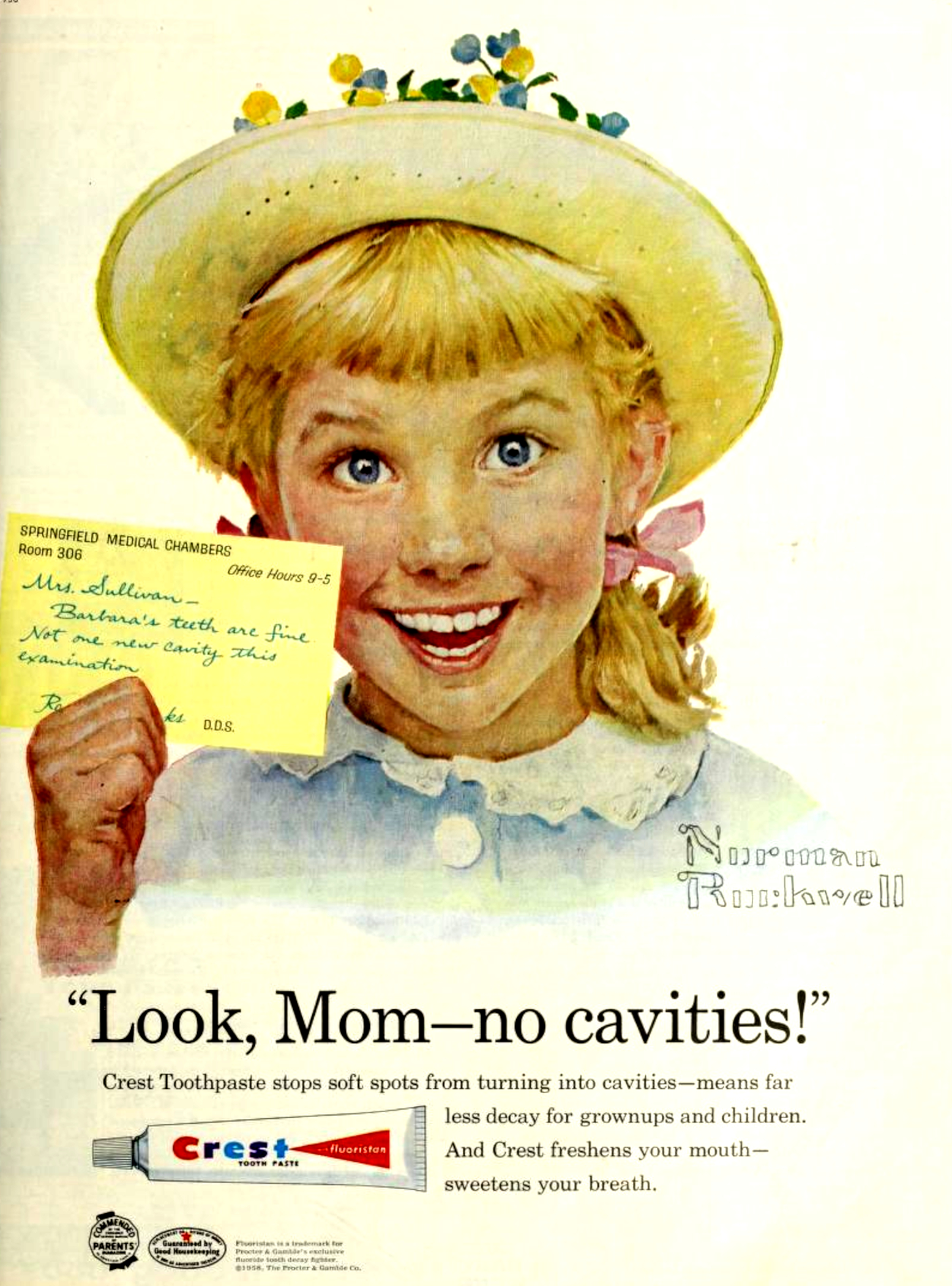
From "Ladies Home Journal", May 1958
Just before the November election, WKRC pulled Tom McCarty from the airwaves when he refused to remove a personal attack on a fluoridation proponent from his newscast. The issue had the opposite effect for Al Schottelkotte, whose growing public profile led to a nightly spot on WSAI radio and later on WCPO-TV.
Simultaneous with the fluoridation brouhaha, the Water Works began injecting carbon into the city’s water, with nary a word of objection. Our forebears, it seems, did not enjoy the delicious water we pour from our faucets today. The carbon eliminated algae that “flavored” Cincinnati’s water, as Ollie James noted [February 26, 1953]:
“The odeur of our aqua pura, especially when it is hot, suggests that it has some traits in common with a camel.”

Facebook Comments