



Photograph courtesy Reach Out and Read
To her nearly 57,000 Instagram followers, Cincinnati-based Becca Thiemann of @beccasbookbox is a go-to source for children’s book recommendations, literacy factoids, and practical tips for reading to kids.
But behind the screen—and her adorable reels—Thiemann is a mother of two, a former second-grade teacher and tutor, and a Ph.D. expert in childhood literacy. Her doctoral research focused specifically on the impact of nonfiction picture books in early education classrooms. “I fell in love with how kids learn so much about their world through picture books,” Thiemann says.
When COVID-19 hit and her in-home tutoring business screeched to a halt, Thiemann recognized an urgent need to keep reaching parents with literacy guidance. Despite not being “a social media person,” she took her tips digital and quickly found a loyal following.
“Social media is like a superhighway,” Thiemann says. It’s an accessible avenue for industry experts like herself to consume, filter, and broadcast new research more quickly than through the traditional modalities of scientific print journals. It’s here that Thiemann has found her most recent niche. “My goal is to show parents how easy it can be to intertwine literacy into everyday life, and that it can easily become part of your family culture by implementing just a few simple changes,” she says.
Her top suggestions? First, strategic book placement. Simply put books around the home in accessible, everyday spaces such as the dinner table, the playroom, the bedroom, and even the bathroom. Second, weave reading into daily routines—and not just at bedtime. Pop on an audiobook while driving to errands, or read a quick picture book during breakfast. The key, Thiemann says, is to make reading an intentional priority in the home.
Thiemann is one among many local literacy leaders who are passionate about raising a generation of competent readers. Together, these leaders represent a network of boots-on-the-ground efforts to get books into kids’ hands and to equip parents with the tools necessary to create readers.
Here are just some of the local heroes doing this important work.

Photograph by Lance Adkins
In 2018, then-Mayor of Covington Joseph Meyer set out to implement a city-sponsored reading program to promote kindergarten readiness and support reading proficiency by third grade. The vision was long and multifaceted: to expose young children to early development and literacy skills, which would yield increased reading proficiency for future third graders (when students in Kentucky begin taking annual skills assessments), which in turn would lead to higher graduation rates and a more educated and engaged future workforce.
“Children who start strong are more likely to finish strong and go on to be productive citizens,” says MaryKay Connolly, the retired teacher and longtime literacy advocate who was tapped to helm Meyer’s new initiative. “[Read Ready Covington] was an investment that impacts everyone in the community.”
To launch, Connolly’s first task was to build communication channels that would inform parents about the importance of reading to infants and toddlers. Here, knowledge was power. “Families want the best for their children, but sometimes they don’t know what they don’t know,” Connolly says.
Connolly describes a family as a child’s first teacher, akin to a baseball franchise’s farm team that is entrusted to nurture and develop young talent. Citing recent brain research, Connolly notes that 90 percent of the human brain is developed by age 6. Those early years are fertile grounds for developing oral skills and vocabulary comprehension, and books are an ideal vessel for teaching those skills. The practice is similar to adult weight training for muscle growth, Connolly says. For a child’s brain to grow and develop optimally, it must be stretched and stimulated appropriately.
As caregivers hold young children in laps and read aloud to them, tots are introduced to new words, shapes, and colors. They begin to connect the pictures on the page with what they’re hearing. This sight-sound connection lays a foundation for future reading comprehension. As babies progress toward toddlerhood, they can begin holding their own books and turning their own pages, which develops fine motor skills and an understanding of story flow. “Before the actual reading occurs, it’s about reading pictures,” Connolly says. “That is vital.”
The second part of Connolly’s mission was—and remains—to get books into the hands of children and families. Read Ready Covington partners with approximately 30 local organizations to collect and distribute books to help build home libraries. Over the past seven years, Connolly has helped triple the number of Little Free Libraries throughout the city, making take-home books accessible in public places such as laundromats, barbershops, and parks.

Photograph courtesy Read Ready Covington
Through the free Footsteps2Brilliance app, Read Ready Covington delivers digital access to age-appropriate books, music, and games that support language and literacy development.
Because of Covington’s increasingly diverse population, Connolly is mindful of breaking through cultural and language barriers to help families access the literacy tools they need to keep kids on the right reading path. Read Ready Covington works with affordable housing programs and bilingual organizations such as Esperanza Latino Center to provide literacy and other development resources to families in formats that they can understand.
“We want to listen to them and see what they need so that they can better help their child,” says Connolly. These resources might also include medical referrals for vision and hearing screenings, as well assessments for developmental delays.
At the annual Early Childhood Fun Fest, happening this year on June 12, 2026, Read Ready Covington partners with more than 25 community organizations to offer kid-friendly activities and resources for families with children ages 6 and younger. The event is free and open to the public, featuring everything from police and fire safety stations to music booths, hands-on building areas, a petting zoo, and, of course, access to books and literacy resources. “We want families to have materials at home over the summer,” Connolly says.
Read Ready Covington also hosts story times at Baker-Hunt Art and Cultural Center, as well as two annual reading challenges (one in November–December called the Mayor’s Winter Reading Challenge and one in the spring called Read Across Covington) to encourage families to get into the habit of reading. Children who complete the challenges are entered into drawings for prizes that coordinate with each challenge’s theme, including craft kits, games, musical instruments, and books.
Like a vibrant tapestry, Ready Read Covington is comprised of myriad interconnected pieces. It’s this multi-pronged approach that makes the program effective. “It’s comprehensive. It’s highly collaborative,” says Connolly. “It’s relationship-focused and place-based.”
Best of all, the model has been so successful that it will soon be replicated. The City of Covington has gifted the branding and infrastructure model to be used in the cities of Ludlow, Newport, Dayton, Bellevue, and Southgate, each working in tandem with the City of Covington to form a cohesive literacy network for families throughout the river cities of Northern Kentucky.
As the program presses onward, Connolly remains dedicated to her original mission of preparing early readers for third-grade proficiency and delivering literacy resources to the communities that need them most. “I won’t be satisfied until every child and family that wants this, has this,” she says.
A retired teacher, Kay Limbach launched Winn Reading in 2021 to combat what she observed as “the literacy crisis”—that is, students being passed on from third to fourth grade without the confident ability to “read to learn.” The crisis was compounded during COVID-19 when students who were already struggling were more likely to fall through the system’s cracks. Data from the Ohio Department of Education shows the blow was especially significant for Black, Hispanic, and economically disadvantaged students.
The Winn Reading website cites the critical connection between reading proficiency and future success, according to The Foundation for Excellence in Education: “A person’s reading ability is a critical predictor of educational and lifelong success. Poverty, dropping out of school, and incarceration are all more likely outcomes for a child who does not read well. A student who still needs time to master reading must have every opportunity to strengthen and gain this skill before entering fourth grade to better ensure a successful future.”
Limbach’s answer to this weighty reality was to develop a tutoring network of volunteers that worked one-on-one with early elementary students during school hours. “Data shows that one-on-one really makes a difference because students and tutors can form a relationship,” Limbach says.
Though Limbach was uncertain how effective her program would be at its inception, she’s thrilled to report that this September marks five years of Winn Reading—and the program is still thriving. Today, the organization serves more than 180 students weekly across three Cincinnati Public Schools: Mt. Washington School, Sands Montessori School, and Rothenberg Preparatory Academy. A new satellite began at Pleasant Ridge Montessori School in March. “The need is there,” confirms Limbach.
Fortunately, so are the volunteers who are ready and willing to support Limbach’s cause; she reports having access to an abundance of eager tutors. Of her 39 current volunteers, many are retired teachers. All volunteers are given specialized training prior to entering schools and classrooms. For volunteers without previous teaching experience, Limbach often accompanies them for the entirety of their first day, ensuring proper protocols are established so that students, administrators, and volunteers alike are on the same page for expectations.
The accessibility and consistency of Winn Reading is a large part of its success, especially for the target age group of students. Going into schools is an enormous advantage, Limbach says, because parents aren’t required to coordinate extra drop-offs or pick-ups. And, of course, it’s all free.
“So many children on that first day say, ‘I can’t read’ or ‘I’m not good at reading.’ We say, ‘That’s why we’re here.’ The big thing is we just build their confidence so they feel like, ‘OK, I can do this.’ ”
As Winn Reading continues to grow, Limbach remains dedicated to maintaining a high-quality program, but in order to do so, the program needs funding for additional staff. Currently there is only one paid staff member, and she’s only part-time. One step in the right direction: The program was recently awarded a $25,000 grant from Greater Cincinnati Foundation, which will allow its continued operations throughout the summer.
Outside of her tutoring operations, Limbach emphasizes the importance of family involvement in a child’s reading success. She encourages parents to model healthy reading habits and to expose children to libraries, where they can pick books that pique their interests. For reluctant readers, “sometimes just finding that right book” is the key to unlocking an interest in reading. Limbach also suggests creating a fun and special place in the house just for reading or listening to audiobooks.
Winn Reading hosts regular community story times at local community partner locations, such as The Potted Palm in Mt. Washington. It welcomes volunteers for this program on an as-needed basis who enjoy reading aloud to young audiences and can bring energy and imagination to the experience.
As one parent of a Winn Reading student puts it, “For the first time that I’ve ever witnessed, my son picked up a book and started sounding out words. I definitely see his confidence growing.” And confidence is truly at the heart of Limbach’s mission.
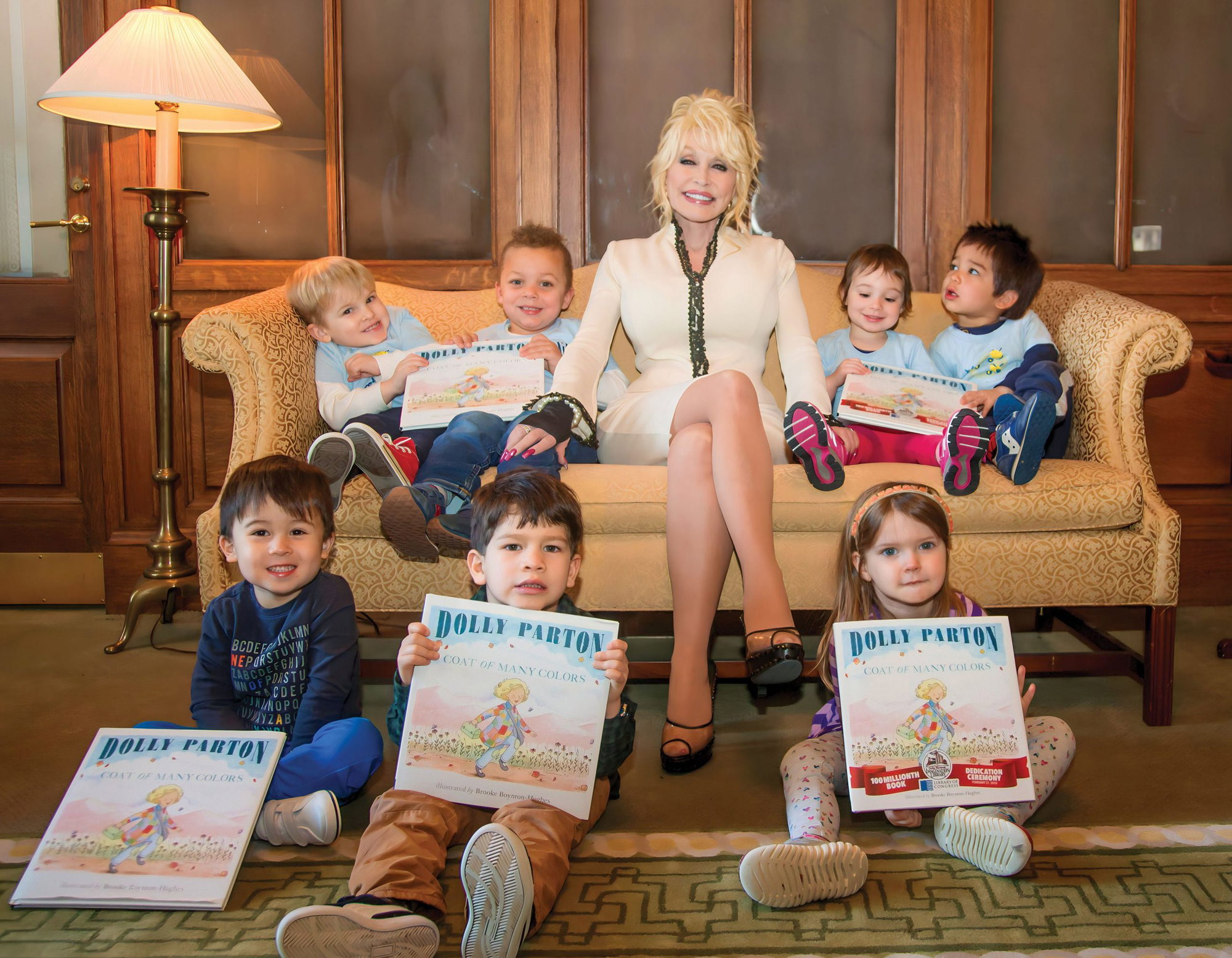
Photograph courtesy Dolly Parton Imagination Library
Dolly Parton Imagination Library
The name Dolly Parton has long been synonymous with goodwill and early literacy. In 1995, Parton founded her eponymous free book program, Dolly Parton Imagination Library, in her hometown of Sevier County, Tennessee, where newborns to 5-year-olds were mailed a new book each month.
The program expanded over the following decades, reaching Hamilton County in 2015. By 2019, however, only 13 percent of eligible kids in Ohio had access to the program. That changed in 2020, when the Ohio Governor’s Imagination Library made the program available in all 88 Ohio counties and began building a coalition of partners to support the program at local levels. In Hamilton County, that partner was Cincinnati Children’s Hospital Medical Center (CCHMC).
“The program is available throughout Hamilton County, but some of the biggest focus is on underserved populations,” says Kristy High, program manager of Imagination Library at CCHMC.
There are currently 31,000 children enrolled in Imagination Library across the county. Since its local inception, registered children have been directly mailed more than 2 million free books.
The program is uniquely accessible—there are no income requirements and it does not require any transportation to access. Families need only to enroll their child in the program online, and age-appropriate books will arrive monthly at their home free of charge until the child turns 5. In fact, most area Hamilton County hospitals offer automatic enrollment for newborns. “It creates consistency, excitement, and ownership,” says High.
Selected by the Imagination Library’s national panel of literacy experts in Tennessee, the books offer a rotating assortment of culturally diverse and age-appropriate content. Themes and vocabulary in the books adjust as children get older. “I always emphasize brain development when it comes to reading,” High says, because a child’s first five years are critical for language acquisition and social-emotional growth.
The book selection is continually refreshed, apart from the first and last book each child receives during their tenure with the program: The Little Engine That Could, and Kindergarten Here I Come, respectively.
Having permanent books inside the home is a powerful asset, says High, as it encourages not only intellectual stimulation but also moments of connection between caregivers and children inside the home. “It enables them to build their own home library at an early age, which is a strong predictor of later reading success,” says High. “It gives them so much joy and excitement. It makes them feel special. They aren’t even realizing that it’s also preparing them for school.”

Photograph courtesy Reach Out and Read
The year Imagination Library reached Hamilton County, 2015, was the same year another national complementary program arrived in the region. Reach Out and Read, also hubbed at CCHMC and helmed by High, is similar to Imagination Library in that it seeks to consistently put age-appropriate books into the hands of children and their caregivers.
Established nationally in 1989, Reach Out and Read emphasizes clinician involvement with local affiliate health care partners. In Hamilton County, approximately 30 pediatrics practices participate in the program.
Instead of mailing books to homes, Reach Out and Read gifts books to families during each well-child medical visit from birth to 5 years old. The program is available in all 50 states and reaches approximately 4.8 million children nationwide, 70 percent of whom come from low-income families. The program gifts 9 million books annually across the country, and since 1998 the American Academy of Pediatrics has officially endorsed the model as an effective and evidence-based system for connecting literacy to overall health care.
“It’s one of the few systems where you can reach nearly all families consistently in early years,” says High. By connecting the reading experience to the pediatrician’s office, “it shows that literacy is also a part of health,” she adds. “It allows families to feel that their health care providers are attending to their child as a whole.”
During the well-child visit, the provider will often give the child or caregiver a book at the beginning of the appointment. The provider then uses the book as a tool throughout the examination, modeling to caregivers how to read aloud with even the smallest children. They might demonstrate pointing out pictures or offer insight on how the importance of making reading a part of their family’s daily routine. Ideally, the provider is able to communicate that reading is not something to be done sporadically, but rather daily, as a part of a child’s holistic health care plan. Just as brushing teeth and good nutrition are daily tasks for well-being and healthy growth, so is daily reading essential to support brain development.
Though the Hamilton County cohort of Reach Out and Read is part of the national organization, High and her local team have the autonomy to select region-specific books that are most appropriate for the Hamilton County demographics. “We’re very diverse here,” she says. “There’s still a focus on the underserved communities.” For infants, selections are often board books that introduce practical vocabulary words and illustrate age-appropriate milestones.
“The shared reading experience is a powerful bonding experience,” says High. “It creates moments of connection and responsiveness between the caregiver and child. These bonds are integrally important for supporting secure attachments, emotional regulation, and language development. Reading together isn’t just about learning words—it’s about building relationships and creating routines that give that sense of safety.”
Best of all, the evidence of more than 20 peer-reviewed studies proves the Reach Out and Read model is effective. In families that participate in the program, parents are 2.5 times more likely to read with their infants, toddlers, and preschoolers. Parents are twice as likely to read with their children three or more times per week. Families are 2.5 times more likely to enjoy reading together. Children’s language development is improved by 3–6 months, and even clinic culture and clinician well-being have experienced reported improvements. Families that participate are also more likely to own 10 or more children’s books in their home.
Picking Your Path
From newborns and preschoolers to kindergarteners, elementary-aged students, and beyond, the Greater Cincinnati and Northern Kentucky region delivers a wide net of resources to support local literacy.
For parents of young children, there are many ways to engage young minds in the magic of reading: enroll in Imagination Library, visit a Little Free Library, attend Read Ready Covington’s Fun Fest or a local story time, download the Brilliance app, or follow @beccasbookbox on Instagram. Ask your pediatrician if they participate in the Reach Out and Read program; if they don’t, encourage them to do so.
“We are a hub and a mecca of early childhood literacy,” Thiemann says.
And while much progress is being made, the work isn’t finished; there are children yet to be reached. For those interested in contributing to the literacy efforts of little learners, reach out to a local literacy organization to volunteer your time or make a donation.
When even one more child succeeds at reading, the whole community benefits.