


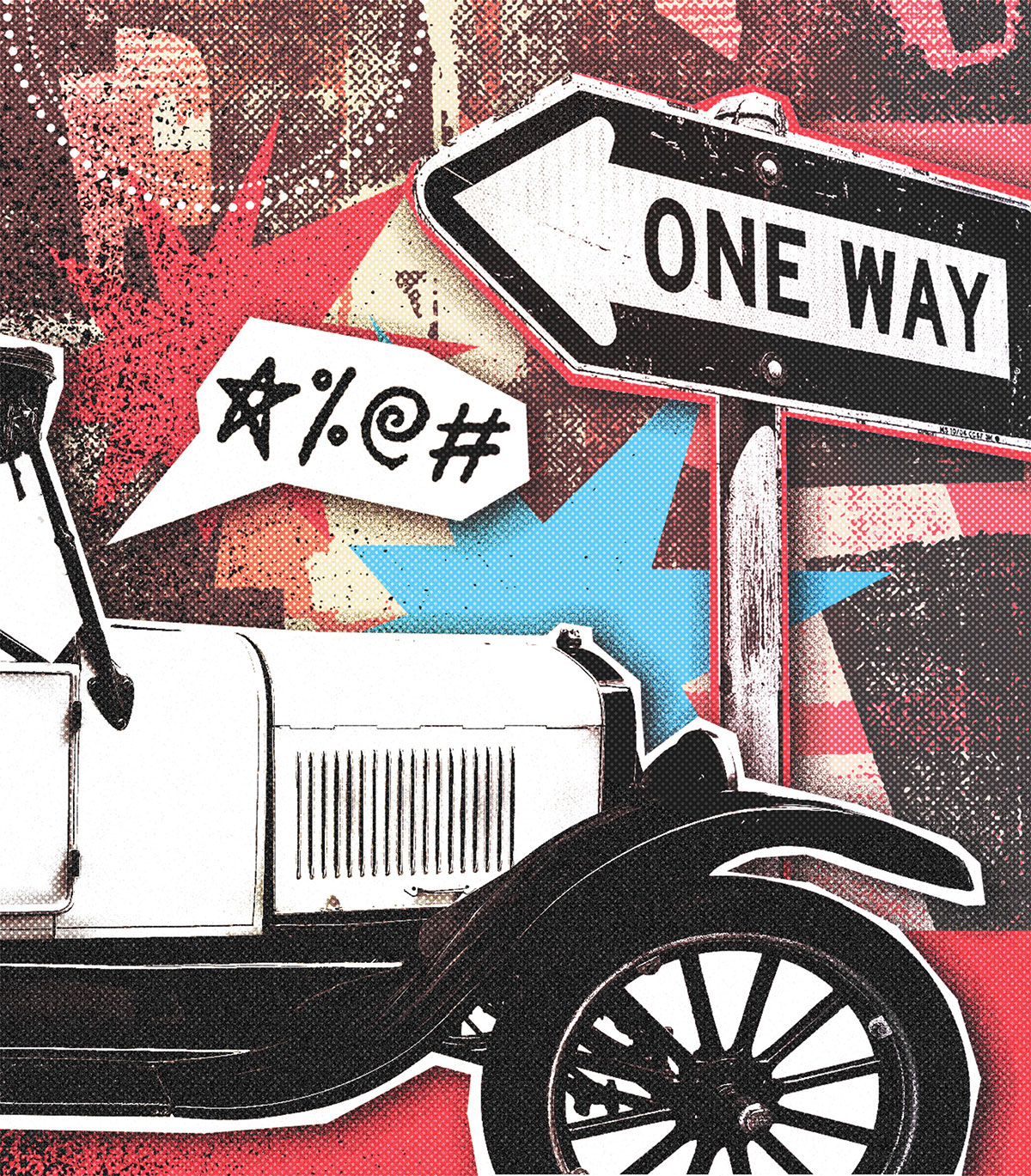
Collage by Carlie Burton
If you commute along Greenup Street or Scott Street in Covington, you may want to avoid this story. It will only increase your current anxiety. Both streets have recently switched from one-way to two-way traffic, so the stress is literally coming straight at you.
When Greenup and Scott first became one-way streets in 1954, it helped smooth out traffic flow, improve safety for pedestrians, and give a boost to the area’s economic activity. Changing it back to two-way, though, should definitely help smooth out traffic flow, improve safety for pedestrians, and give a boost to the area’s economic activity. I feel better already.
It is ever thus across Greater Cincinnati. Just as we skid back and forth electing our political leaders, we randomly swap directions on our streets, never agreeing about which way works best. Cincinnati drivers have been jerked around like this ever since the first citywide crack at a one-way street grid in 1916. Again and again, we’ve been forced to go this way and then that. Or that way and then this. Or partially this and partially that, but only during certain hours of the day. And never on weekends. Or only on weekends. Repeat. Regret. Reroute.
That proposed 1916 ordinance included early versions of things we now take for granted, like bans on U-turns and time limits on parking. But by the time the ordinance finally passed, the one-way streets section had disappeared. Too many people hated the idea.
Police Chief William Copelan announced that he’d back the proposal only if every north/south street had total right of way top to bottom and every east/west street had stop signs at each intersection. If I’d been around back then, I would have sold tickets to see that.
They tried again in 1920, proposing a grid that looked much like the one we have today, with some differences. Streetcars, for instance, would run in the center both ways. Parking would be on the right side of one-way streets and on two-ways on weekdays from 9 a.m. to 5 p.m., but coal deliveries had to wait until 11 a.m.
Anyone trying to synchronize their pocket watch—while gazing at the tower clocks, which didn’t agree—also dealt with an additional and interesting situation: Cincinnati was in the midst of battling over what the hell time it was. For years the city was so desperate to get itself squeezed into the Eastern Time Zone (we were CST until 1927) that we started faking it.
City Council passed a “more daylight” law that added one hour to local clocks. That law was fighting its way to the Ohio Supreme Court just as these crazy parking rules were being tossed around. Excuse me, I want to park here. Do you have time to help me figure out the time?
This would be a good time (ha!) to recall several circumstances that made Cincinnati traffic infinitely worse a century ago. Major streets back then were half as wide as they are today and were clogged with horses and horse-drawn wagons. We have a streetcar today that sometimes gets in our way, but not hundreds of them running in both directions on fixed tracks along dozens of streets. We may grumble about driving on roads with speed bumps and bike lanes and potholes, but we don’t have to drive on cobblestones or gravel or just plain dirt.
Also remember that, before the automobile, it was perfectly normal for pedestrians to wander into the street anywhere anytime. Jaywalking was not even a concept until laws against it began showing up in the early 1900s, with weak enforcement. So imagine everything I described above, and spice it up by peppering random people strolling between moving vehicles—maybe stopping to chat with friends—while carefully avoiding the horse shit.
The 1920 one-way plan failed, so another proposal was attempted in 1922. It went through two more years of negotiations before becoming official, assigning various chunks of downtown street to go in one direction or another, or both. I will spare you the ordinance’s final dizzying details other than to point out that some people really hated it.
For instance, on April 8, 1924, Edward Baumgardner deliberately drove the wrong way on Main Street, was pulled over, refused to turn his vehicle around, and demanded to be arrested. As a member of the Main Street Merchants Association, he’d volunteered to be the designated poster boy for challenging the new one-way ordinance.
To his disappointment, he received only a citation, so Baumgardner skipped showing up at his court hearing. That worked, and out came the handcuffs. At his highly publicized trial, various people testified that one-way streets had created dangerous speeders, impossible parking, and—most significantly—empty stores.
Even though Baumgardner lost his case and had to pay the fine, Main Street merchants kept fighting. By the 1930s they’d managed to restore two-way traffic along several blocks. More street victories and defeats continued into the 1940s. I’ve done us all a favor by not even mentioning how many of those battles and grand plans included Cincinnati’s doomed subway. You’re welcome.
America’s victory in World War II was probably the worst thing that ever happened to Cincinnati traffic. The boys came home, igniting an explosion of auto sales that coincided with a stampede to the suburbs. Downtown’s approaching decline wasn’t yet obvious, but the nightmare of getting there on city streets from places like Blue Ash and White Oak definitely was.
In response, City Hall created the Cincinnati Metropolitan Master Plan of 1948. Putting aside its horrors of obliterating entire neighborhoods—mostly majority Black ones—the plan helped develop our network of interstates and horizontal highways, which did noticeably improve the city’s overall driving experience.
What it missed, though, was addressing the neighborhood streets feeding into those highways and the downtown streets that were now overloaded with suburban commuters. There was only one way to address the problem: one-ways! And after Cincinnati’s streetcars were retired and removed, a truly comprehensive one-way grid was implemented.
On July 13, 1952, our new downtown layout said Hello! and the city held its breath. Newspapers had printed maps. Extra cops were on duty. By dusk of that first day, downtown was still standing. Good job, everyone!
That first day, however, was a Sunday, and the following day would be the true test. Monday saw thunderstorms, some bottlenecks, and a number of bus riders waiting at stops that no longer existed—but the overall assessment was that things went pretty smoothly.
As for neighborhood streets, they got scattershot attention over subsequent years. In 1964, for example, the McMillan and Taft/Calhoun street approaches to University of Cincinnati were targeted to become one-ways. Four years later it still hadn’t happened.
Then our brand-new Cincinnati Bengals started playing on Sundays at Nippert Stadium, and the one-ways miraculously appeared for just those games. They soon became permanent. Until 2012, that is, when portions of both streets returned to going both ways.
Ever thus. There’s the human tendency to get weary of a current system’s drawbacks and start feeling like those old drawbacks weren’t so bad. It’s ever thus here. Kind of like the recent trend to go back to buying vinyl records or to reconnect the landline.
There’s been talk in Cincinnati of turning Vine and Race streets downtown back into two-ways from the riverfront to Central Parkway. Retro moves have already happened in outer neighborhoods here and there, and they seem to have satisfied people living and working there.
Let’s make sure, though, to check back in 30 years. We’ll likely debate whether to switch directions yet again. Our roads go on forever, but they never stay the same.