



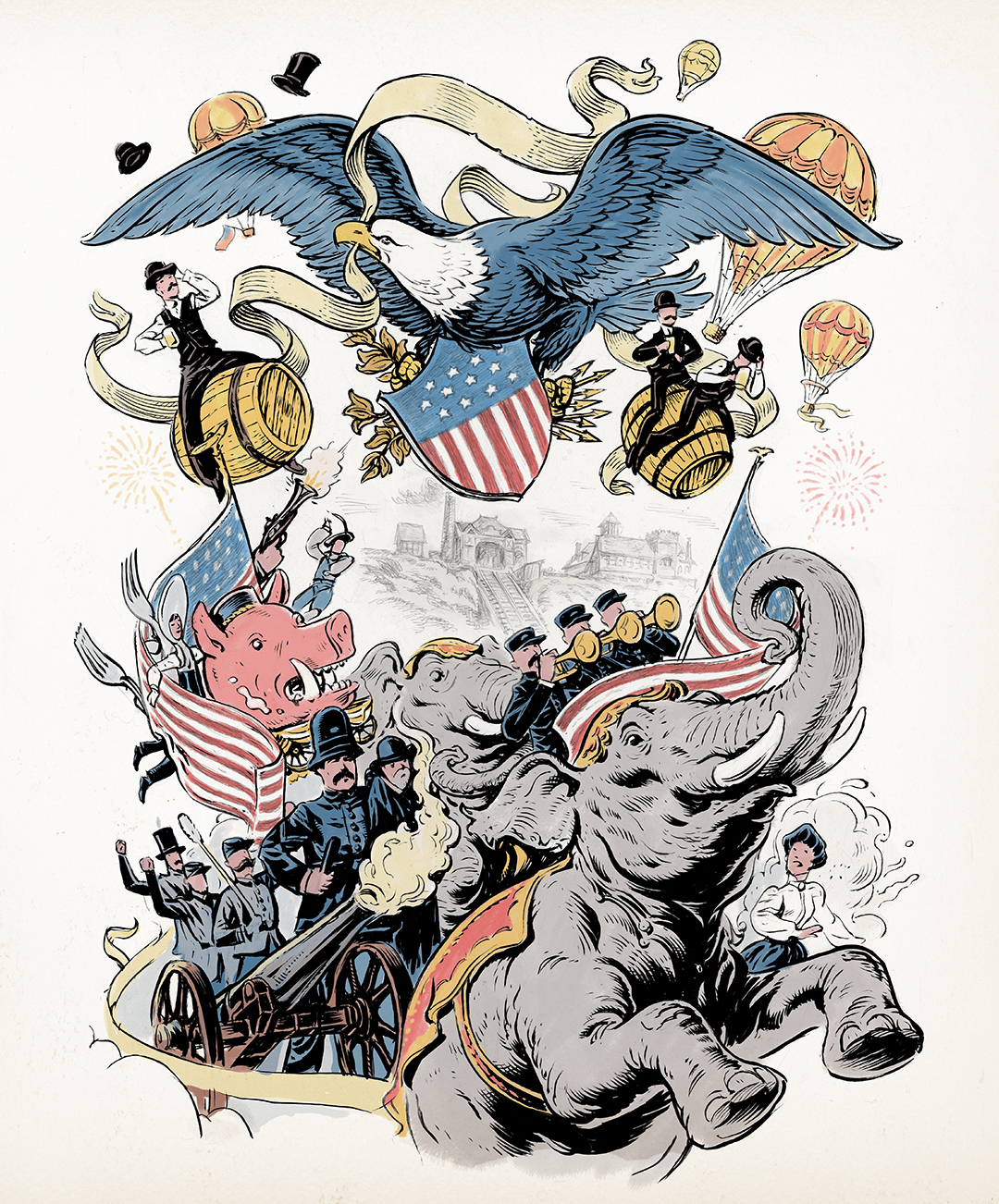
Illustration by Lars Leetaru
As Americans get ready to mark the 250th anniversary of the Founding Fathers applying their signatures to the Declaration of Independence, Cincinnati will no doubt play its part in patriotic celebrations. And one outcome is assured every time the Queen City plans a public party: Shenanigans will ensue.
Before we raise a glass to the U.S. semiquincentennial, however, let us cast our gaze back to national birthdays of yore—particularly Cincinnati’s embrace of the centennial, which featured blather, bombs, beer, brawls, and balloons. And yet Independence Day may not have been the most boisterous wingding the city enjoyed in 1876.
Cincinnati was the eighth-largest city in the U.S. at the time, with a growing population of around 230,000. Having first settled the downtown basin, residents gradually climbed toward greener pastures atop our suburban hills. Streetcars were still horse-drawn. Two new inclines (Mt. Adams and Bellevue) joined the venerable Mt. Auburn and year-old Price Hill funiculars. Both College Hill and Westwood dedicated narrow-gauge railways that year.
Music Hall and City Hall didn’t exist yet. The University of Cincinnati had just opened in Over-the-Rhine at the top of Elm Street. Procter & Gamble was located near the canal in the West End. Many of our civic landmarks—including the Roebling Suspension Bridge, the Cincinnati Zoo, and the Tyler Davidson Fountain—were less than a decade old.
Cincinnati’s mayor in 1876 was George W.C. Johnston, the first Democrat to hold that position since the Civil War. His politics are irrelevant because he was a mere puppet, a distracting frontman for the political cabal whose corruption and avarice would instigate the Courthouse Riot of 1884.
Mayor Johnston happily ignored his colleagues’ fiduciary fraud and devoted himself to glad-handing and municipal shindigs. He enjoyed few things more than a party—and the bigger the better. So he must have gazed with some trepidation upon his datebook for 1876, as two of Cincinnati’s premier events—the biennial May Festival and the Industrial Exposition— were on hiatus.
That simply would not do. The mayor’s reputation was built on pomp, parades, and promenades, a strategy that had gotten him reelected the year before. The Cincinnati Gazette had his number: “Mayor Johnston delights in the pleasure of his subjects, we mean his constituents. He is never so happy as when they are glad.”
Cincinnati would, of course, join in the national observance of the Spirit of ’76, but Johnston proposed jumping the gun by marking the dawn of the centennial year with a citywide Jamboree. As 1875 elided into 1876, he proclaimed that Cincinnati would honor American independence with a raucous bacchanal.

From "Illustrated Police News", March 23, 1876
Mayor Johnston’s Jamboree consisted of a mostly random parade, miles of patriotic banners, brightly colored fires at major street corners, prodigious consumption of brewed and distilled beverages, and cacophonic commotion. The stroke of midnight on New Year’s Eve exploded into a veritable bedlam of military bands and lodge orchestras blaring away at full volume; firecrackers, cannons, and innumerable firearms erupting; and all this racket overlaid with fire alarms, church bells, and household pots and pans. The city achieved an ear-splitting crescendo when all the steamboats along the riverbank sounded their whistles in unison.
The Cincinnati Commercial encapsulated the pandemonium: “When midnight finally came, the clatter was terrific. The steamboats were ringing and whistling, locomotive whistles were being blown, men and boys by thousands were blowing horns, and there was, with it all, the constant roar of the great crowds of people watching the procession, principally on Walnut and Fourth streets. Through all this noise it was impossible to hear the 1-8-7-6 that was tapped on the fire bells, all over the city, at the midnight hour and equally impossible to distinguish the beautiful chimes on the Cathedral bells.”
Amid the dissonance, the city’s newspapers described what sounds like a citywide street battle: “Several rowdies at the corner of Eighth and Elm streets took occasion to hoot the procession as it was forming. The police on that beat knocked the ruffians down in a systematic manner and squelched the disturbance. The officers said they hadn’t any time to fool away in making arrests.”
The next day, everyone congratulated the mayor on his genius. Johnston knew a good thing when he saw it. He needed another celebration, but July 4 was too far away. Instead, he asked his secretary, “When does Mardi Gras fall this year?”
Johnston proclaimed a Mardi Gras Carnival, and the Queen City jumped to attention. Unfortunately, the mayor’s brainstorm rolled in rather late. He first broached the Mardi Gras concept in early January. Fat Tuesday that year was February 29, so plans evolved over seven chaotic weeks. A committee was formed, duties assigned, and reality encountered.
The Cincinnati Commercial described just one of the organizational hiccups: “The getting of costumes from New York was also an embarrassment. The inexperienced committee, unaided with instructions as to what was wanted, the procession not being organized, didn’t know what to order. A costumer came here with a large lot of miscellaneous stuff, much of it not of the best quality or condition.”
Consequently, it was a bit of a miracle when Cincinnati’s first Mardi Gras kicked off almost on time, with Rex gingerly mounted atop a 13-foot long hog’s head pulled by four of Old John Robinson’s circus elephants and preceded by a small herd of camels. Rex was embodied by William I. Torrence, a local capitalist whose substantial girth was as ponderous as his bank account.
The inaugural Mardi Gras was etched into civic memory when the elephants stampeded. While crossing the canal on the way to the Exposition Hall at Washington Park, the King’s carriage bumped into the trailing pachyderm, who bumped the elephant ahead and sent all four beasts charging toward their winter quarters in the basement of the Exposition buildings, tossing King Rex nearly out of his throne while his pages landed in the streetside shrubbery.
At length, order was restored and many of the spectators adjourned to the interior of Exposition Hall, where a masked ball occupied the hours until just shortly before dawn. Like all good Cincinnati events of the day, it was interrupted by gunfire as a couple of attendees took potshots at one another, but no one was injured and the dancing resumed.
Despite all the missteps, the event was considered a triumph for the Queen City. The Cincinnati Commercial summed it up on March 1, 1876: “Altogether it was a grand success and furnishes additional testimony to the already fixed fact, that when Cincinnati starts in a big thing, she goes the ‘whole hog,’ and then smothers in glory.”
The nation’s centennial year was not only a leap year but also a presidential election year, and the Grand Old Party elected to hold its nominating convention in Cincinnati. This was a real old-fashioned convention in which backroom deals and multiple ballots saw major celebrities defeated and obscure functionaries shoved into the limelight. Amazingly, the Republicans, in just three days of carousing and debate June 14–16, conjured a presidential ticket out of a field crowded with political talent. Potential candidates for President that year included the presumed favorite, Senator James G. Blaine of Maine, and the dark horse, Governor Rutherford B. Hayes of Ohio.
There wasn’t a vacant room left in Cincinnati’s hotels, and delegates wandered the streets pushing their favorite candidate. Hayes, who had deep roots in Cincinnati as a former city solicitor, fared poorly in the early balloting, polling fifth in the first round and still a distant second by the sixth round. Blaine led throughout until the very last ballot, when Hayes grabbed 384 votes to his 351. He went on to win the U.S. presidency that fall through a back-room deal with Democrats that remains controversial today.
Just weeks after the Republicans left town, Cincinnati hustled to finalize plans for our centennial celebration, but the Queen City labored under a significant handicap in 1876. Alfred T. Goshorn, stalwart organizer of Cincinnati’s glorious industrial expositions, had been drafted by Philadelphia to organize the Centennial International Exhibition, the very first World’s Fair staged in the U.S. Since that was the nation’s official centennial event, all eyes were on the City of Brotherly Love, and Cincinnati’s Independence Day would by necessity pale in comparison.
The centerpiece of Cincinnati’s July 4th was a parade, and it was a doozy. An estimated 150,000 people crammed sidewalks along the six-mile route, each vying for the best viewpoint. The weather was ideal, warm but moderated by a gentle breeze and dry with enough clouds to preserve the complexions of young ladies waving from parade floats, then known as “tableau wagons.” Dozens of bands interspersed among hundreds of marching units and floats maintained a thrilling selection of patriotic airs. The massive aggregation required a full hour and a half to pass any given point.
In addition to military units, marching bands, workmen’s guilds, social organizations, and religious congregations, almost every one of Cincinnati’s political wards presented some patriotic scene atop a wagon drawn by four or more horses. Among the largest was mounted by the 23rd Ward in Brighton, featuring a large Temple of Liberty supported by 13 columns representing the original colonies, in front of which sat busts of Abraham Lincoln, George Washington, Benjamin Franklin, and Henry Clay on pedestals. The 17th Ward from the West End portrayed Washington crossing the Delaware, but the ward heeler enacting the General elicited chuckles as he vigorously gnawed a wad of tobacco and expectorated from his perch atop the wagon.
Corporate sponsorships abounded. Hermann Lachman’s brewery rolled out two substantial wagons loaded with beer barrels painted red, white, and blue. A wagon with 13 barrels for the initial number of states was labelled “Common Beer in 1776,” while a wagon with 37 barrels—the number of states at that time—bore the slogan, “Lager Beer in 1876.”
The Cincinnati Commercial was particularly taken by the various regiments of Civil War veterans, barely a decade having passed since their service: “One of the most pleasing features of the thing to the close observer was the enthusiasm aroused at all points as the tattered battle flags of Ohio and Kentucky—the shreds that brought up vividly the scenes of sacrifice for the Nation’s safety—went by, nodding a dumb recognition of the plaudits of the thousands. It was a happy thought, the bringing in of those glorious old battle flags. They told a Fourth of July story in themselves.”
As expected, especially on a warm July day, Cincinnati’s celebrants downed liquid refreshment by the barrelful, with unsurprising results. The Cincinnati Commercial recounted one bibulous incident at a picnic sponsored by St. Peter’s Orphan Asylum in Cumminsville: “Lieutenants Williams and Benninger were both on duty, assisted by 10 men, including both the day and night force, and yet they were inadequate to preserve order. Whenever they made an arrest they would be set on by a howling mob, who in their drunken rage would try to prevent their companions being taken off. In some cases the clothes of the police were torn, and Officer Miller had a new blouse torn from his back, and frequently the officers were compelled to use their clubs in self-defense and secure the arrest of their prisoners. The result was that the Cumminsville Police Station was crowded.”
As the day drew on, Cincinnati’s festivities went airborne. The Enquirer reported “troops upon troops” of hot-air balloons filling the sky, pear-shaped, globular, and colored red, white, and blue. Two barbers, George Boethelt and David Loewenstein, crafted many of the aerial ornaments. Most were a foot or less in diameter, but the two tonsorial artists lofted a 10-foot paper behemoth they christened “The Enquirer.” If they were fishing for publicity, they got it. The newspaper described their lofty swarm on the front page and may have omitted their names from the report of a balloon that ignited a small fire when it landed on the roof of a building at Ninth and Central.
The prime aeronautical action was on the west side of town, atop “Buttermilk Mountain,” the wry nickname for Reese Price’s teetotaling resort. He abjured alcohol and served none at the resort crowning his Price Hill incline. Hot-air balloons launched from that prominence would drift gloriously eastward over the downtown area.
Among the aircraft launched that day was a “monster” balloon 65 feet tall and 45 feet in diameter, allegedly the largest aeronautical device ever seen in Cincinnati. Although impresario Robert Miles, manager of the Grand Theater, promised an alluring young lady named Ida Lindell would float off in the balloon, she demurred. A young printer named Neil C. Kerr immediately volunteered when offered $25. The gargantuan bag shot upwards almost 300 feet into the afternoon sky but met a sudden rain squall and plummeted rapidly toward State Street at the bottom of the hill. The plucky aeronaut survived, the crowd roared, smaller balloons floated into a gentle breeze that sent them across the city, and the band played on as the crowd slaked their thirsts with buttermilk and lemonade.
Over at the old Avenue Grounds, located just north of the stockyards on Spring Grove Avenue, the Philadelphia Athletics defeated the Cincinnati Reds 6–3. The 1876 season turned out poorly for the ol’ Redlegs, who finished dead last in the new National League with a 9–56 record.
Beyond the parade, flotilla of balloons, and some jingoistic oratory, Cincinnati’s centennial gala unfolded as a rambunctious affair redolent of alcohol and gunpowder. A Mt. Adams resident named Patrick McGurren blew off a hand while discharging a cannon. Lena Brauneis, 15, grabbed a pistol from her father’s saloon and, in her excitement, sent bullets whizzing randomly around the intersection of Court and Main streets, fatally wounding 12-year-old Julius Ruzika. Martin Eiden, a Mohawk painter, fired and reloaded an antique blunderbuss several dozen times before he miscalculated and sent the ramrod through the palm of his hand. Henry Boegel, 15, shot off his left thumb while brandishing an old horse pistol. A young lady from Pleasant Ridge, riding in a carriage on Elm Street, was shot in the eye by a young boy with a pistol. On the morning of July 5, Robert Kurtz, a West End pharmacist, perched a jar of fingers pyrotechnically amputated by enthusiastic patriots atop his dispensing counter.
Oh yes, there were professionally detonated fireworks around the city that evening as well, with the most breathtaking display presented at Eden Park. Staged by fireworks magnate Harrison P. Diehl, whose factory atop Mt. Adams occasionally exploded, the centennial extravaganza was coordinated by his junior partner, “Professor” Thomas Jefferson Johnson. Diehl’s firm was famous citywide for the dazzling spectacles launched from the Highland House, and so the streetcars and the Mt. Adams incline strained for hours before sundown as spectators jostled for the best vantage points on park lawns. According to The Cincinnati Gazette, “the place was so packed with people that it was only with difficulty that they could be kept back far enough to save themselves a scorching.”
The crowd was treated for more than an hour to masterpieces of incendiary art, among them The Scroll Wheel, The Floral Circle, Persian Glory, Martha Washington Fan, Pyrritic Cross Fire, Tree of Liberty, and the pièce de résistance, Washington on Horseback. The Cincinnati Commercial reported: “The pieces were liberally interspersed with bombs, colored lights, rockets, batteries &c., which maintained the interest of the display until prosy darkness and a dense sulphurous atmosphere closed upon the brief and brilliant spectacle of the Centennial fireworks in Eden Park.”
In 1876, electricity was still a scientific curiosity, so illumination involved flames of one sort or another. The Cincinnati Times raved about the 30-foot eagle stretching across Plum Street in front of the Cincinnati Gas, Light & Coke offices, blazing with gas jets. On Fountain Square, the Genius of Waters fountain was bathed in limelight, with colored shades transforming the cascading streams into ribbons of red and gold. The next morning, The Times reported general satisfaction and recorded a specific appraisal: “A gentleman standing near the Lookout House, last night, watching the great roaring, blazing city, with its strange sounds and weird lights in the darkness below, remarked, ‘It is like the day of judgment!’ ”
Strangely—despite the New Year Jamboree, Mardi Gras, the Republican convention, and centennial celebrations—Henry and Kate Ford, in their authoritative 1881 History of Cincinnati, Ohio, introduced their review of 1876 with an anticlimax: “The centennial year was not signalized by events of commanding importance in the Queen City.”
Will 2026 be similarly dismissed, or will it be remembered at least until the next rambunctious affair?
How We Celebrated Other Anniversaries
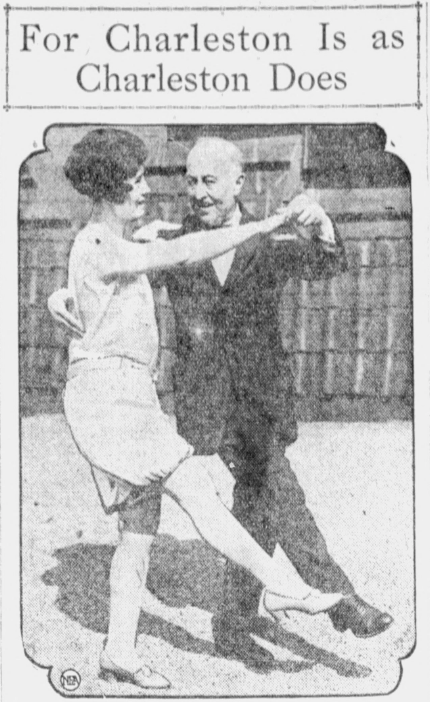
Image from "Cincinnati Post, July 3, 1926
July 4, 1926
Although Cincinnati residents were fully aware that 1926 marked the 150th anniversary of American independence, Independence Day was indistinguishable from the preceding or succeeding years. Notably, the automobile had transformed our city. The Cincinnati Post estimated 20,000 automobiles were decorated with the “virile colors,” and the Hyde Park Business Club rolled out an automobile parade for the occasion.
Although the usual fireworks-related casualties got reported, a newspaper reader was forced to scour the back pages to find any mention. Automobile accidents grabbed the headlines, with one fatality and scores of serious injuries tallied. The Walters family of Northside, for example, celebrated July 4 with a long Sunday drive out into the country. They bought barbecue from a roadside stand and drove straight to the hospital with ptomaine poisoning.
Despite the thermometer reaching only 84 degrees, The Post complained about the heat: “Under a sullen sun, they draped their homes, their lawns, their avenues and buildings with the Stars and Stripes. In the heavy atmosphere the flags flapped slowly, for they, like the celebrants themselves, were at the mercy of the weather.”
The Evanston Welfare Association sponsored boxing matches during the day and a Charleston dance contest in the evening. Cincinnati’s Scotch and English societies collaborated on a picnic in Hartwell, but the Welsh Society insisted on holding its own picnic elsewhere.

Image from "Cincinnati Post", July 3, 1976
July 4, 1976
In contrast to the centennial year of 1876 or the sesquicentennial of 1926, planning for the U.S. bicentennial of 1976 began at least a decade before the big day. Local committees were hard at work by the dawn of the 1970s, and commemorative gewgaws ranging from special coins to “Spirit of ’76” model trains hit the market as early as 1973.
Cincinnati observances included the Cincinnati Zoo distributing posters featuring Betsy Ross—the zoo’s bald eagle of that name, not the patriotic seamstress. Closson’s art gallery displayed replicas of George Washington’s dueling pistols. Appropriately costumed folks reenacted the landing of European settlers at Yeatman’s Cove. Dan Sewell of The Cincinnati Enquirer tracked down three centenarians residing at the Restview Nursing Home in Avondale who were toddlers during the nation’s 1876 centennial. WLWT-TV broadcast a special titled Trouble, with Rob Reider leading viewers through two centuries of American travails.
On-duty sales clerks interviewed by The Enquirer either expressed dismay at having to work on July 4 or shrugged it off just another workday. Notably, every single retail outlet mentioned in that survey—Pogue’s, Twin Fair, Liberal, Thriftway, Shillito’s—is no longer in business. When a reporter asked a young boy on a skateboard in Camp Washington for his opinion on the bicentennial celebration, he said, “They got a funny name for it.”