



Illustration by Carlotta Notaro
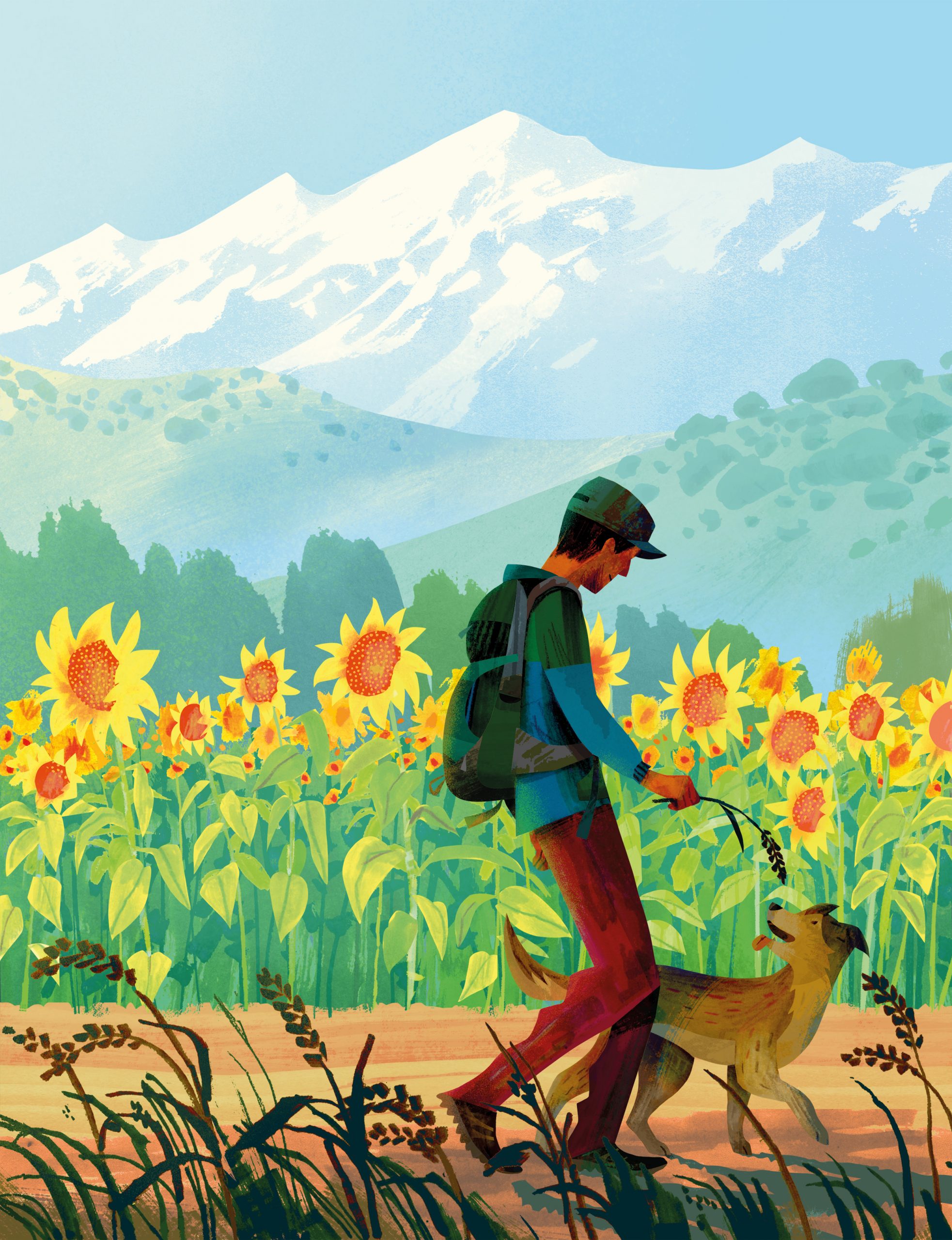
A small boy rode sidesaddle on a braying donkey nonchalantly eating grapes as he slowly made his way down the dusty street of a remote Turkish village. Tom Turcich didn’t know the boy. He didn’t know anyone. It was just an ordinary sun-splashed day, but the moment struck him like a thunderbolt.
“I remember thinking, after all these miles, This is what life is,” Turcich recalls. “I thought about all the generations of people who have lived and died there, lived very rich lives, and never knew anything else. They never saw what I’ve seen or experienced what I have. And it just calmed me. It taught me to live with what I am and where you are.”
Photograph provided by Tom Turcich
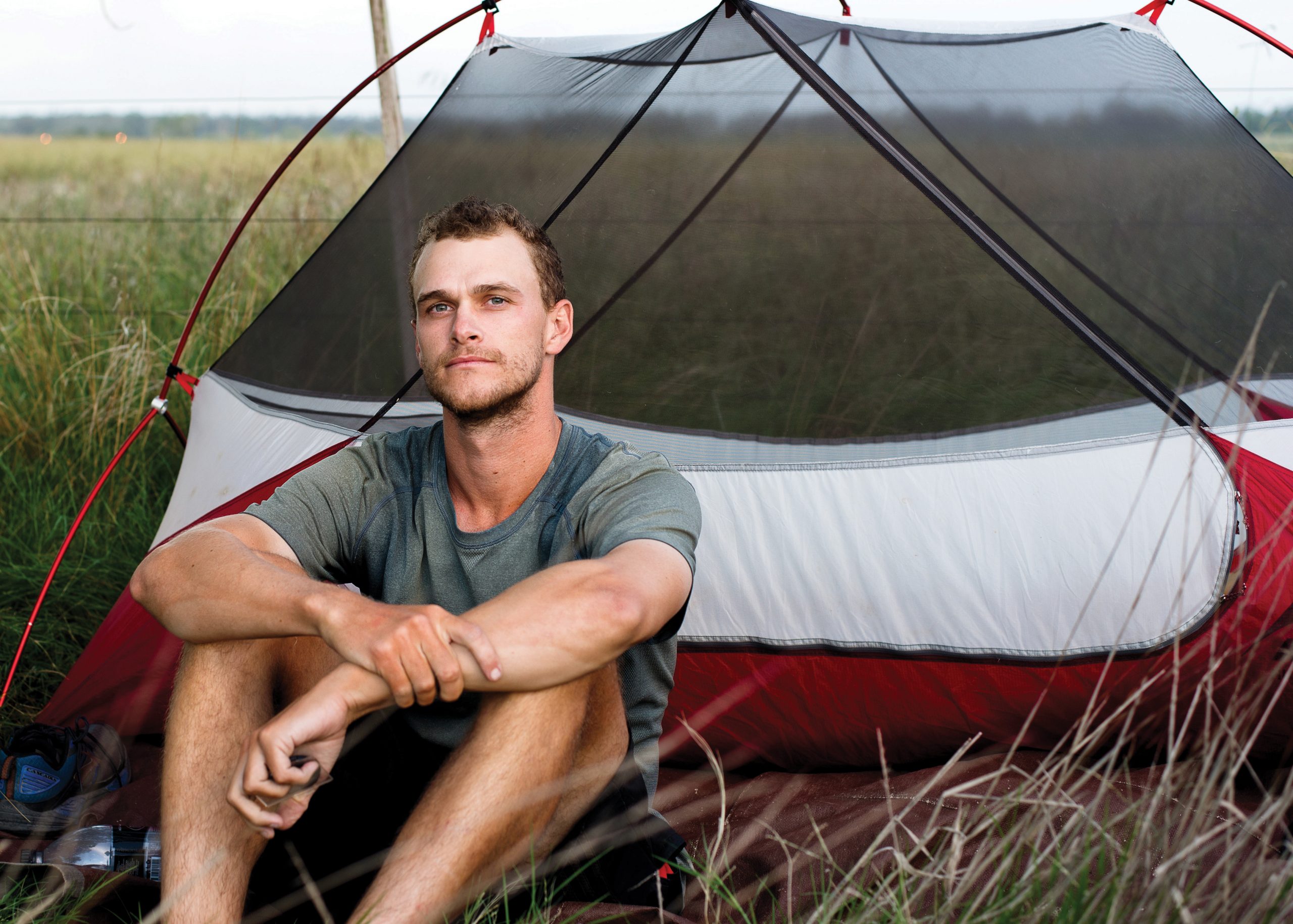
By this point in his journey around the world, Turcich had seen and experienced thousands of miles of pavement, thickets, woods, deserts, and dirt paths on six continents. He was on the final leg of a seven-year, 28,000-mile walk. He’d faced strength-sapping heat and bone-numbing cold. He’d been attacked by vicious dogs. He’d been robbed at knifepoint in Panama and held up at gunpoint in Turkey. He had visa issues that turned borders into barriers. COVID would strand him in Azerbaijan and cut short his planned route. He’d fall seriously ill and wonder if that was how his life would end. And he’d find a dog and best friend.
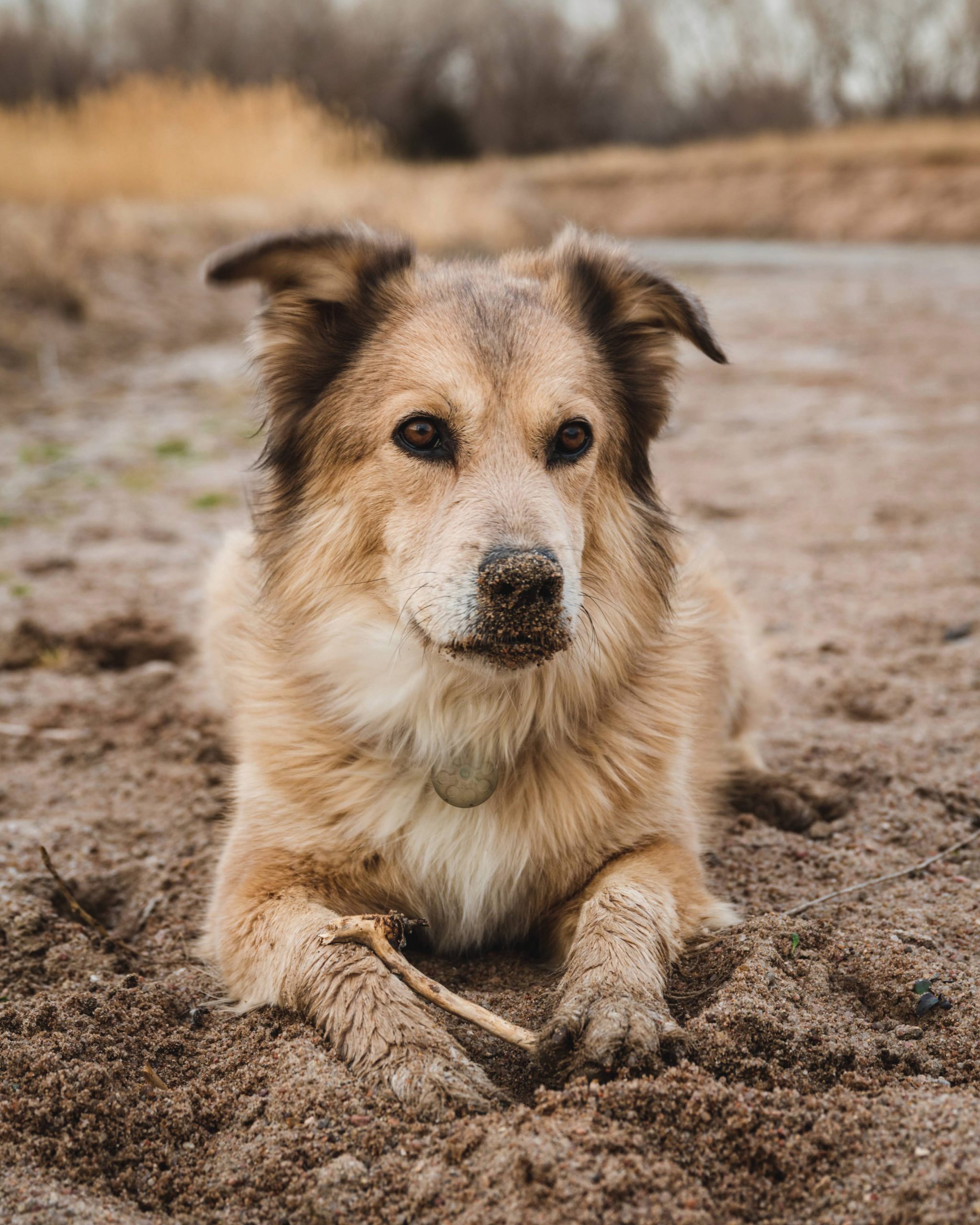
His 2024 autobiographical book, The World Walk, tells the remarkable story of his journey with his trusted companion, Savannah, who became the first dog ever to walk around the world. Turcich was the 10th human to accomplish the feat.
Photograph provided by Tom Turcich
Turcich, 36, now lives in Newport with his soon-to-be wife, Bonnie, whom he met late in his odyssey. They’re planning a May wedding, two weeks shy of the fourth anniversary of his walkabout’s final steps.
The first sentence of Turcich’s book will, undoubtedly, surprise any reader anticipating a modern-day Travels With Charlie. “If you’re considering travel, I would advise against it,” he warns. “The longer it goes on, the more ruined you become.”
If it sounds like Turcich regrets his roughly 60 million steps and seven years of pushing a modified baby carriage around the globe, you’d be wrong. What he “ruined” was the overgrown garden he was desperate to plow under—a fear of death and a life without purpose and, as he puts it, “a head full of weeds that needed to be pulled.”
Those weeds weren’t easily explainable. He grew up in a Leave It to Beaver neighborhood in suburban New Jersey with a loving family. “No divorces, no drama, and family meals with a lot of laughter,” he recalls with a wry smile. “I was a product of an idyllic environment, so I was pretty naive and trusting.”
But there was also a silent partner at the dinner table. A persistent Grim Reaper was always hanging around, flooding Turcich’s thoughts with both a fear of and fascination with death. He remembers going to bed at night and intentionally working to cut off contact with his senses: Placing a pillow over his head and fingers in his ears, he’d imagine drifting off to the great beyond. But that search for nothingness always failed because his mind kept racing. “And, in death,” he writes, “there are no thoughts.”
Death did come suddenly to a close friend, and, when it did, Turcich’s thoughts of death became obsessive. He remembers being in a stupor, neither crying nor caring. He was 17 and lost. He attributes his rescue to a speech class where he watched a few clips from the 1989 classic film Dead Poets Society, and Robin Williams’s uplifting line grabbed him: “Carpe diem! Seize the day!” It felt like a personal admonishment to leave his uncomfortable comfort zone and embrace life…out there somewhere.
Somewhere turned out to be everywhere. “It was in that same speech and communications class when I gave a talk my senior year about walking around the world,” he says. “I’d been thinking about doing it for a while, but once I said it aloud I knew I couldn’t back out, even though I knew no one in my class was going to remember it.”
His promise, he concluded, wasn’t to his high school classmates—it was to himself. “I guess I couldn’t imagine anything worse than someone who talks about all the things they’re going to do and then does none of them,” he says.
Turcich went to college and spent a few years saving for the journey while meticulously plotting his route. He found a patron who constructed a cart where he could store his belongings, picked up a local sponsor, fell in love, and then broke it off because, as he says, “we would have settled down, bought furniture, had kids, and I’d never do the walk.”

Photograph provided by Tom Turcich
Life is about choices, and Turcich’s choice found him on his parents’ porch in spring 2015 marveling at the beautiful early April morning, surrounded by a couple of dozen well-wishers and a tearful mother. He was off to see the world and, with that first step, knew his life would never be the same.
The best-laid plans often fall by the wayside when tested in real-life situations. It wasn’t long before blisters, aches and pains, torrential downpours, searing heat, and struggles finding places to sleep became issues. He had too much stuff, he says, so he began jettisoning items, starting with a camp table and chairs. He traded his cart for a jogging stroller and became proficient in using Google Maps to find out-of-the-way campsites.
Turcich’s training had been more hit-and-miss than manically dedicated. He’d been loyal to the stair-stepper and organized several weekend hiking trips with friends that were vigorous, but nothing like what he’d face on a day-to-day basis. “I figured I was an athlete and could adjust easily, since it was just walking,” he says with a laugh. “My first month, I lived on Advil PM.”
He uses the word naive often to describe his early days on the road. He instinctively trusted people, he admits, and it almost got him into trouble as he walked the back roads of central Georgia. A stranger, seemingly a Good Samaritan, offered him a hot meal and a place to sleep. He lived just down the road, the stranger named Rob said, and an uncertain but dog-tired Turcich fought the nagging warning light pulsating in his brain. He took Rob up on the meal.
Sometimes those weeds that Turcich wanted to pull weren’t weeds at all. Rob took Turcich on a late-night ride along the back woods, continually commenting on how “good looking” he was. He talked about how he used to cook meth. His car would drift left and then right as he focused his eyes intently on Turcich.
Turcich had been raised to be polite and looking for the good in everyone. “I was on a slippery slope and knew it, but all my stuff was back at his place and I didn’t know where I was or where we were going,” he recalls.
They eventually returned to the ramshackle home and Turcich made a quick exit, politely rebuffing Rob’s pleas to stay. It was one of the many adventures he would have in his tour of the planet, highlighted by a chance stop at a Texas animal shelter several months later. That’s where he found a sandy-colored puppy with white paws and a bad case of mange, Savannah.
As anyone who’s ever travelled with a pet knows, logistics can be challenging. Turcich now had two mouths to feed and an undisciplined and sometimes frightened dog to train. There would be veterinarian visits, visa issues, and overnight complications when he wanted to sleep with a roof over his head. Could she keep up, or would her pace crash a carefully-curated walking timetable?
Savannah quickly provided Turcich with what he wanted most: Better security, especially as he slept. He had also reasoned he wanted companionship, but that didn’t come easily. As they trudged through the unbearably hot landscape in Costa Rica, he knew she was there and was keeping up. “But I was too lost in the sauce just trying to cope with the heat,” he says. “It wasn’t until we made it into Panama that I began to emotionally appreciate that she was with me.”
Over time, Savannah became an experienced and disciplined companion. She might have been as trusting as Turcich was when he set out on his journey. She didn’t instinctively attack, for example, when a large man wielding a machete in Nicaragua surprised Turcich in the middle of the night. It turned out OK, both for Turcich and Savannah. Weighing in at around 35 pounds, she wasn’t imposing, but Turcich believes her mere presence at his side was a deterrent. And it gave him peace.
“She was a working dog,” Turcich says of Savannah, who died in 2024. “She wouldn’t cuddle. If you tried, she’d break away.” He remembers her as a “pro and a natural” who would follow his commands all day and then, after walking 21 to 24 miles, would beg him to play after he pitched his tent.
Her only fear, once she conquered her phobia of cars and trucks, was other dogs. We’re used to well-behaved dogs on a leash or at least behind a fence. But dogs in many developing countries, often abused or neglected, are fiercely territorial and aggressive. Turcich was attacked several times, and Savannah, in terms of temperament and size, was no match.
By the end of Turcich’s first leg, which took him from New Jersey to Panama City, Savannah was thoroughly convinced the entire canine world was against her. A three-month break in the walk was planned after the second leg while Turcich waited to get Savannah’s paperwork to get her into Europe. So it was back home for a few weeks and a little home cooking.
“I remember taking her to the dog park when we were home and she just sat there in the corner on edge,” Turcich remembers. “It took a while, but it was a healing experience for her when she learned not all dogs were out to get her.”
Photograph provided by Tom Turcich
To qualify for Guinness World Records as a circumnavigating pedestrian, you need to walk at least 18,000 miles and set foot on four continents. You can stop and take breaks, and there’s no overall time limit. Records have to be measurable, verifiable, and breakable, so Turcich and Savannah were smart about how they circled the globe. They took their time and had planned and unplanned breaks. They’d settle down for a few weeks with new-found friends, relatives, or just out of necessity. Then they’d pick up the walk near where they left off, but not necessarily exactly at the same point.
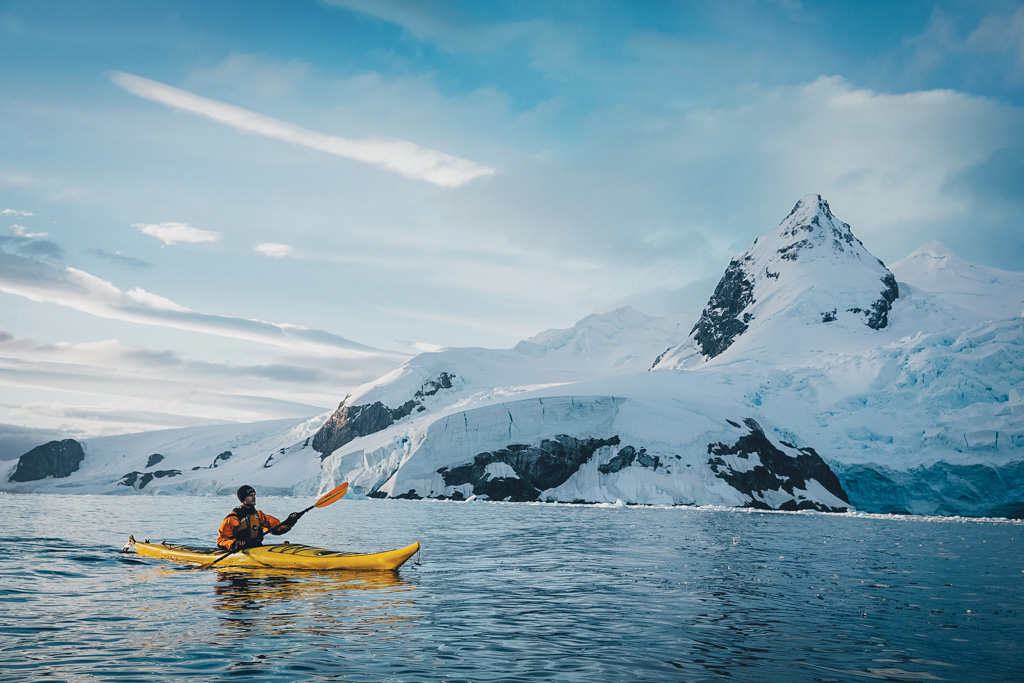
Turcich started his second leg in Colombia in 2016, for example, and ended in Uruguay, then hopped a flight to southern Argentina to board a ship to Antarctica. There, on the planet’s southernmost continent, he says, “I took a few steps, but it was more an experience than a walk. I’m not that adventurous.”
In early 2017, Turcich was reading quietly by his tent as he scanned the volcanic flats in Iceland and suddenly felt a stomach spasm. He had left Savannah behind in New Jersey while he and his sister hiked the rocky island. The pain was nagging at first, and he didn’t think much about it.
By the summer in Ireland, the spasms were knocking the breath out of him. One morning, standing shirtless in front a mirror, he noticed his protruding ribs. In Scotland, he was struggling to cover just six miles a day and, when he arrived at his cousin’s doorstep in London, he was spent and suffering nearly constant pain. His cousin persuaded him to return to the U.S. for treatment for what turned out to be colitis and a bacterial infection.
Turcich says he recognized his old friend, the Grim Reaper, who was standing over his shoulder again as his weight dropped to 118 pounds. (Turcich is 6-foot- 2 and today weights about 165.) As his health deteriorated, so did his natural optimism. Doctors in Philadelphia prescribed the right antibiotic but nothing for the weeds that had regrown in his head.
It was all he could do, he remembers, to get back in shape and return to the road. But he did, returning to Europe in spring 2018.
“I’d lost the resilience I’d built up through the Americas, and that’s important to have,” he says of his miserable journey through Denmark, Germany, and France. “When you’re out there, something is always going wrong, you’re often uncomfortable and tired, and it’s easy to lose your fricking mind.”
As Turcich trudged through western Europe on his way to the Rock of Gibraltar, he played the “I give up” scenario in his head. A loving family, warm bed, good food, and familiar life was just across the pond. But so was an apartment, furniture, commutes to a 9-to-5 job, a car, bills, and a life in his comfort zone. “And then it hit me,” he says with a laugh. “I realized, God, that would be terrible.”
He and Savannah would have many more adventures in Europe, Africa, and Asia before COVID slammed a door in their faces in March 2020. Plans to walk all the way to Mongolia and fly to Australia for a cross-continental stroll were shelved as borders closed. Stuck in Azerbaijan for months, he decided that neighboring Kyrgyzstan would be the end of the line.
“I had been walking for six years and just decided, You know, that’s enough,” says Turcich. “It was time to go home.”
Before heading for the U.S. west coast, though, there would be one more meeting with the Grim Reaper.
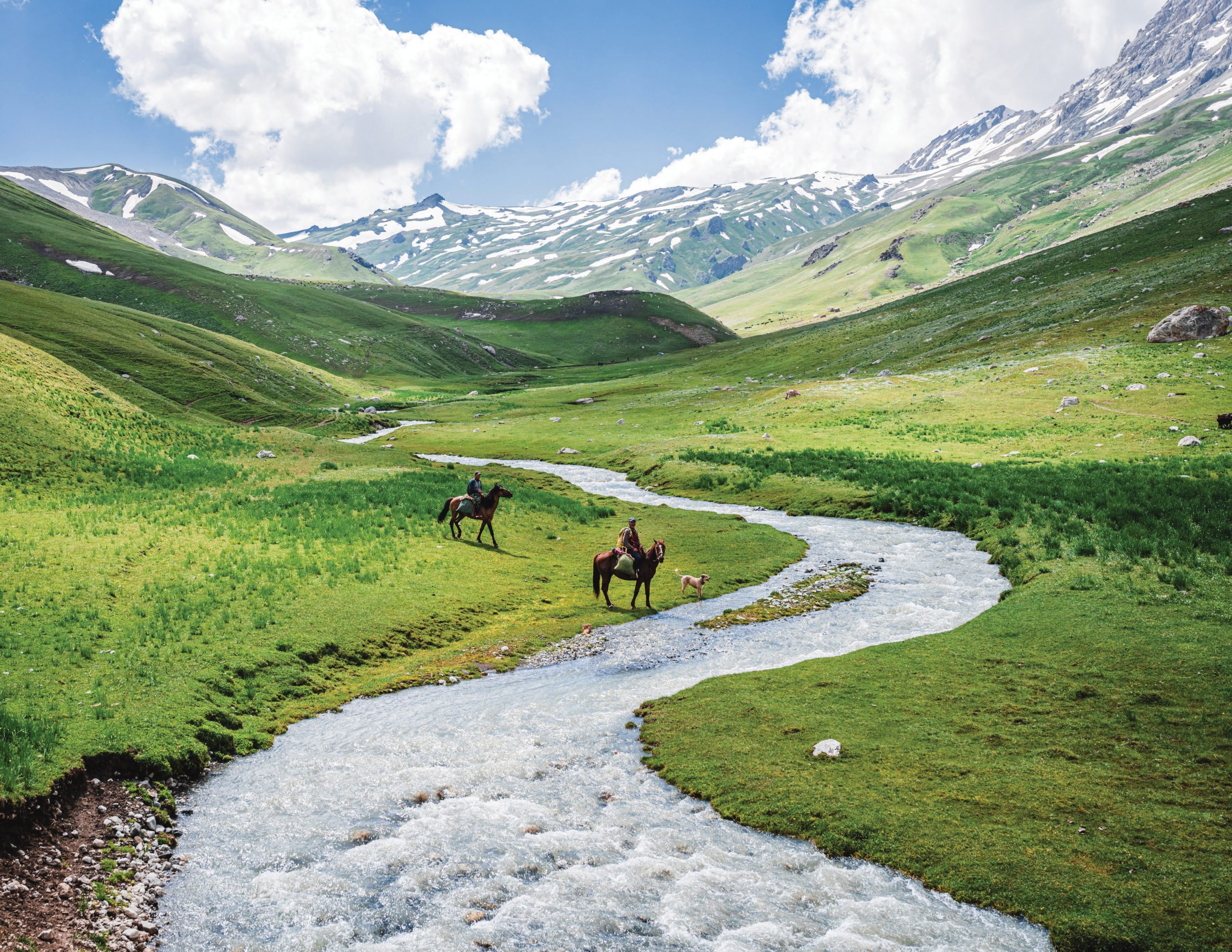
As Turcich and Savannah, along with a local guide named Husnidin, traversed a snow-covered, boulder-strewn glacier high above a Kyrgyz village, the path narrowed. Turcich’s worn-down shoes didn’t hug the snow, and he felt unsteady as he glanced to his left and the sheer drop that led to the abyss. He panicked and fell to his knees. The snow began to give away and, as he puts it, he “felt the icy hand of death on my shoulder.”
His guide rescued him, and they exchanged footwear—Turcich donning Husnidin’s boots and making it to the other side, where he collapsed in mental and physical exhaustion. It was spring 2021, and the journey on foreign soil was finished. It was time for the last leg: Seattle to his parents’ New Jersey front porch.
Photograph provided by Tom Turcich
After meeting hundreds, if not thousands, of people from the Andes to the deserts of Algeria and the rugged mountains of the Caucuses, Turcich would find his true love, Bonnie, on social media. A native Alaskan, she’s currently doing her emergency medicine residency at the University of Cincinnati. I don’t ask Turcich where they’re planning to honeymoon, but I’m betting on Turkey—where that young boy riding the donkey was eating grapes. Or perhaps Australia, the only continent his feet have yet to touch.
After 2,068 days on the road, Turcich stepped onto his parents’ porch on May 21, 2022. Cheering crowds gathered along the last few miles, many of them walking with him or behind him as he strolled his hometown’s familiar streets. Some people had come from hundreds of miles away, drawn by loyally following his Instagram account.
It was a spectacle Turcich says he hadn’t expected, and he was grateful. Most of all, he was glad it was over.
He says he’s at peace today, and the weeds are gone. The Grim Reaper has been banished. “I needed to walk around the world. I found that sense of clarity and authenticity I was looking for.”
Turcich thinks back to that boy on the donkey, the Chilean teens who whisked a very ill Savannah from the desert to a veterinarian, the Algerian police who befriended him as they shadowed him through a lawless land, the herdsman who pulled him off the Gora Babash-Ata glacier, the rat-faced man who pulled a knife on him in Panama, and even Rob in Georgia.
All of them, and the countless others he met on the road, are now a piece of him. When you travel, says Turcich, especially off the beaten path, your growth is relentless. You’re always being challenged and tested. The dizzying experience isn’t for everyone. Many of the people he met would, in their lifetimes, never travel more than 50 miles from where they were born.
“But they were no less worthwhile,” he says. “There’s something to be said about staying in the same place with your family and friends, all of them having the same experiences. Ignorance is bliss in this way, and life can be satisfactory and content.”
That clearly was not Turcich’s path. He and Bonnie love Newport and are happily making the repairs and maintenance that all homes need. He enjoys the nearby restaurants, coffee shops, and parks. Savannah is gone, but now he has Pastrami, an almost-year-old mixed breed. “He isn’t the walker Savannah was, but we still go out almost every day for an hour or so,” he says. “Newport is a very walkable place, so I love it.”
Turcich has developed a successful career as a motivational speaker, traveling across the U.S. to deliver his “get out there and live” message. In 2023, he published a children’s book, Savannah’s World of Adventure, detailing their journey across the Andes Mountains; he says a second book in the series is coming soon. And he’s writing another book, The Unbreakable Self, to explore seven truths he learned on his walk and how to apply them to everyday life.
His relaxed smile tells it all: There’s no place like home. Even a new one.

Photograph provided by Tom Turcich
Tom Turcich’s World Walk at a Glance
- More than 28,000 miles (Earth at the equator is 24,900 miles)
- Six continents (all but Australia) and 38 countries
- Walked between 21 and 24 miles a day
- Went through 45 pairs of shoes
- Ate around 5,000 calories and drank 2.5 to 3.5 liters of water per day
- Walk started on April 2, 2015, and ended on May 21, 2022