



From "Illustrated Police News", Volume 65, Number 1552, July 18, 1896
Exactly how many Belles of Tusculum were there?
Tusculum, of course, is the verdant hilltop overlooking the old town of Columbia in the eastern reaches of Cincinnati. At least two women acquired the title of “Belle of Tusculum” and it’s possible that a third beauty lurks in the annals of time.
We shall start with Anna Rebecca “Reba” Harcourt Long Elliott, born in 1875 to Sarah Ann Greenwald Harcourt and her husband, Doctor Thomas Jefferson Harcourt. The Harcourt and the Greenwald families were both conspicuous in society. According to the Cincinnati Enquirer [January 5, 1900]:
“Miss Reba Harcourt was the Belle of Tusculum. Her mother was a prominent club woman and an official in most of the fashionable clubs of that portion of Cincinnati. Her daughter Reba was very beautiful and her admirers were legion. Her future was bright for her social victories were sweeping. The one who won her favor, however, was fated to be the one who would disappoint and pain her.”
According to the newspaper reports, one Walter Long, associated with a lumber company in El Paso, Texas, saw a photograph sent by Reba to his sister and was immediately smitten. His sister encouraged Walter to correspond with her friend. For three months, many letters flew back and forth. Eventually, Walter traveled to Cincinnati where, despite the anxieties of her parents, Reba and Walter were engaged.
The couple was joined in matrimony on February 15, 1899, at the home of the bride’s parents. Reba wore white organdie. Her brother stood in as Walter’s best man. The newlyweds relocated to El Paso. By December, Walter had deserted Reba. According to the Enquirer [January 5, 1900]:
“For several days, she brooded over her troubles, saying nothing to anybody about the matter. In the meanwhile she discovered that Mrs. R.G. Perry, alias Mrs. Robert T. Stillman, who boarded at the same house, was the cause of the abandonment.”
Reba’s father rushed to El Paso and enlisted two attorneys who filed suit against Mrs. Perry, known as Gusta (short for Augusta), charging her with alienating Walter’s affections. The El Paso Herald [December 28, 1899] claimed this was the first case of its kind filed in the county. According to the suit, Reba alleged that Gusta Perry induced Walter to abandon her. Gusta was employed as a housekeeper by Walter’s father. Previously, she had served as governess for Walter and his sister. Hints that Walter and Gusta had an “improper” relationship were whispered through the El Paso rumor mills.
Matters escalated when Gusta, in the sight of witnesses, assaulted Reba on the street and showered her with verbal abuse. Reba filed another lawsuit seeking damages from that incident. Gusta filed her own lawsuit, alleging that Reba had circulated anonymous letters besmirching Gusta’s character and good name.
The citizens of El Paso gobbled up all the delicious details of these trials but both eventually resulted in acquittals. Throughout her trial, Reba seems to have won the affection of many El Paso residents, following her acquittal, the El Paso Herald [March 8, 1901] reported:
“Last evening Mrs. Long was the recipient of many floral offerings from friends and neighbors and at 8 o’clock an orchestra was taken to her house and she was given a serenade.”
Gusta was apparently subject to a little envy, telling a Herald reporter:
“You may say that Mr. Long’s house was also crowded with the many friends who came to sympathize with Mrs. Perry over the injustice done to her by the jury system.”
In the end, Walter divorced Reba, married a totally different woman, and spent the rest of his life in Los Angeles. Reba remained in El Paso after her divorce and several years later married a grocer named William Elliott. They had two children, a boy and a girl, but William died of a heart attack, aged 49, just ten years into the marriage. Reba lived to be 70 years old and is buried in El Paso.
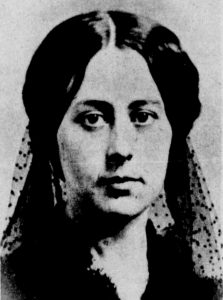
From "Cincinnati Enquirer", August 6, 1970
Perhaps the original Belle of Tusculum is memorialized with a magnificent monument in Spring Grove Cemetery. She is Mary Stites Nixon, known as Mollie, and she was a descendant of the Stites family who founded the town of Columbia in 1788. Mollie, born 1837, was raised in the Stites House, built by her father, Hezekiah Stites Junior, known as Kiah. He was the nephew of Benjamin Stites, the founder of Columbia. The Stites house still stands just off Eastern Avenue and is now listed on the National Register of Historic Places.
Mollie was known as the Belle of Tusculum and her beauty brought suitors from all around. After breaking the hearts of many young men, Mollie chose the dashing William Penn Nixon, an aspiring journalist. Sadly, Mollie succumbed in 1862 to tuberculosis just six months after her wedding, and her grieving husband erected that remarkable pillar over her grave.
William went on to an illustrious career as editor of the Chicago InterOcean newspaper. He remarried and named his first child, a daughter, after his late wife. The daughter, Mary Stites Nixon, founded the Florentine School for Girls in Italy, a sort of finishing school for expatriate debutantes.
The third Belle of Tusculum is a mystery, specifically the type of mystery found at the bottom of a bottle. From 1877 until Prohibition, Cincinnatians August Kayser and Fred Hegner owned a company engaged in distilling and wholesale liquor distribution. The company boasted their sole proprietorship of four trademark brands of whiskey: “Yacht Club,” “Short Horn,” “Small Still,” and “Belle of Tusculum.”
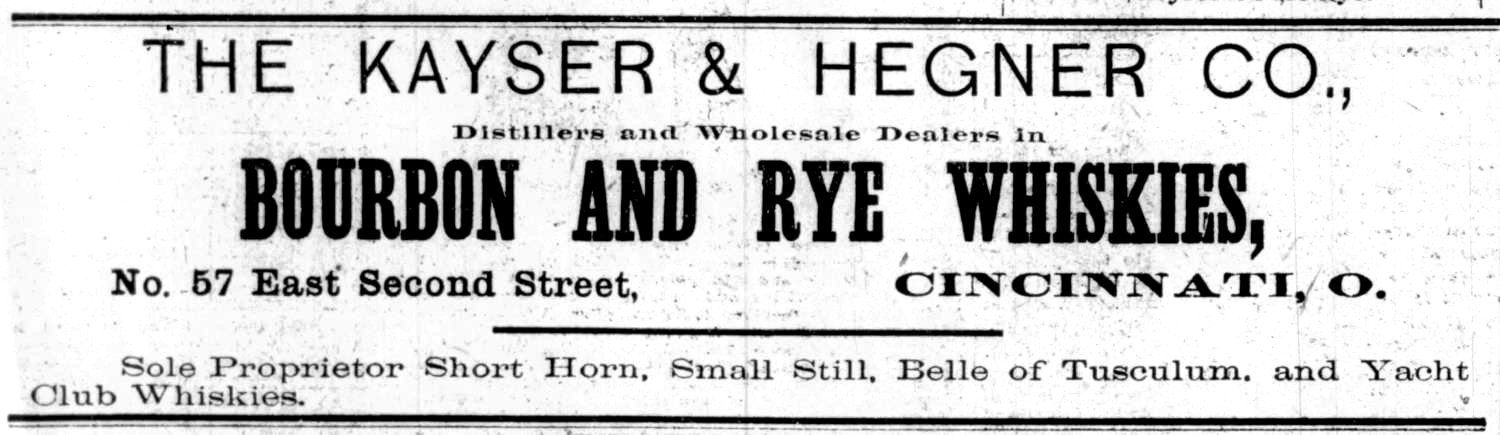
From "Cincinnati Commercial-Gazette", May 25, 1893
By the time Kayser and Hegner formed their partnership, Mollie Stites Nixon had been dead for 15 years. Reba Harcourt was 2 years old. It is therefore unlikely that either of them inspired the spirituous concoction that shared their sobriquet. Neither distiller offered a backstory for their flagship brand.
Curiously, the firm after 1913 became Kayer, Hegner & Siemer when the original pair welcomed a competitor, Frederick Siemer into the partnership. Siemer, who lived atop Mount Tusculum, marketed a bourbon named “Belle of Columbia” before the merger. It’s not clear whether Columbia in this case refers to the Cincinnati suburb or to the nickname for America.