



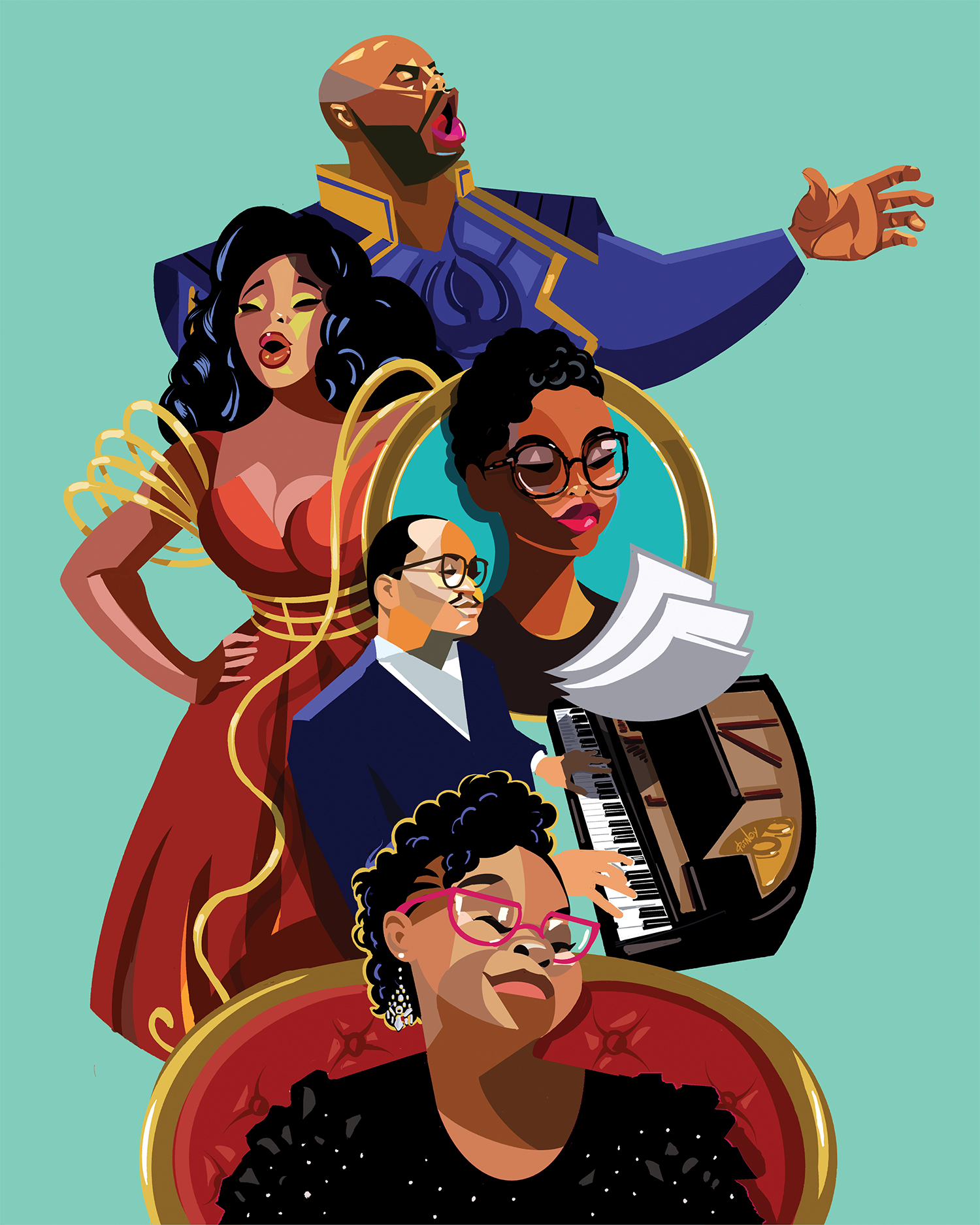
Illustration by Quincy Sutton
In 2001, I was a stressed-out, underemployed graduate student at Xavier University, longing for some sort of escape from the daily monotony of the wake/eat/work/study/sleep cycle I found myself stuck in. I was firmly in the grip of a quarterlife crisis, teetering between failing and succeeding, constantly seesawing between confidence and doubt. I just wanted to throw away my carefully crafted routine, kick up my heels, and live a little, if only temporarily.
One day I came across an advertisement for the Cincinnati Opera’s annual summer festival and decided to cobble together a few paychecks to splurge on a new dress and a floor seat for Madame Butterfly. I was already familiar with the art form, having seen several collegiate performances during my undergraduate years, but nothing prepared me for the extravagance that is a Cincinnati Opera production.
Walking into the opulence of Music Hall took my breath away. And everything from the sets and lighting design to the costumes and the music overwhelmed my emotions. When Cio-Cio-San and Lieutenant Pinkerton sang their love duet “Vogliatemi Bene,” I sighed longingly. “Un Bel Dì Vedremo,” Cio-Cio-San’s tender aria anticipating the return of her absent husband, had goosebumps breaking out all over my skin. By the time the distraught and betrayed titular character sang her moving farewell aria “Tu, Tu, Piccolo Iddio!” to her son and commits hara-kiri, I was in tears. That’s when I truly fell in love with the beauty of opera as a storytelling medium.

Photograph courtesy Aiesha D. Little
In the 25 years since that production, I’ve seen just about all of “the classics,” from tragedies like Aida, La Traviata, Carmen, and Porgy and Bess to comedies like The Barber of Seville, The Marriage of Figaro, and The Pirates of Penzance. But as time goes on, I’ve thought more and more about the handling (and mishandling) of race and ethnicity in opera.
Classic opera narratives require a massive suspension of disbelief when race and gender are involved, because while the music and melodies showcase undeniable feats of talent, the stories are primarily rooted in colonialism and patriarchy. For decades, opera has been one of the few artistic mediums that continues to lean on the presentation of stories in their original forms without doing much reckoning with changes in social and cultural norms.
It’s only been a little over a decade since the Metropolitan Opera in New York banned the use of blackface, beginning with its 2015 production of Otello, and the issue still rears its ugly head from time to time on the international opera circuit. The use of blackface at the 2022 Arena di Verona Opera Festival in Italy during its production of Aida drew criticism, and African American soprano Angel Blue withdrew from the event’s production of La Traviata.
It’s a big ask to expect Black operagoers as well as those of other marginalized communities to open themselves up to outdated racial, ethnic, and gender depictions. Times are changing, thankfully, and opera companies are becoming more in tune with the needs and sensitivities of their more diverse audience members. As luck would have it, an initiative that could help drive this idea forward and potentially change the face of opera—both figuratively and literally—started with a single conversation at Music Hall in Over-the-Rhine.
Photograph courtesy Lawrence Brownlee
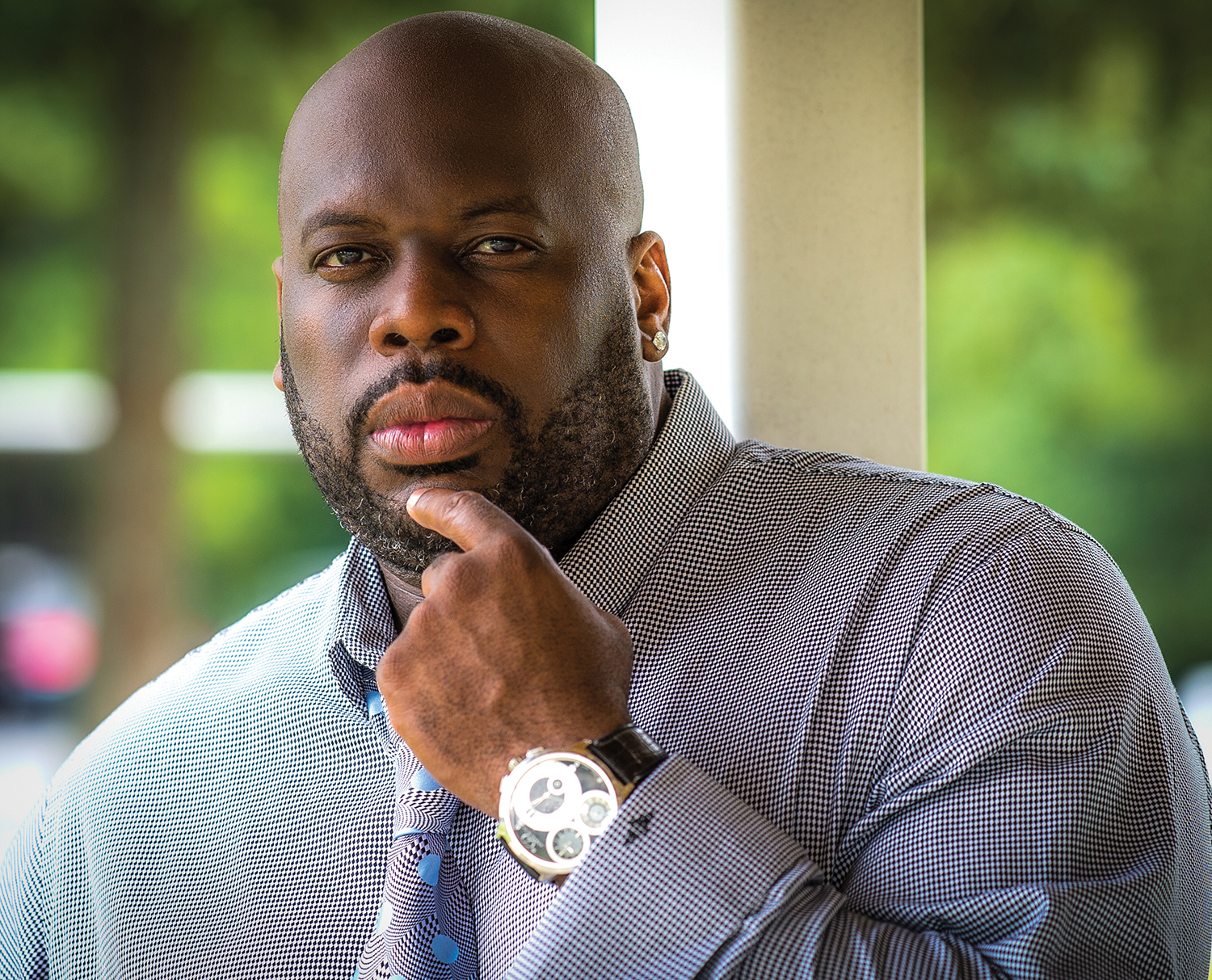
A former All-American college football player, Morris Robinson cuts an imposing figure. The Georgia native has spent nearly three decades as one of the nation’s go-to bass opera singers, bringing gravitas to roles such as the Grand Inquisitor in Don Carlo, Ramfis in Aida, Sarastro the Sorcerer in The Magic Flute, and Porgy in Porgy and Bess.
In 2019, he was booked for Porgy with two different companies—Atlanta Opera had the production on its winter schedule, and it was also set for Cincinnati Opera’s annual summer festival—but he was having reservations. His son had started high school a few months before the Atlanta rehearsals began, and the teen and some of his middle school teachers and friends as well as some of his new high school acquaintances were planning to attend the production’s dress rehearsal.
“I knew in the back of my mind that the first thing they’re going to see is gambling, an alcoholic, a drug addict, murder, and the police, and that’s just the first 10 minutes of the opera,” Robinson recalls. “It’s all Black folks feeding into stereotypes. It’s not all that we were then, but that’s all George Gershwin wrote. I just kept thinking, ‘We got to be better.’”
In the three months between the Atlanta engagement and rehearsals for the Cincinnati production, several questions had formed in Robinson’s mind. “Morris was leaving a Porgy and Bess rehearsal one day and took me aside, visibly frustrated,” says Evans Mirageas, the Harry T. Wilks Artistic Director at Cincinnati Opera. “He asked why this was the only opera about a Black community where the focus was not on slavery, civil rights, or the killing of young Black men and women. When was someone going to tell the world about Black joy and creativity?”

Photograph courtesy Mikki Schaffner
It wasn’t the first time Mirageas had heard a complaint about the cultural limitations of classical arts. While working at the Atlanta Symphony Orchestra, he’d had a conversation about representation with a Black businessman who served on the organization’s board.
“He faithfully attended every meeting, but I rarely saw him at concerts,” he says. “When I asked him why, he told me that he loved what the Atlanta Symphony did for the community, that he appreciated how a great orchestra is a magnet for recruiting employees and an important contributor to a city’s vibrant cultural life. However, he said he didn’t attend performances because he saw next to no one on the stage or in the orchestra who looked like him.”
That conversation swirled in his mind when Robinson shared his concerns about Porgy and Bess. The exchange led to an hours-long discussion with members of the Porgy cast and Cincinnati Opera staff a few days later.
“I said to the whole room, ‘When is the opera world going to produce something that has the same impact on opera that Black Panther had on the movie screen?’ ” says Robinson. “It was a one-off meeting that turned into, ‘Let’s have another meeting about this.’ ‘Let’s pull this person into the meeting.’ ‘Let’s talk about these things.’ ‘You know, we can really do this.’”
Mirageas left the meeting inspired. “I warranted that we would have to find a way to tell one of these more uplifting, joyous stories,” he recalls. “The Black Opera Project is the result of that conversation.”
For the last 15 years, Opera Fusion: New Works—a partnership between Cincinnati Opera and the University of Cincinnati College-Conservatory of Music, which gives composer/librettist teams 10-day residencies to workshop new operas—has been bringing more diverse voices into the opera space. Some of those workshops birthed Black-led operas that would go on to have full-scale productions, such as the Opera Theatre of St. Louis’s 2013 premiere of Champion, based on the true and tragic story of New York prizefighter Emile Griffith (composed by famed jazz trumpeter Terence Blanchard), and Cincinnati Opera’s 2022 premiere of Castor and Patience, the tale of two African American cousins squabbling over a parcel of inherited land in the Deep South against the backdrop of the 2008 financial crisis.
When The Black Opera Project was announced in 2024, however, Black stories were placed solely at the forefront. The $6 million initiative is responsible for creating three full-scale productions focusing on Black life over three consecutive festival seasons, starting with Lalovavi this month (July 9 and 11).

Scenic design by Steven B. Kemp
“The Black Opera Project aims to shine a light on the vibrancy of the Black American experience through operas created and performed by artists whose own experiences inform the stories being told on the stage,” says Mirageas. “We hope this is a first step that will encourage other opera companies to present these works on their stages in the future or to commission similar works themselves.” For its first production, the initiative will fling audiences forward, hurtling straight into the future.

Photograph courtesy Philip Groshong
In his seminal 1993 essay titled “Black to the Future,” cultural critic Mark Dery coined the term “Afrofuturism” in reference to speculative fiction that’s informed by African American themes and addresses African American concerns in the context of 20th century technoculture: “More generally, African American signification that appropriates images of technology and a prosthetically enhanced future.”
“The notion of Afrofuturism gives rise to a troubling antinomy: Can a community whose past has been deliberately rubbed out, and whose energies have subsequently been consumed by the search for legible traces of its history, imagine possible futures?” Dery wrote. In other words, how do Black people’s past and present in America inform and shape their future narratives? Lalovavi seeks to answer this question in opera form.

Photograph courtesy Brittany Olivia Morgan
Set in the year 2425 (year 400 in “Atlas,” formerly Atlanta), the opera tells the tale of Persephone, youngster daughter of the tyrannical ruler Titan (sung by Robinson), who is in search of a genetic code that will make him immortal by any means necessary—even at the expense of his own family. The story is the brainchild of first-time librettist Tifara Brown, a writer, oral historian, and performance poet based in Georgia whose love of science fiction and fantasy narratives like The Lord of the Rings and The Chronicles of Narnia helped her create Persephone’s hero journey.
Brown’s maternal great grandmother, who grew up in segregated Texas in the 1940s, was a classically trained opera singer, but Brown herself had never seen an opera until she decided to write the story for a Black Opera Project production. “I just knew what I’d seen on television, you know, like in movies and things,” she says. “I couldn’t have dreamed that I’d have the actual opportunity to write something like this.”
Brown initially wrote a libretto based on her and composer Kevin Day’s upbringings in the deep South, but she decided it wasn’t the final product she wanted to submit. “When I write a poem, as I’m shaping it, there’s a moment where it settles,” she says. “It’s almost like I physically feel like, ‘OK, it’s done.’ With this opera, the story was sincere but it hadn’t settled yet.”

Photograph courtesy Sara Bill Photography
Then one day, out of the blue, director Kimille Howard asked Brown and Day something along the lines of “What if we allowed ourselves to dream?” Black stories presented by the media are often rooted in struggle and trauma, and Howard wanted the librettist and composer to think outside of what’s considered normal for the Black American experience.
“Kimille was like, ‘What if you imagine a world where that’s not a factor?’” Brown recalls. “Where we have heroes, we have true love, we have all these things, and there’s no trauma attached to it. There’s conflict, but that conflict doesn’t have to be based in trauma.”
A week later, Brown returned with a different story set in a fantastical futuristic world full of intrigue, family drama, and discovery: Lalovavi. “I just started writing,” she says. “I took off all of my filters. I said, ‘I’m not going to edit this as I’m writing it, I’m just going to write.’ ‘If we can do it on the stage, that’s great. If not, they’ll let me know and we can adjust.’ For a good six or seven days, I just allowed myself to dream.”
Howard currently serves as an assistant stage director at the Metropolitan Opera and has directed productions for dozens of opera and theater companies and festivals, including Opera Theatre of St. Louis, Chicago Opera Theater, Glimmerglass Festival, and Des Moines Metro Opera. Like Brown, she grew up on science fiction, fantasy, and adventure stories in which she hardly ever saw herself reflected.
“Black people are rarely ever invited to the theater to just escape, to experience escapism,” she says. “They’re constantly being reminded how hard it is to exist. We’re doing something extraordinary with Lalovavi. It’s not like anything I’ve never seen before but everything I’ve dreamed and craved.”
The most innovative element of Brown’s libretto by far is her use of Tut, a secret language created by enslaved people in the South to teach reading and writing in English when it was illegal to do so. After stumbling across an article about Gloria McIlwain, the author who’s often credited with the language’s resurgence in the present day, her interest was piqued, and she went on her own research journey.
“I thought I would go down the route of J.R.R. Tolkien and come up with my own futuristic language,” says Brown. “I was fully prepared to do that, but then I said, ‘No, I’ve been studying Tut. I wanted our rebel clan in Lalovavi to speak another language, and it’s fitting that this underground liberation movement would be speaking a language that was also used to liberate individuals from slavery in the 1700s and 1800s.’”

Photograph courtesy Philip Groshong
Once the narrative fully revealed itself to Brown, it was then time for Day to set it all to music. “Tifara writes in a way that translates very well to me rhythmically, and through what she wrote in Tut and in English I could automatically hear rhythms,” he says. “I could pick up on rhythms associated with that, which helped a lot with creating what goes around it.”
Day used his background as a jazz pianist, combining his familiarity with the likes of John Coltrane, Sun Ra, and Cecil Taylor with his doctoral studies on Afrofuturism. (He has a doctor of musical arts degree in composition from the University of Miami Frost School of Music.) “There was definitely a corollary between how this futuristic concept translates in both how it looks and how it sounds,” he says. “What I did initially was to have moments of contemporary atonal music, but I mostly kept the opera quasi-tonal, where you get a sense of a tonality but there’s tension within a lot of the lines. There’s tension within the orchestration or there’s tension with what’s happening in the voice, and kind of walking a tightrope between being true to what I see on the page but also being true to what I know of Afrofuturism.”
One of the criticisms faced by many modern American operas is that they don’t sound grand enough for the medium. “Lalovavi, to me, musically, is a cinematic representation of what Afrofuturism can be that we just don’t have within that framework at all,” says Day. “That’s what kind of guided the process.”
An opera production lives and dies by its music, and Day’s arrangements are full of lush, gorgeous melodies well suited for operatic undertaking.


The weather is unusually crisp one evening in early May as deejays Apryl Reign and Rah D battle to cut, scratch, mix, and remix parts of arias from Lalovavi for a crowd of about 50 people at Cincinnati Opera’s “The Afrofuturist Salon.” The event—which also includes a discussion of Afrofuturism and Black hair, featuring Brown and Lalovavi’s wig/makeup designer and CCM grad Tiara Jones—is the final installment in the company’s Underscore series of “bite-sized, immersive, and fun opera-inspired” programs to get regular operagoers and newcomers alike excited about the upcoming season.
In the last year and a half, Cincinnati Opera has done its due diligence in promoting how different the new production will be for audiences. So far, community engagement around Lalovavi has included two public workshops of the opera’s first, second, and third acts, an Afrofuturism-themed fashion show, and art displays.
For an art form that takes great pride in preserving its classics, it takes a leap of faith to invest in creating an opera like Lalovavi. It’s impressive to see a company delve headlong into a meaty topic like Afrofuturism, and the Cincinnati Opera is swinging for the fences.
“It’s high risk, but there’s no reward without high risk,” says Robinson. “But the full team at Cincinnati Opera is behind it, and I’m looking forward to being a part of it. I could be part of something that’s going to hopefully change our world for the rest of my life and my kids’ lives, even my grandkids’ lives.”
Mirageas echoes his sentiment. “My hope is that the audience will rise as one at the final curtain with an ovation that will shake the rafters of Music Hall,” he says. “Lalovavi is a story of victory over adversity, the bringing down of evil, and the triumph of love. It’s grand opera through and through.”
Check out Aiesha’s web extra about her journey to becoming a Lalovavi supernumerary (a background actor in an opera production).