



Photograph by Avery Padgett
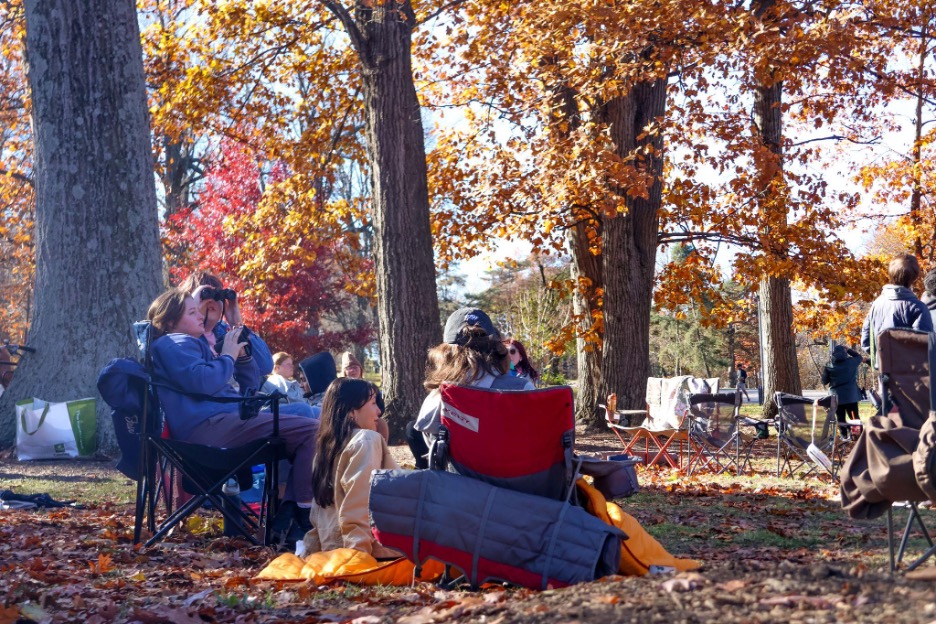
On a chilly November morning in Cincinnati, a group of birders set out blankets and chairs near the Burnet Woods Bandstand. As they settled on the ground, hot chocolate steaming from ceramic mugs in hand, 30 pairs of eyes and binoculars pointed toward the clear blue sky, searching for just a flit of a tail feather or a dash of a wing.
These birders, part of the Queer Birders of Cincinnati, have come together for a Queer and Chosen Family Little Sit. Members have brought warm drinks, an assortment of mugs, and pastries to share with their friends and fellow birdwatchers, who have come to be their “found family.” The event was supposed to begin at 10 a.m. but started at 10:15 a.m., because—as Ash Conway puts it—“queer people are always late.”
Conway, whose favorite bird is a ruby throated hummingbird, is the founder of Queer Birders, an organization dedicated to creating safe spaces for local LGBTQIA+ people to find community and joy in the outdoors—or more specifically, in birds.
Conway is no stranger to bird clubs—after developing a love for the flying fowl on the trails of the Cincinnati Nature Center, they launched the University of Cincinnati’s Ornithology Club while pursuing their undergraduate degree. Conway sought to create an environment for people to connect over their shared passion.
Beyond the birds, though, they wanted to assemble a group that they also felt they could relate to on a more personal level. After studying barriers to accessing outdoor spaces for marginalized communities in graduate school at Miami University, Conway developed the idea for Queer Birders.
“It’s not always a great feeling when you’re walking through the woods and you have to walk on eggshells describing things in your personal life,” says Conway. “You might leave things out because you’re not sure how someone is going to react. I really just wanted to be in a space where I knew other people were going to accept and affirm me for exactly who I was.”
While Cincinnati’s queer scene is far from lacking, Conway feels that most dedicated LGBTQIA+ spaces usually involve alcohol or are only for people ages 21 and up. Their idea to create inclusive, non-alcohol-related events has guided the Queer Birders through its first three years and inspired gatherings ranging from spooky bird walks to the group’s annual “Big Gay Picnic.”
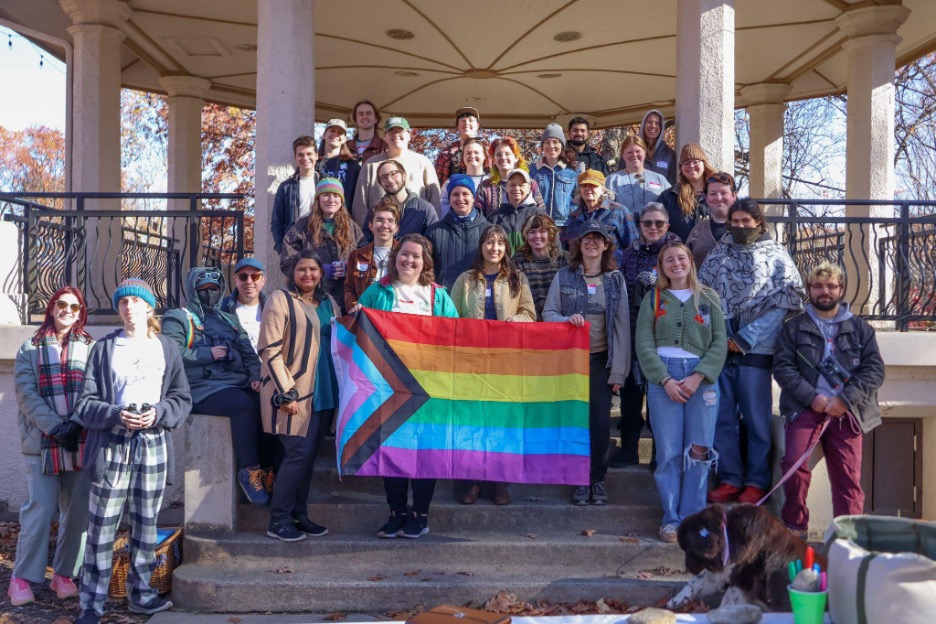
Event attendance averages at around 40 to 50 members, but Conway says as many as 100 people attend their gatherings. The Little Sit event is a smaller version of Queer Birders’s Big Sits, where members gather in a 17-foot circle and try to spot as many birds at once as they can.
During the November morning Sit, members debate over feather colors and shared bird sightings like pieces of gossip, watching like hawks as the tiny creatures fly in and out of sight. Friends catch up, their many conversations occasionally interrupted by the shout of a bird spotting. They move as a flock around the bandstand to watch a red-tailed hawk circle far above and debate on the species of birds they only catch glimpses of. The group packs and shares extra blankets and binoculars, and most people talk just as much as they observe silently over the course of two hours. At the end of what they describe as a slow bird morning, the Queer Birders record sightings of a turkey vulture, a downy woodpecker, a red-bellied woodpecker, a dark-eyed junco, a red-tailed hawk, and a northern cardinal.
Even during the colder months, Conway says it’s important to host these kinds of events to remind queer people of the support and community around them. “Sometimes our families don’t come around and that’s a very painful experience,” they say. “But I think that’s a reminder of why this community and this space is so important.”
Photograph by Avery Padgett
Queer Birder Morgan Mitchell, whose favorite bird is a northern flicker woodpecker, says she has made good friends through the club and has found a way to relax outside of her stressful job as an attorney for the Abortion Fund of Ohio. Even as she finds the world to be “crumbling” around her, she says she finds an escape in birding. “No matter what, people are here; no matter what, birds are here,” she says. “Birds are resilient just like the queer community. They adapt just like we adapt.”
As members of the Queer Birders, like Mitchell, find freedom and joy in birdwatching, some also may find a kinship and understanding. “Nature itself is inherently queer,” says Conway. “When we’re talking about birds, there [are] close to 150 species that exhibit same-sex sexual behavior. In nature in general, this number is likely way more than we’ve realized.”
Same-sex sexual animal behavior has been documented across about 1,500 species in total from almost every evolutionary line, according to Josh Davis, a science writer for London’s Natural History Museum, in his book “A Little Gay Natural History.” Queer people are so frequently taught to be ashamed of themselves, Conway says, and it can be comforting to remember they are not out of place in the natural world.
The Queer Birders have broken down barriers in the birdwatching community, opening up outdoor spaces to those who may think they can’t afford to birdwatch, don’t know enough about birds, or think that the hobby is reserved for a specific demographic of people. A 2022 economic and demographic analysis of birding in the United States conducted by the U.S. Fish and Wildlife Service found that 44 percent of birders are over the age of 55, that 75 percent of birders are white, and that birders in general are more likely to have a higher annual income and education level.
To help combat these potential financial and accessibility obstacles, Queer Birders collects donations of birding gear, such as binoculars, which can cost anywhere from $100 to $2,000. The group also fundraises by selling merchandise, with a goal to provide financial help to members who may not have the same level of access as others and to fund club activities.
“You don’t have to know a single thing to be welcome here and upheld here and part of the community,” says Kayla Ferdelman, a member of the club who supported Conway through the founding of the UC Ornithology Club and later Queer Birders. “No one’s going to look down on you because you don’t know a cardinal versus the blue jay.”
Ferdelman, whose favorite bird is a barn owl, still makes the trip to visit Queer Birders whenever she can, despite living in Dayton, Ohio. She says she has not yet found a group in Dayton that matches the Queer Birders’ sense of community and spirit. “It’s very niche, but it has clearly filled a need just because of how many people come to almost every event. I think they come for the queerness or they come for the birdwatching and they stay for the community.”
Being queer isn’t mandatory to partake in the group’s birding activities, though. Sam Glew and his 11-year-old Newfoundland dog, Lulu, have participated in this community despite not identifying as queer, because of the welcoming environment and friendly people.
The tufted titmouse, Glew’s favorite bird, was “supposed to be the state bird of West Virginia, which is now a cardinal—less fun,” says Glew, “but the tufted titmouse was too silly and undignified of a name to be representative of a whole state. So I really resonate with the idea of being silly and undignified.”
As Cincinnati’s migratory bird species fly south for the winter and other species fly in from the north, the year-round Queer Birders plan to stay active in the colder months and continue to make outdoor plans—Conway says they hope to create events that support marginalized communities in the future as well, specifically immigrants and those facing food insecurity. The Queer Birders also held a short-eared owl walk in November and a crochet lesson in December where participants learned to make a pattern of two male cardinals. Just days after Christmas, the Queer Birders partnered with the Cincinnati Audubon Society for a Christmas Bird Count.
The queer joy and community aspect of the Queer Birders is one of Conway’s favorite parts. Even when it’s cold outside, they say, people still get up at 8 a.m. to bird watch and share their excitement with others who understand them best.
“It is just kind of a different thing to do, and I think that’s what queerness is,” Ferdelman says. “It’s being unique and different in a way that we can be really proud of.”