



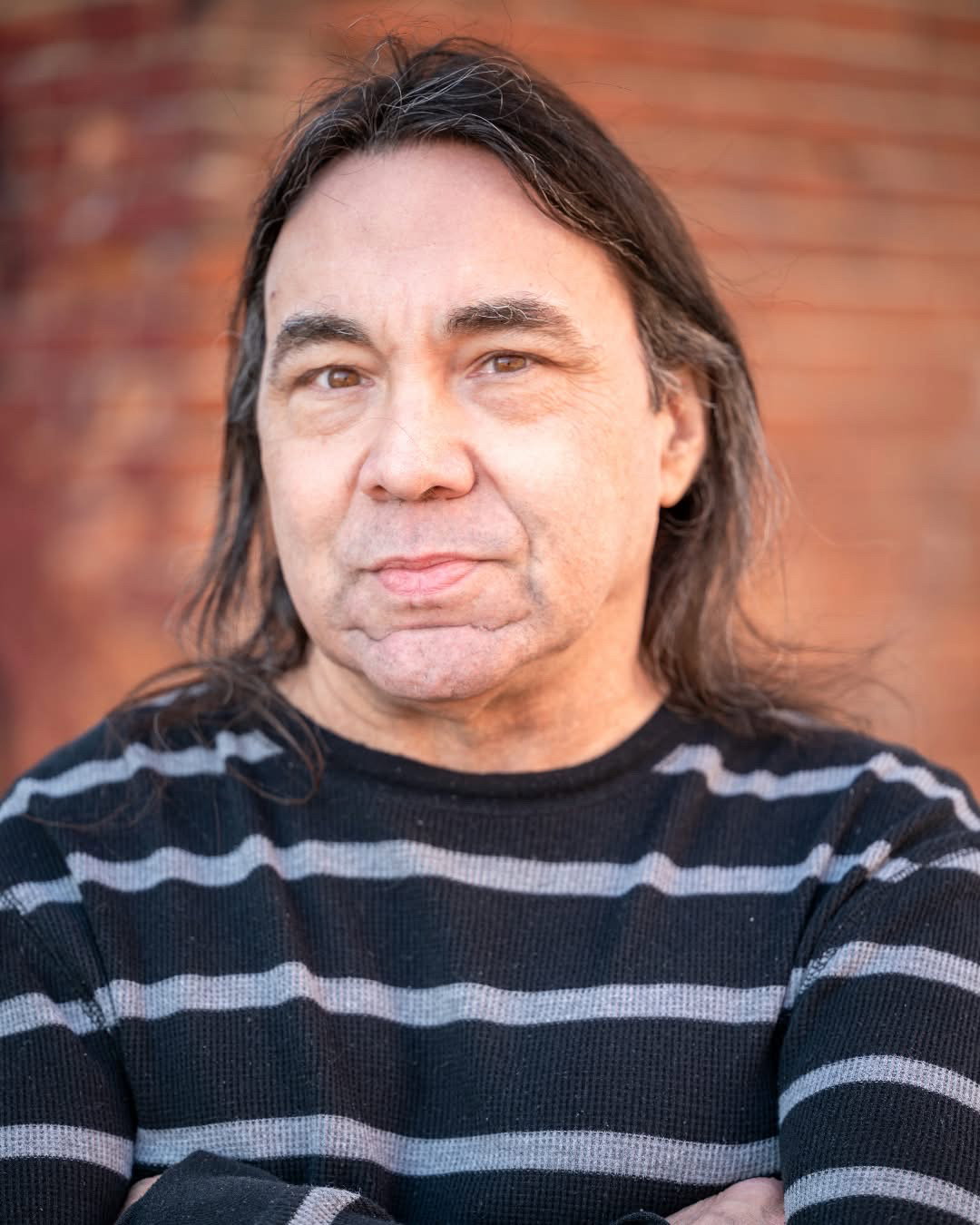
Photograph by Mike James
Born and raised in Petersburg, Kentucky, a small town in Boone County, Homer Shadowheart graduated high school in the 1980s and moved to Los Angeles to study music at Musicians Institute. He played in several bands and almost received a record contract. In 1989 he moved back to the Cincinnati area to take care of his sister who had leukemia. A decade later, in March 1999, he had a kidney and pancreas transplant. During the surgery, the hospital staff put his arms in the wrong position, resulting in paralysis in both arms. It took eight months for Shadowheart to get motion back in his right arm and three years in his left arm. The paralysis forced him to quit playing music; however, it led to something else.
“About a year and a half into that, my ex-wife said, ‘I bet you miss being on stage,’ and I said, ‘Yeah, I do.’ She goes, ‘You should try stand-up. You’re kind of funny,’ which is a glowing endorsement. So I said, ‘Sure, why not?’”
Shadowheart, who is of Anishinaabe and Susquehannock heritage, took classes at the now-defunct Funny Bone Comedy Club in Newport, 21 years ago. “Everybody always asks, ‘Do you get nervous?’ And I’m like, ‘No, I’m more comfortable talking to a thousand people than I am one person.’ And I don’t know if there’s something wrong with me mentally that causes that, but I’ve always been comfortable in front of people, whether I was playing music, being in a play, or just doing stand up.”
According to Shadowheart, he’s the only indigenous stand-up comic in Cincinnati. His racially-charged sets focus on politics, and his identity, which at times cause the audience to make “oohs.” “I don’t mind the ‘oohs,’” he says. “To me, that’s as good as a laugh because I struck something in you. I got that reaction.”
Unfortunately, his comedy didn’t cure his health issues. On his birthday in 2006, doctors diagnosed him with stage-four bladder cancer and told him he had two years to live. In 2010, doctors diagnosed him with lung cancer in both lungs, and three years ago doctors diagnosed him with prostate cancer. “I’ve now had four different cancers,” he says. “I’m just trying to collect them all.” Cancer also runs in his family–his dad died from lung cancer and his sister died from leukemia.
“Everybody’s like, ‘How do you keep such a positive attitude?’ I’m like, ‘It’s easy. I wake up in the morning next to the most beautiful woman in the world [his wife, Courtney]. The important part is I woke up, so I have nothing to complain about. I might be in some pain, but I’m still breathing.” He jokes if he wrote a memoir it’d be called “It’s Lucky I Like Lemonade,” referencing to the old adage of if life gives you lemons.
He also has conversations with his tumors. “‘You’re allowed to be here as long as you want,’” he tells them. “‘You can cause me pain–that’s fine. I’ve dealt with pain my whole life. But the minute you kick me, we’re both gone. So as long as you want to live, just keep me alive.’”
That’s where humor becomes a lifeline. He tells an anecdote about a time in chemo when he befriended an 83-year-old man named Mr. Kip. “We sat there for the next six months, every Friday for six hours, having poison pumped into our system and cracking up, just having the best time anyone could have,” Shadowheart says. “People would ask to not be in the room with us because we were having fun. At one point Mr. Kip said, ‘You can always tell who’s not going to make it.’ And I’m like, ‘Yeah, it’s on their face, like they’ve already said I’m done.’ He said, ‘Have you said that?’ I’m like, ‘No, I got a long time to go.’”
Shadowheart doesn’t know why he’s still here, but he does know his stand up makes a difference in people’s lives. “I’ve had people say, ‘Thanks for making me think. Thanks for making me laugh,’ which is nice. I’m trying to bring some light to things that people aren’t aware of, and have them hopefully laugh at the joke, but then on their way home go, ‘Oh wait a minute, I get that.’”
Like with everything, representation matters, and Shadowheart wants to inspire young native people to get into comedy. “I don’t want to say we have a responsibility, but I think it’s important to be those role models for our youth, because they don’t have a lot of them,” he says. “For our community to see us being vulnerable—because comedy can be very vulnerable—you’re kind of exposing yourself for everyone to pick on. I may put others down, but I don’t put any marginalized community down.”
His comedy is autobiographical, and even though he’s telling jokes with an indigenous man’s perspective, he believes comics shouldn’t pigeonhole themselves. “If you’re a straight white man, that shouldn’t be the only thing you’re looking at in life, because there’s so much you’re missing,” he says. “But the minute you close off any part of what’s available to you, you really handcuff yourself and you stifle your own creativity. I can talk all day about being a native man, but I know enough straight white men. I know enough queer white men. I know enough drag queens. I know a ton of people. I know and love all of them, and I can talk about experiences we’ve had together. And nine times out of 10, funny things happen if you hang out with your friends long enough.”
Basically, be a Homer Shadowheart and not a Shane Gillis. “The First Amendment guarantees us the right to say what we want to say, but I was very angry at Gillis,” he says. “People forget that along with saying what you want to say comes responsibility for what you’ve said. I think he was horribly misogynistic. My arms are in better shape than his, and they’ve been paralyzed.”
On October 29, alongside indigenous Indianapolis-based comic Janette Perez, Shadowheart will perform a stand-up show called I’m Not Your Costume at the Know Theatre. “I always want to share a stage with Janette,” he says. “She’s one of my favorite people. She is extremely funny, and she just lights up the room.”
The “costume” part of the title alludes to a certain costume shop in downtown Cincinnati that sells sexy female native costumes, tomahawks, and other stereotypical and offensive native props and costumes. “I’ve written to them and got no response, because they don’t care,” says Shadowheart. “It comes down to the fact that we are less than 1 percent of the total population of the country. ‘We can offend you. It’s okay.’ ‘No, you can’t. I’m not your costume, because we’re human beings.’”
Shadowheart is also writing a sitcom about urban natives, continues to tour the country with his stand up, and is looking forward to what’s next. Even though he’s been doing it for a long time, his craft keeps evolving. “The minute you say, ‘Okay, I’ve got this. I’m good,’ you stop trying, and that’s horrible for anybody,” he says.
On October 29, Homer Shadowheart and Janette Perez will perform at the Know Theatre. Tickets are $17-$22.