



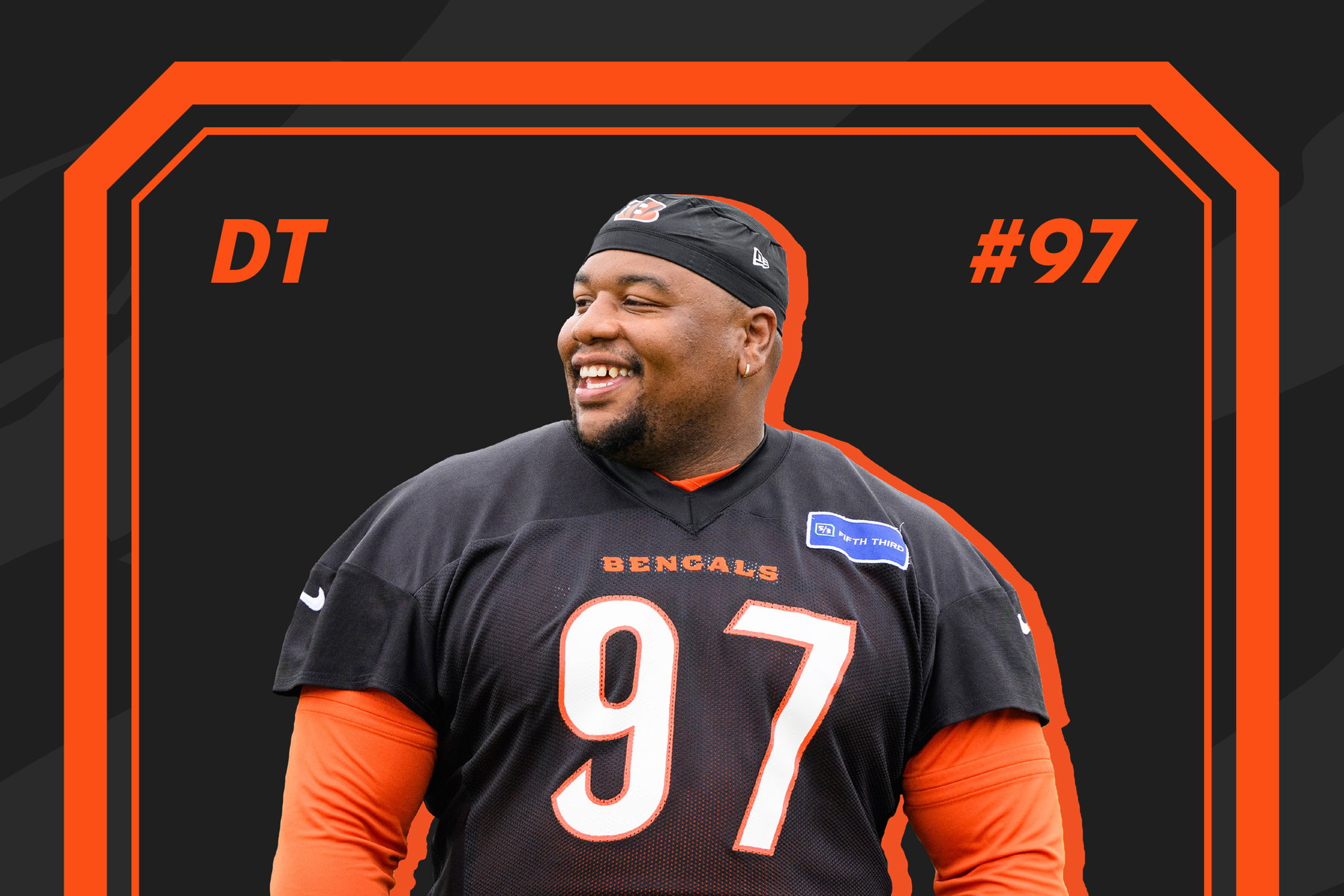
Photograph courtesy Cincinnati Bengals
I am already grateful to the newest Bengals superstar, defensive tackle Dexter Lawrence II, before he ever plays a down in stripes. Thanks to him, I’ve learned an important geographical distinction that saved me several hours in driving time. It seems that Wake Forest, North Carolina, is a quiet suburb in the pine forests north of Raleigh and nowhere near Wake Forest University, which is in Winston-Salem, a couple of hours west.
This distinction is critical. Wake Forest, home of the high school Cougars, is where Lawrence first made his name on a football field. I have come here (and not to the ACC college campus) to meet the 6-foot-5, 350-pound behemoth who has dominated the line of scrimmage as well as anyone in the NFL over seven seasons with the New York Giants. Thanks to the stunning trade the Bengals made in April, in which they swapped their first-round draft pick for Lawrence, he is now poised to do the same in Cincinnati.
Today is also, not coincidentally, the Dexter Lawrence 7-on-7 Football Tournament. “Seven-on,” as it’s commonly called, is a competitive version of the passing drills common to every football practice that removes linemen, blocking, and tackling from the equation. The tournament predates Lawrence, but as his high school coach, Reggie Lucas, who runs the event, says, “We wanted Dexter to be a part of this, and he was anxious as part of the local community to get involved.”
Upon lending his name, Lawrence asked, “Where’s the beef?” So a big boy component was added, competitive one-on-one pass rushing drills, a challenge closer to his heart. Eight local high schools teams are here on a punishingly hot and humid Thursday afternoon at Wake Forest High.
Lawrence arrives alone, with no entourage or handlers. He wears a purple paisley shirt that may be visible from space, but he quickly blends in by changing into black shorts and a black T-shirt emblazoned with “Cougar Football.” Up close, his immensity is mind-bending. When he’s at midfield, I expect the goalposts at either end to bend in toward him.
Lawrence gives Lucas an enormous bearhug in his small, stifling office. “Sorry the air-conditioning isn’t too useful,” the coach says.
Incredible as it is to conceive, Wake Forest High, while very good during Lawrence’s time as a Cougar, reeled off three straight state titles immediately after he graduated. The Cougars lost in the Region 4AA championship game twice while Lawrence was tossing poor high school linemen around like potato sacks, but couldn’t win it all.
I choose not to see this history lesson as an ill omen for the Bengals.
“It was just one of those things, I guess,” says Lucas, a scintilla of sadness in his voice. “Dexter certainly elevated our program to the point we could compete for titles, but we just didn’t win them.”
Dexter’s younger (and much smaller) brother, Devon, played running back for the Cougars and had a strong college career at North Carolina. Skill-player brash to Dexter’s lineman humble, Devon has a simpler, tongue-in-cheek explanation: “I needed to be the man in charge of the offense. Once I was, we won the titles. Had nothing to do with Dexter.”
Despite that particular disappointment, Lawrence remembers his high school years as “the most fun I’ve ever had in football.” That’s evident when he talks with the current Wake Forest players before they take the field.
“Everybody here looks up to you, on the low, so enjoy the moment, all of it, even going to class,” he tells the team with a smile as they cluster around him like tiny moons orbiting Jupiter. “Grind every day, and ask yourself, ‘How can I help somebody else? How can I make the guy next to me better?’ Don’t be selfish out there. Don’t be haters. This is the best of it. You get to play together and hang out together after the game. There’s nothing better than that.”
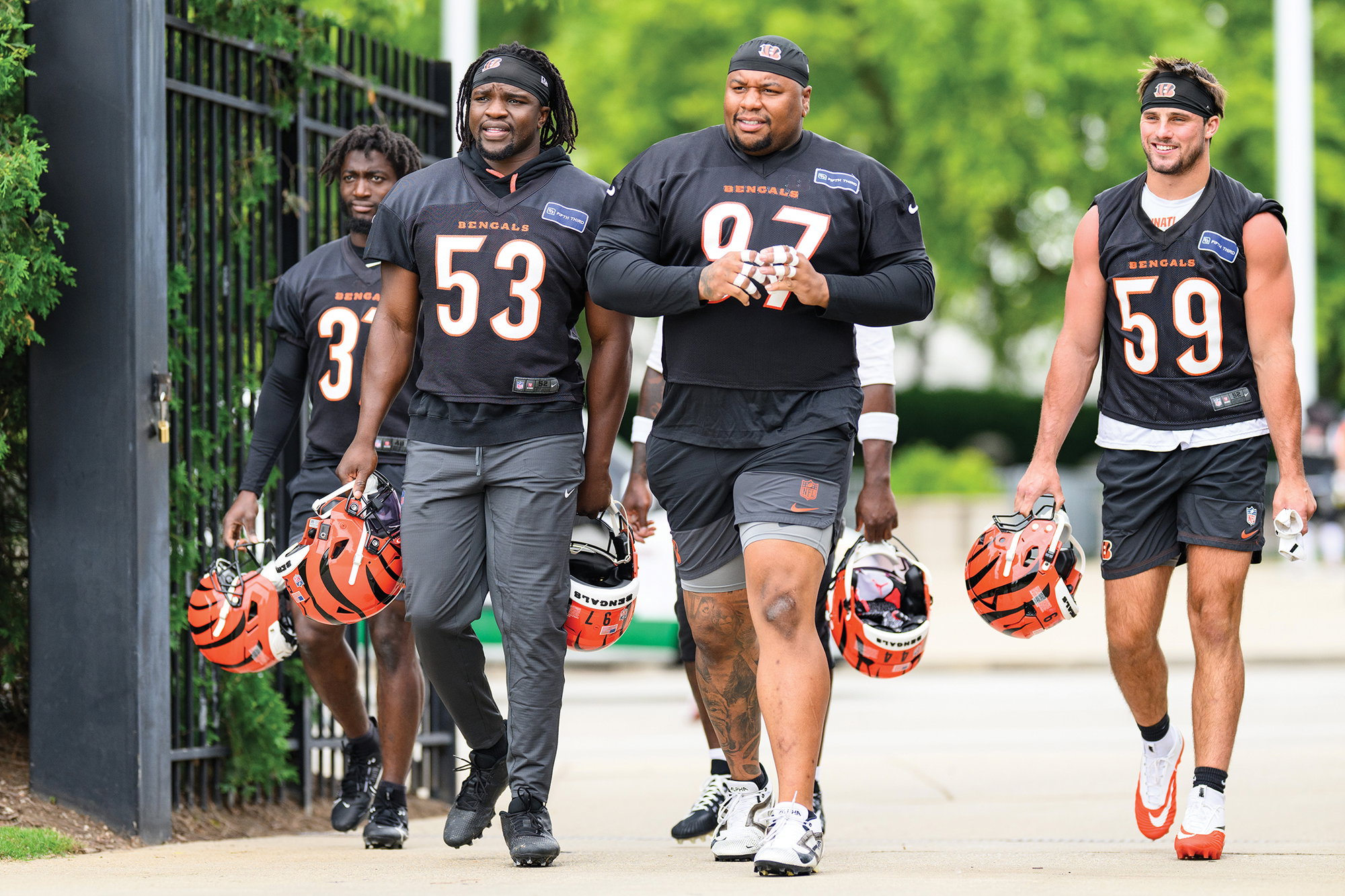
Photograph courtesy Cincinnati Bengals
The greatest NFL defensive tackles—Mean Joe Green, Bob Lilly, Aaron Donald, and the man who wore No. 97 in Cincinnati before Lawrence, Geno Atkins—were largely penetrators with exceptional quickness and a blazing first step. They mostly played the “three-technique” spot, lining up outside the offensive guard in the “B gap,” and often prized getting to the quarterback above run defense.
This isn’t what Lawrence does. He largely plays nose tackle, straight up on the center, controlling the “A gap” mere inches from the quarterback’s face when the QB isn’t in shotgun formation. Nose tackles are traditionally much slower and heavier, if more powerful. Atkins, for example, played at right around 300 pounds, some 50 pounds lighter than Lawrence. Their primary concern is stopping the enemy run game in its tracks.
What makes Lawrence so special is that he combines the best of the two positions. His ox-like strength allows him not only to stand up double-teams and anchor the point of attack to defeat run plays but also to bull-rush centers and plant them in the quarterback’s lap before any play can develop. Beyond power, he also possesses rare quickness and initial burst, incredible for a man of his size and bulk. Tackles who weigh 310 pounds and have elite movement can disrupt a play or a drive; Lawrence doing it at 350 pounds can fundamentally alter offensive game plans.
Lawrence, who turns 29 in November, is the kind of player the Bengals have been missing on the interior since Atkins retired. The dubious defenses of recent seasons have mainly lacked power and disruption at tackle, and opposing offenses have run roughshod over them as a result—part of the reason Cincinnati has missed the playoffs three straight years.
Still, the trade was a stunner. The Bengals prize draft picks so much that the last time they went without a first-rounder was 1989. Before this deal, one prominent commentator wondered if the team even had a phone in its draft war room. But Lawrence is sui generis, even by NFL standards, the sort of unique player who was worth the 10th overall pick in the draft, an asset ordinarily so prized in Bengaldom it may as well reside at nearby Ft. Knox.
The team also took on more financial commitment than it’s generally comfortable with, though not as much as originally feared by some. The team added one year to Lawrence’s existing deal, which will pay him $28 million in 2028, when he turns 31. Cincinnati is thus responsible for $70 million over the next three years. Tennessee’s All-Pro tackle Jeffery Simmons received $105.8 million for the next three years in a recent contract extension. By contrast, Lawrence is a bargain.
Between giving up the high draft choice and dedicating the money, the move was an “all-in” detonation of Cincinnati’s usual conservative operational tempo. It was also an important signal to Bengals standard-bearer Joe Burrow that the team recognizes the time to win is now and is willing to do whatever it takes to reach the promised land while Joey Franchise is in his prime.
That, of course, is a lot to put on one player, even one with such an immense frame. “The Bengals were my first choice of teams to be traded to, really my only choice,” Lawrence says. “The community in Cincinnati has shown me nothing but love, but I know I’m here to do a job.”
When I ask what that job is, specifically, Lawrence has a simple answer: “To be Dex!”
At the tournament, Lawrence dutifully watches some of the 7-on-7 action, but the endless passing gets boring quickly, so we make for a worn, browning practice field off in the woods— where the lineman challenge is going on. It has a simple appeal: A pass rusher attempts to get past a blocker and “sack” a tackling dummy. A referee/judge than declares a winner for each rep, yelling out “offense!” or “defense!” The line with the most wins is the champ.
As rushers from his alma mater go up against linemen from other schools, Lawrence focuses in, doling out tips and advice not just to the interior players but the guys on the edge. “Focus on the man, not the bag!” he yells as several rushers go wide and lunge at the dummy. His urge to jump into the fray and demolish a blocker is palpable, rolling off him in waves. He shows one Cougar a better hand placement for seizing and tossing his man, and sure enough he wins his next rep.
“Oh goodness!” Lawrence yelps as a Cougar edge rusher scores a sack. “He can move! We got some players this year!”
Anyone of Lawrence’s mammoth size is going to feel the heat more than us mere mortals—he has more surface area, after all—and the Appalachian sun is unrelenting. Sweat pours off him in Niagara-sized sheets. “Anyone got a towel?” he asks plaintively.
Mercifully, someone suggests heading up to a suite at the top of Trentini Stadium, where air-conditioning and cold water await. The sight upon entry warms his heart, as a beautiful spread of crab legs and short ribs has been laid out.
“Now I’m happy!” Lawrence says with a broad smile. “We can break bread now.”
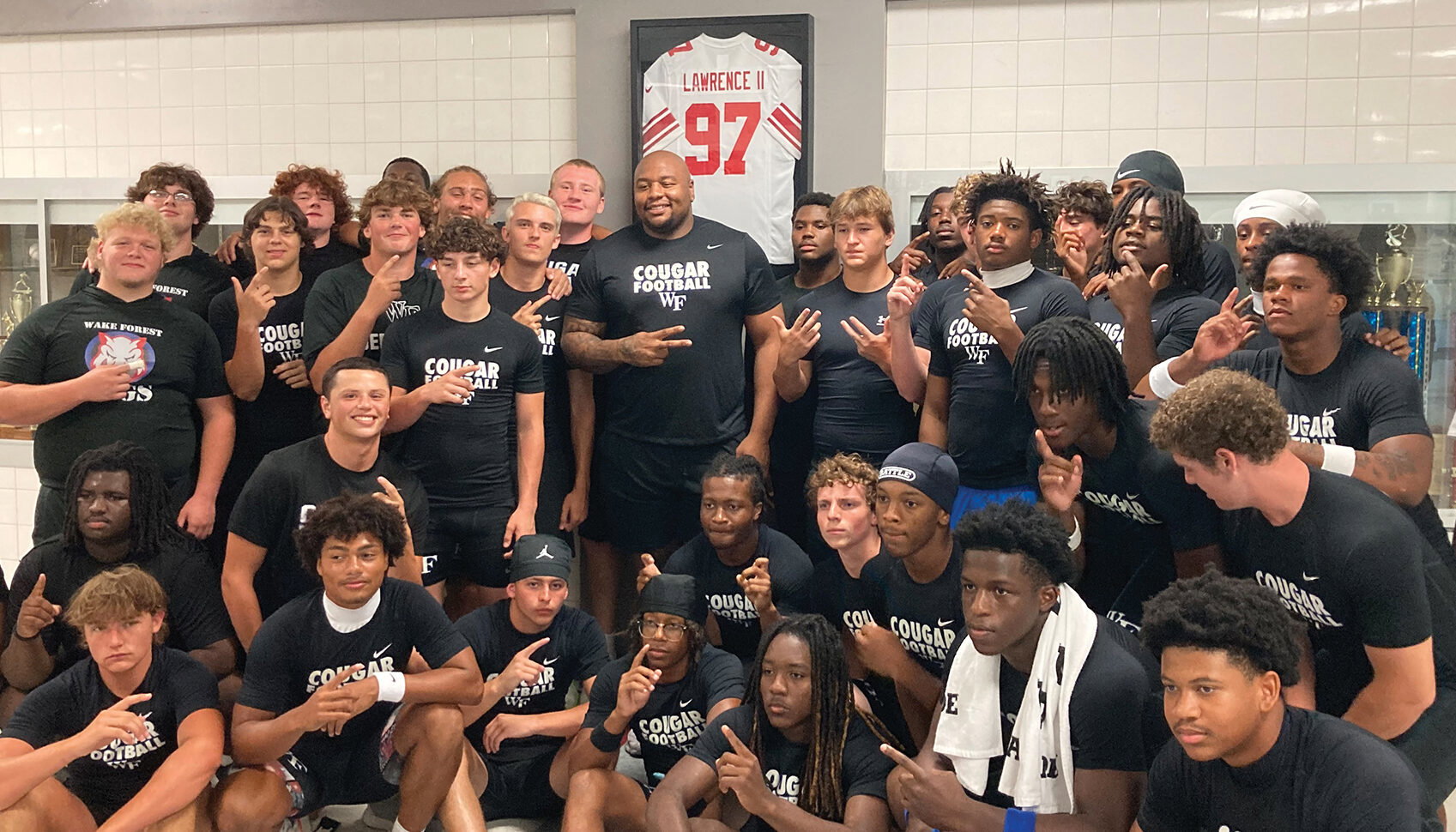
Photograph courtesy Robert Weintraub
Dexter Lawrence is a Junior, as the II on the back of his uniform attests. The athletic genes are easy to discern. His father was a collegiate linebacker at Arkansas State, and his mother, Julia Parker, a track star at Arkansas-Pine Bluff. The family spent time in larger cities like Fayetteville, Arkansas, and Raleigh when Dexter was young but moved to the quieter countryside when he was ready for middle school.
He already topped six feet, too big for local youth football leagues. No problem, because North Carolina is basketball country, and young Dex fit right in. “That was my first love,” he says of hoops. He played a mean pivot, idolizing former Columbus prep star and Ohio State center Jared Sullinger, a name that appeals to Bengals/ Buckeyes crossover fans, along with the likes of Hakeem Olajuwon. But reality intervened.
“I was killing it,” Lawrence says, “but then I grew wider, not taller.”
Devon explains the enormous size differential between him and his brother. “Where I had one plate, he had two or three. And when I went for seconds, Dex would eat that, too.”
Unsurprisingly, Coach Lucas took one gander at the big fella on the local basketball courts and imagined him destroying offenses across Wake County. “We’d had big kids before, but nothing like Dexter,” he recalls. But Lawrence wasn’t too keen on the effort football required, especially in the summertime.
“We started workouts, and Dexter wasn’t there for the first three days,” says Lucas. “My defensive line coach, Blake Brooks [father of former NFL player and current scout Bucky Brooks], said, ‘You absolutely need to call him.’ His mother told me firmly, ‘He will be there in the morning.’ He did not want to be there, but he feared his mother more than the hot weather.”
Lucas credits most of Lawrence’s notable kindness and humility to Julia, an educator in the county school system. “She demanded respect and that Dexter represent the family name with class, effort, and dignity. She did a great job raising him.”
Lawrence’s coaches worked him hard as well, instilling an ethic he repays with his loyalty to the school and its football program. “Coach knows I’d do anything for him,” says Lawrence. “He taught me discipline, effort, intensity. He meant the world to me.”
Lawrence became one of the great defensive players in North Carolina prep football history. “I haven’t ever coached anyone as talented or as dominant as Dexter,” says Lucas. His senior season was incredible: 13 sacks and 91 tackles, 21 of them for loss. “He even blocked a punt,” Lucas says with an admiring shake of his head. “I was like, ‘How in the hell did he get there so quick?’ ”
In one game, Lucas recalls, a pulling guard tried to lead his running back around the corner. “Dexter just flew through the opening and demolished the ball carrier. The other coach upbraided his player. ‘You can’t pull with that guy across from you!’ The poor guard yelled back, ‘Coach, there’s no one in North Carolina who can pull with him there.’ ”
Lawrence was the second-ranked high school prospect in the nation in 2016, and after an intense recruiting battle he chose Clemson for college ball. That’s where his patented “Sexy Dexy Dance” began.
“College is a mood, you know?” Lawrence says. “I was dancing everywhere, just not on the field, really, because it was against the rules. When I got to the pros, though, I would let go on the sideline, and Saquon [Barkley, the then-Giants star running back] told me I needed to do it after sacks.”
The dance didn’t figure to be used very often, as NFL nose tackles seldom put up big sack numbers. But Lawrence is the exception. He has logged 30.5 sacks in his seven-year career as well as 139 quarterback pressures, miles more than any other nose tackle. These are numbers that made Lawrence a no-brainer of an acquisition when the Giants made him available for trade.
Lawrence is the biggest—figuratively and literally—newcomer in an offseason spent remodeling Cincinnati’s horrific defense, which set new standards for ineptitude at times in 2025. The Bengals brought in another accomplished, if older, tackle in Jonathan Allen, signed edge rusher Boye Mafe from the Super Bowl–champion Seahawks, and replaced missed tackle machine Geno Stone at safety with former UC Bearcat Bryan Cook, who has missed about as many tackles in his four years in the NFL as Stone missed just last season with the Bengals. The team also drafted twitchy edge rusher Cashius Howell, the SEC Defensive Player of the Year, from Texas A&M, and a long and fleet cornerback, Tacario Davis, from Washington.
But Lawrence is the central figure, one capable of changing a defensive outlook on his own. “He’s 350 pounds of sunshine,” says Dan Hoard, the radio play-by-play voice of the Bengals. “He’s just what the defense needed, not just on the field but off it, too. He’s a leader, he brings people together, and his play speaks for itself.”
“Who beat up this place?” Lawrence yells as he gets a gander at Wake Forest High School’s weight room. “Y’all been tearing up the walls!” He stops to look at an old framed newspaper clipping. “Oh, this is where Coach said I was the most dominant player in the country,” he says aloud, still glowing from the decade-old compliment.
He gets more plaudits from the steady stream of well-wishers who approach, including a gaggle of teenage softball players. “We came here just to meet you,” one exclaims as Lawrence takes a photo with the group. One former teacher gently reminds him of a time before his star turn. “I remember you constantly missing the bus and Coach making you do push-ups in my classroom,” she says, laughing.
A fan appears in Giants blue and a New York accent. “It was a sad day when you got traded, not gonna lie. We gonna miss your traits in New York.”
The general consensus among everyone, Lawrence included, is that playing with Burrow is going to be an overwhelmingly positive experience. “He’s a real one,” Lawrence tells one friend. Another man enthuses, “When I saw you were going to Cincy, I lost my shit. You finally got a quarterback, son!”
While Lawrence is too politic to say it, his brother Devon says he’s happy to be out of New York. “He called me right after the trade, ecstatic,” says Devon. “He’s not used to the losing.” Lawrence’s teams at Clemson went 41–3 in his three seasons and won two national championships. (He was suspended for the second title game after testing positive for a banned substance.)
In New York, however, Lawrence was saddled with mediocre coaching and worse quarterback play. Over his seven seasons with the Giants, he played for four different head coaches. He also watched despairingly from the sidelines as a dozen passers—including decline-stage Eli Manning, failed savior Daniel Jones, concussion collector Jaxson Dart, and pigskin punchline Tommy “Cutlets” DeVito—took turns leading the team straight into the ground. New York’s record during Lawrence’s time there was 36–80–1; the team won six or fewer games every year but 2022, the first of his three straight All-Pro seasons.
Small wonder Lawrence seemed to quiet quit on the team, especially when they failed to reach agreement on a contract extension. After recording nine sacks in 2024, he had just 0.5 last year. An elbow injury originally sustained in 2024 was also a factor.
Another, more subtle reason for his statistical decline may have been that he was a new father. Nella Lawrence was born mid-season, and all the sleeplessness and distraction that comes with raising an infant can’t have helped his on-field focus. Lawrence proudly shows off photos and videos of his 10-month-old daughter to everyone who inquires. “She’s moving around so much,” he beams. “Getting ‘Happy Father’s Day’ texts was crazy!”
“I wasn’t in a lot of good positions,” Lawrence tells me about his 2025 season. He mentioned at the press conference following his trade that his opponents “got smarter.” I wondered what he meant by that. “[Opposing linemen] tried different techniques, different blocking styles, a lot of combinations I hadn’t seen much before. And it wasn’t just the players. Offensive coordinators watched me all offseason and did things to mitigate my presence.”
“He demands so much attention that a drop off in stats comes with the territory,” says Lucas, his high school coach. “You have to expect other teams and coaching staffs to adjust to him.”
So how to counterattack? “It’s about trusting my technique,” Lawrence says. “Don’t let myself get frustrated, and being good when they put a bunch of blockers on me, because that will mean freedom for the other guys.”
Lawrence’s former Giants and now Bengals teammate B.J. Hill brought him up to date with his new team before he arrived in Cincinnati. “I know it’s an old-school organization, but it’s very player-friendly,” he says. “New York is New York—it’s hard to beat for the ambience. But for my mental space, I like it quieter. I can sit outside in Cincinnati and just be at peace.”
He has embraced his new team and town in the same open manner he treats his people in Wake Forest, immediately moving to Cincinnati and doing things like throwing out a pitch at a Reds game. (“It got over the plate, that’s all that matters,” he says about his effort.)
“He arrived for his physical and to sign his contract, and he never left town,” says Hoard. “That shows how committed he is, and the fact the team was willing to give up the 10th pick is meaningful to him.”
The last three Bengals seasons have proven that, even when healthy, Burrow and his offense can’t win enough games on their own to get the team back to the Super Bowl. Hence the enormous optimism that accompanied the trade for Lawrence. He welcomes it, as well as the pressure that comes with savior status.
“Last year, I wasn’t me,” he says. “Now I have a fresh start to do what I do best.”
After five hours, the high school tournament is finally over, and a wrung-out Lawrence is ready to depart. One last round of photos and glad-handing, and he slowly trudges toward his car. Before he gets there, yet another old pal invites Lawrence to bowl a few frames the following night.
“Sorry, but I can’t,” Lawrence replies. “I got to fly back to Cincinnati tomorrow afternoon. I got a Super Bowl to win!”