



From "Cincinnati Post," January 9, 1909
The other day, someone apparently born in the present century posted a photo of an ash tray in the “What Is It?” section of Reddit, a stunning reminder of how precipitously tobacco consumption has declined in recent years. Younger viewers of retro series such as “Mad Men” ask if smoking was really that prevalent. (Spoiler: Yes it was.)
The accepted narrative these days is that almost everyone smoked, and they all smoked everywhere. Cigarette advertisements boasted the many doctors who endorsed particular brands and photos circulate today showing nurses offering cigarettes to hospital patients and it might seem like no one worried about the health effects of tobacco until the United States Surgeon General announced to general shock and amazement in 1964 that cigarettes just might not be good for your health. That story line is enshrined on the website of the Centers for Disease Control, which proclaims:
“The first report of the Surgeon General’s Advisory Committee on Smoking and Health was released in 1964. It was a landmark first step to diminish the impact of tobacco use on the health of the American people.”
Many people today believe that smoking used to be considered beneficial, and even healthful. That is simply not the case. Cigarettes were described as “coffin nails” as early as the 1890s, and newspapers throughout the 1800s were full of advertisements for medicines guaranteed to cure the tobacco habit, most of which warned against the dreaded disease known as “tobacco heart.”
Tobacco heart was recognized as a legitimate disease by practicing physicians. The Cincinnati Lancet-Clinic, official journal of the Cincinnati Academy of Medicine [September 18, 1897] described a typical case:
“There was a slight intermission of the pulse-beat about every thirty beats, which I attributed to a nervous condition superinduced by the excessive use of tobacco, as my patient had been some five years ago an inveterate smoker and chewer—a typical case of ‘tobacco heart’.”
Far from being limited to irregular heartbeats, tobacco heart was often fatal. In 1902, a traveling salesman from Cincinnati, one William I. Casselberry, was found dead in a hotel room. Cause of death was tobacco heart, Casselberry being a “great cigarette smoker.” Likewise, a coroner’s inquest in 1905 determined that John L. Foster, an artificial limb manufacturer, died from tobacco heart. According to the Cincinnati Post [April 21, 1905]:
“He had been warned by Dr. Edwin Wiggers that he had a tobacco heart, but persisted in smoking a cigar in spite of his wife’s entreaty, and died five minutes after.”
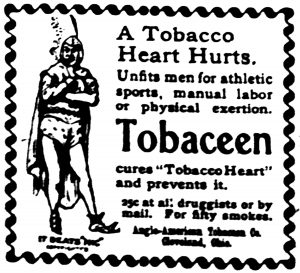
From "Cincinnati Enquirer," October 10, 1898
Tobacco heart struck nicotine fiends at all levels of society. The Cincinnati Enquirer [February 28, 1901] reported that Ohio Governor George K. Nash would miss the inauguration of William McKinley in his second term as U.S. President because of tobacco heart:
“Governor Nash is slightly improved this evening though it is announced that he will not be able to leave his office before Friday afternoon. The attack is due to tobacco heart, and not to indigestion, as at first announced by his physicians.”
Despite general agreement that there was a real disease called tobacco heart, there is substantial evidence that doctors did not consider it more than a chronic inconvenience, if they believed it was an affliction at all. The Enquirer [August 19, 1900] reported the case of Doctor Charles W. Parsons, who died suddenly:
“The doctor was talking to a friend, when he remarked that he had pains around the heart. ‘You’ve got a tobacco heart,’ said the friend. ‘Oh, no: just watch me,’ said the doctor, drawing out a cigar and striking a match. He had just touched the flame to the tobacco when he gave a cry and fell to the pavement senseless. He was taken to his home, but died within a few minutes.”
It’s impossible to tell whether Doctor William D. Stroud was serious or not when, in a paper presented to a regional medical conference, he promoted alcohol as the best antidote to tobacco heart because it dilates the arteries. According to the Enquirer [November 23, 1946]:
“Dr. Stroud said he envisaged a smoker with heart disease ‘going through life with a cigar in one hand and a highball in the other—although I’m sure the Women’s Christian Temperance Union won’t agree.’”
As late as 1956, Dr. T.R. Van Dellen, medical columnist for the Enquirer, acknowledged that “tobacco heart,” although not officially recognized as a medical condition, accurately described the effects of tobacco use on heart health, especially because many symptoms disappeared if the patient gave up nicotine.
Of course, tobacco heart was not the only effect of nicotine addiction. A 1907 advertisement for “Easy-To-Quit” listed cancer, as well as inflammations of the stomach, bowels, liver and kidneys among the curses inflicted by tobacco. An 1898 article about a City Hospital inmate blamed tobacco usage for “fullness about the heart, headaches, flushing about the face and flashes of light in the eyes, feeble pulse and heartbeats now rapid now slow.” Doctors predicted he was destined for apoplexy, or stroke. All of this at least a half-century before the Surgeon General’s pronouncement.
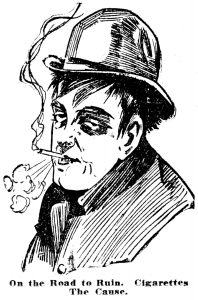
From "Cincinnati Post," March 23, 1907
And, if tobacco heart and its associated diseases weren’t enough, smokers also risked tobacco-induced insanity. The Post [June 25, 1892] reported the case of Claire T. De Garmo, a young man of great promise, who had been declared insane after he was found wandering around downtown Cincinnati aimlessly, unaware of his name or condition. Doctor James G. Hunt declared De Garmo the victim of nicotine addiction and incurably insane. He determined institutionalization as the only possibility.
As early as 1886, the Enquirer quoted medical authorities aware that smoking was definitely not good for health:
“There can be no question but that the inhalation of smoke induces disease of the mucous membrane with which it comes in contact. It will produce a catarrhal state of the nose and throat when none exists, or it will awaken a new one in a patient who has been cured of the disease.”
With apparently general agreement that tobacco heart was bad, not to mention catarrh and insanity, why did it take so long for the general public to give up “cancer sticks”? It’s yet another reminder that common sense is anything but common.