



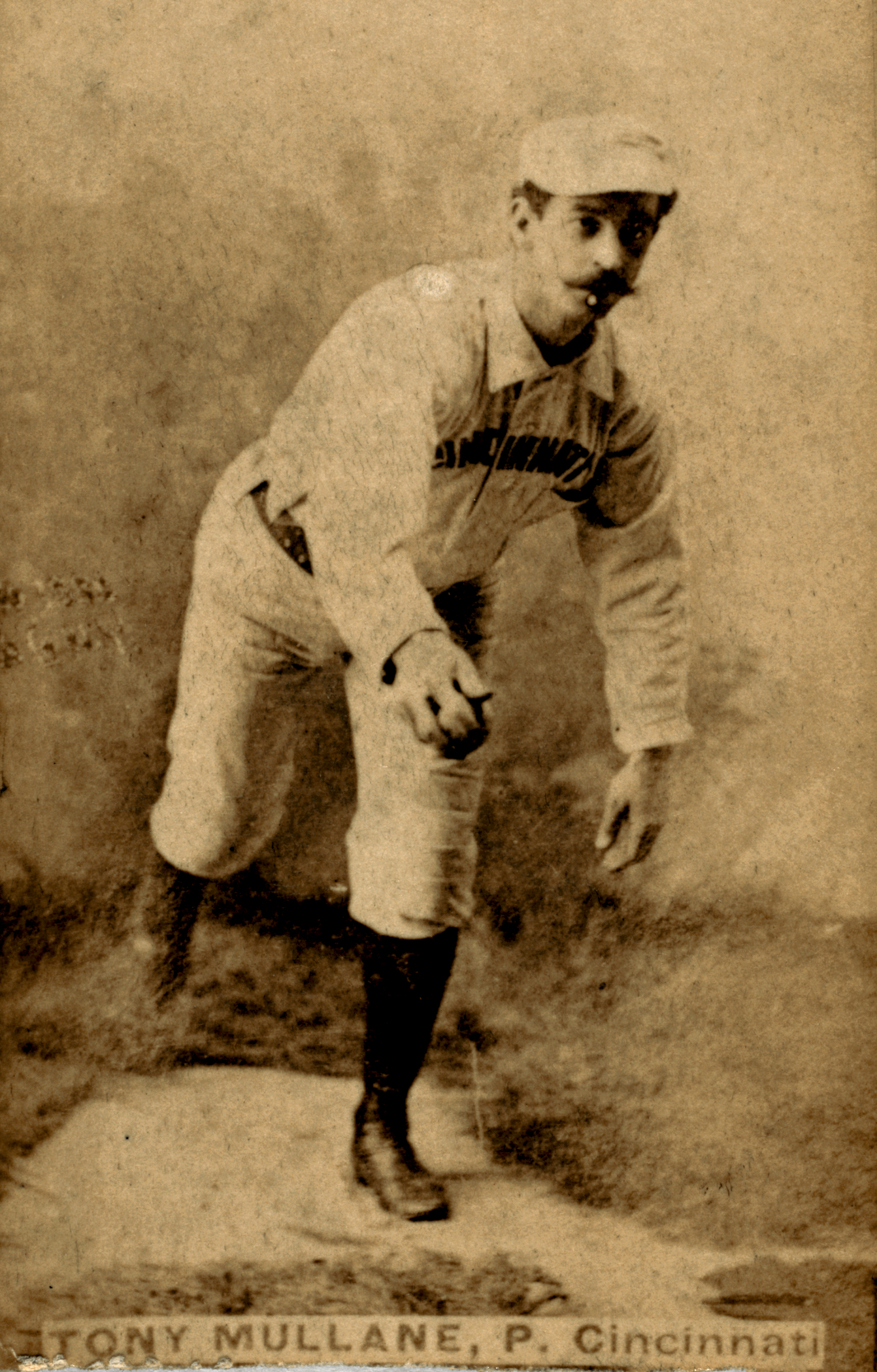
Photograph from Library of Congress
As Opening Day nears, many of us bust out our favorite baseball movies, often including 1989’s Major League with the unforgettable performance of Charlie Sheen as Ricky “Wild Thing” Vaughn, hurling hypersonic fastballs almost anywhere except the strike zone. Who remembers these days the Cincinnati Reds’ very own “Wild Thing”? Tony Mullane was a wild one, no doubt, but he left a far more complex legacy.
Mullane wasn’t a Cincinnati native. In fact, he wasn’t even born in the United States. Anthony John Mullane came into this world in County Cork, Ireland, on January 30, 1859. The Mullane family emigrated to the States in 1862 and eventually settled near Erie, Pennsylvania, where young Tony was introduced to baseball, much to his family’s dismay. The youngster ditched school so often he effectively expelled himself. He refused to learn a trade. All he wanted to do was throw the ball, hit the ball, catch the ball. In 1881, he made his big-league debut with the Detroit Wolverines, departing the next year for the Louisville Eclipse (later Colonels).
During his first full year in the majors, that 1882 season with Louisville, Mullane racked up two significant accomplishments. On July 18, 1882, he logged the first ambidextrous pitching appearance ever recorded, in a game against the Baltimore Orioles. After surrendering seven runs through two embarrassing innings while pitching right-handed, Mullane switched to his left arm. Although, as a southpaw, he held the Orioles to only two more runs, the hometown Louisville Courier-Journal [July 19, 1882] was unimpressed:
“The Louisville boys lay their defeat at Mullane’s door. He pitched a game against which any nine boys could have won. He was brought to task for his pitching and claimed his arm was sore, but this is a very lame excuse.”
On September 11, 1882, Mullane pitched the first no-hitter in American Association history, in a game against the Cincinnati Reds. This time, the Courier-Journal was kinder, dubbing his pitching “remarkable.” Still, Mullane’s experience with the fans, the back office and the press in Louisville set a pattern that would follow him the rest of his career. He rarely felt appreciated.
Mullane finished the season at Louisville with a breath-taking 1.88 ERA and a 30-24 win-loss record, the first of five 30-win seasons. His stats inspired a bidding war, and he joined St. Louis for the 1883 season, then ignored the reserve clause to join Toledo in 1884. St. Louis allowed the move with conditions that would later bite Mullane.
In Toledo, Mullane openly admitted that his catcher, Moses Fleetwood Walker, was the best he had ever thrown to. But Walker was Black. Mullane was openly racist and intentionally disregarded whatever signals Walker showed him. Undoubtedly, Mullane’s prejudice contributed to him throwing 63 wild pitches during that season in Toledo.
Mullane jumped again, in 1885, signing with the Cincinnati Reds for a reported $5,000. In this move, he jumped too far, breaking a contract he signed in St. Louis. For punishment, he had to sit out the 1885 season, smack in the middle of his run of 30-win seasons. That year off probably cost him the wins that might have sent him to baseball’s Hall of Fame.
When Mullane finally joined the Cincinnati Reds in 1886, he brought with him a controversial reputation. He also carried celebrity as a ladies man. The Reds’ owner, a haberdasher named Aaron Stern, noticed there were significantly more women at the park every time Mullane pitched. Fans had bestowed a couple of nicknames on the Irish hurler by this point, one of which was The Apollo of the Box. Stern had the manager schedule Mullane to pitch every Monday, declared that Ladies Day, and offered free admission to any woman accompanied by a paying male customer.
Baseball in those days was not the year-round commitment it is today. Most players found something to bring in cash during the off-season. Rookies and journeymen often pursued a trade, while the stars opened saloons. Mullane was no exception, as the Enquirer [February 14, 1886] noted:
“Tony Mullane is the latest accession to the ranks of ball players who mix long flies, foul tips and strike-outs with mint juleps, sherry flips and other palatable bar decoctions. He has about completed all arrangements, and will soon open a saloon on Vine Street, near Eighth, which, to use his own words, will be a ‘dazzler.’”
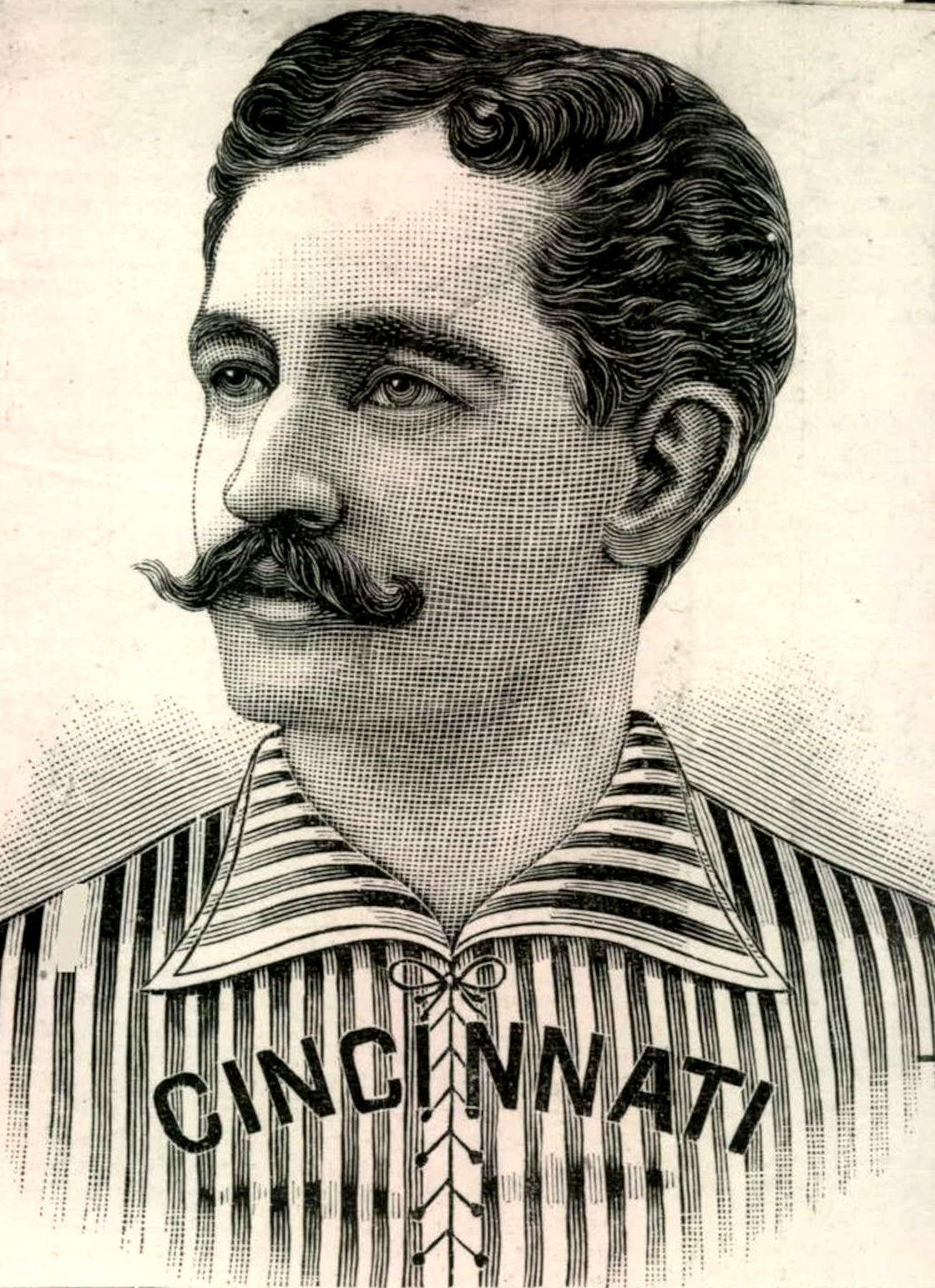
Illustration from an antique card at Alchetron
Over a career spanning seven and a half years with the Reds, Mullane won 163 games and notched two more 30-win seasons. As his pitching arm tired, Mullane’s value as a hitter emerged. In 1889 he recorded a career-high batting average of .296, a slugging percentage of .418, and 24 stolen bases in 196 at-bats. He regularly took on non-pitching positions, especially at first base where he was skilled at scooping up grounders without a glove. But—and this must be noted—he was vocally unhappy about playing for Cincinnati.
In May 1887, it looked like Mullane’s career was over, at least in Cincinnati. He refused to pitch one day in a bid for a higher salary, which led to a stormy confrontation in President Stern’s office. Mullane threatened Stern, who called for police. He also spent much of his time in Cincinnati in court, defending himself from his wife’s request for a divorce.
Throughout Mullane’s career, baseball was rapidly evolving. Rule changes were frequent and so were club realignments. In 1890, for example, the Reds rejoined the National League after more than a decade in the American Association. But the change that effectively ended Mullane’s career was introduced in 1893—the pitcher’s mound.
Before 1893, pitchers threw from a box on flat ground 55.5 feet from home plate. In 1893, a rubber plate 60.5 feet from the plate, atop a small mound, became the pitcher’s perch. Mullane’s stats plummeted immediately. He was traded to Baltimore mid-season. Baltimore dropped him in the middle of the next year and he closed out his career pitching just four games for the Cleveland Spiders. Mullane told Sporting Life magazine, as reported in the Enquirer [July 9, 1893] that he was glad to leave the Queen City:
“I feel like a man who has just been turned out of jail. I mean that Cincinnati-Baltimore deal. Honest, I was never as glad to leave any place in my life as I was in Cincinnati. There I got cussed every day, whether I pitched good ball or not. In Baltimore they appreciate me for what I am worth, and treat me like a ballplayer should be treated.”
We have reviewed Mullane’s unique ambidexterity, his role in establishing Ladies Days at baseball parks, his temper and his initial no-hitter, but we haven’t clarified Mullane’s connection to Ricky “Wild Thing” Vaughn. For that, we turn to the Guinness Book of World Records:
“The most wild pitches thrown by a pitcher in a MLB career is 343 by Tony Mullane (USA) playing for the Detroit Wolverines, Louisville Colonels, St. Louis Cardinals, Toledo Blue Stockings, Cincinnati Reds, Baltimore Orioles and Cleveland Spiders between 1881 and 1894.”
That’s a lot of wild pitches. Mullane’s closest competitor for this dubious honor was an almost year-for-year contemporary of his, Mickey Welch of the New York Giants, who tallied just 274 wild pitches in a career spanning 1880 to 1892.
Nevertheless, over Mullane’s 12 full seasons, only three other pitchers won more games than he did and all three are in the Hall of Fame. In total, Mullane garnered 284 wins, the second highest sum among pitchers not enshrined at Cooperstown. Cincinnati stopped cussing him long enough to induct Mullane into the local Reds Hall of Fame in 2010.