


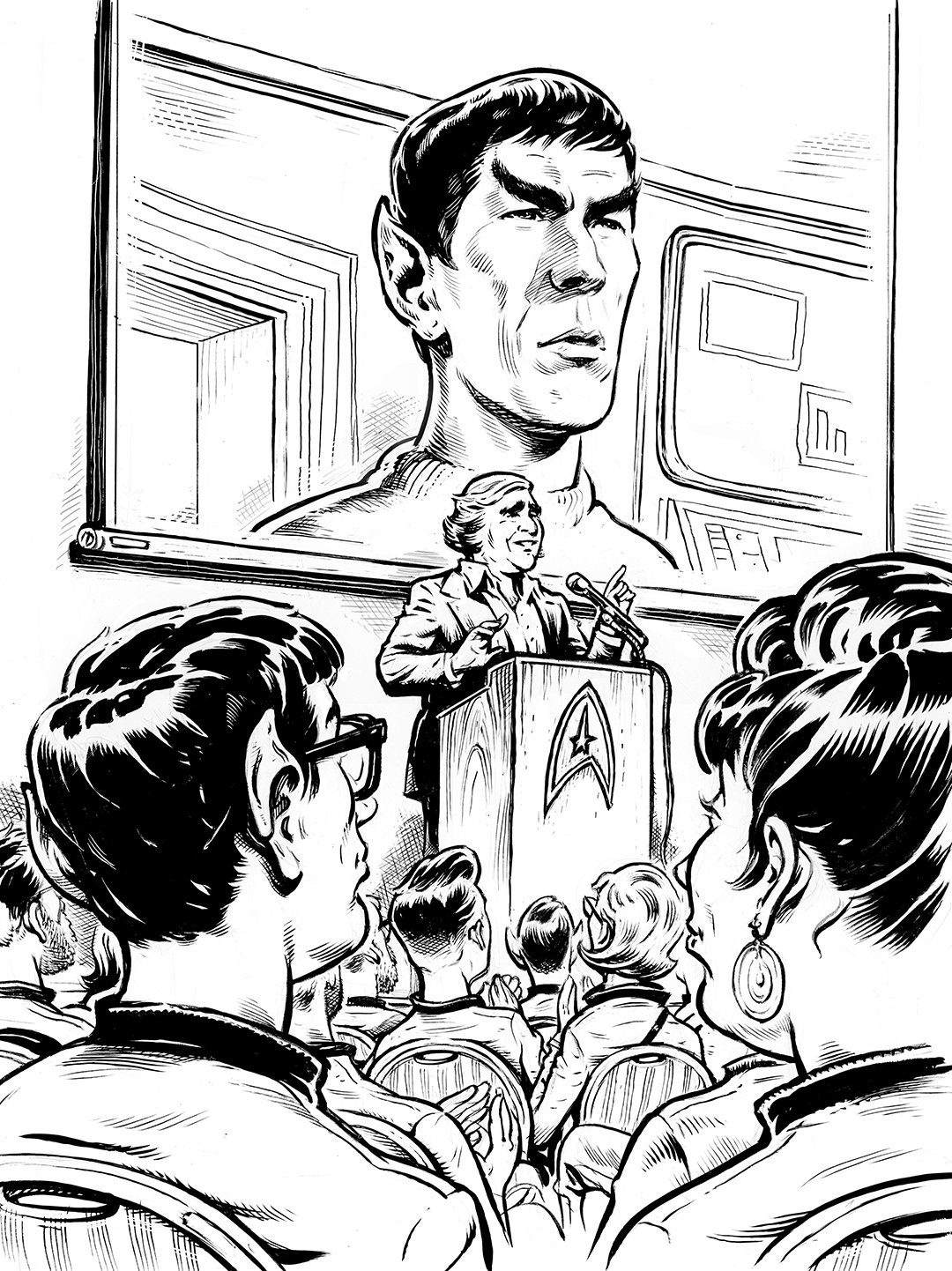
Illustration by Lars Leetaru
I was born long after Star Trek first aired, but I love researching its history. I found an old news item saying that Gene Roddenberry once came to Cincinnati and showed the “original unaired pilot.” True fans know that the pilot did air as part of a new episode. Can you unearth what Roddenberry actually showed? —ILL LOGIC
DEAR ILL:
A long time ago in a decade far, far away (sorry), Star Trek was a forgotten TV has-been. Only the most rabid fans stayed loyal between the show’s 1969 cancellation and its 1979 movie comeback. Creator Gene Roddenberry kept hope alive in the mid-1970s by touring a presentation of the show’s hilarious blooper footage, plus the “original unaired pilot.” He came to Cincinnati exactly 50 years ago on September 24, 1976.
Here’s why the news item you saw is both true and untrue. Midway through Star Trek’s first season, an episode aired that used footage from the 1965 pilot, which had no William Shatner but showed Leonard Nimoy sporting extra-severe ears and eyebrows. Thanks to the “fiction” part of science fiction, the current cast was able to “view” scenes from a long-ago Starship Enterprise. What Roddenberry presented at Riverfront Coliseum was the complete pilot in its original form, which had indeed never been broadcast. That “other” space movie in 1977 eventually gave Star Trek a chance to live long and prosper (again, sorry).
I’m new to Cincinnati and love it, but something vexes me. Why is the expanse between the stadiums called The Banks? Was the area near the river always called that, even in the 1800s, or is it a recent name? Or is it about the various banks that financed its development? —BANKING ON YOUR ANSWER
DEAR BANKING:
No, the name is not from the 1800s, and for this you should be thankful. Today’s tract between our stadiums was planned in the late 1990s, and if an existing old nickname for the area had been chosen, we would be doing our pre-game partying at The Bottoms. Or Rat Row. Or even Sausage Row. (That last one meant both pork and prostitution.)
Our riverfront was perfect for Cincinnati’s early economic growth until it wasn’t. Coal-fired steamboats perpetually fouled the air. Thousands of pigs and tons of excrement didn’t help. When the banks of the river were abandoned thanks to railroads taking over most of the freight, they turned into Cincinnati’s worst neighborhoods—hence those nicknames. The original Ft. Washington Way highway
project obliterated most everything around 1960, leaving behind some produce warehouses and the Original Spaghetti Factory.
In September 1999 the Riverfront Advisory Commission, tasked with developing a rebirth of the area, proposed calling it The Banks. If they really were thinking about something with a financial meaning, perhaps a more appropriate name might have been The Taxes. Or The Reds-Bengals Exemptions. Or simply Impossible Parking. The Bottoms up, everybody!
I’ve always known that Elvis Presley’s “Love Me Tender” has a Cincinnati connection, that a local man named Fosdick wrote a poem during the Civil War, and someone else wrote the melody. Did Fosdick ever do anything else notable, or was he just a one-hit wonder? —I WONDER
DEAR WONDER:
There are multiple reasons why Cincinnati-born William Whiteman Fosdick’s name is slightly less famous than Elvis Presley’s. His accomplishments are not so much notable as footnote-able. The rather pedestrian love poem he wrote in 1861, “Aura Lea,” inspired a melody composed by George R. Poulton. It is only Poulton’s melody that has achieved immortality. Fosdick’s poem lies a-molderin’ in the grave.
The sentimental song was introduced just as the Civil War was beginning, gaining popularity among both Union and Confederate troops. A new set of lyrics turned it into “Army Blue,” the graduation anthem for soldiers at West Point. And still another lyric in 1956, the grammatically annoying “Love Me Tender,” became a No. 1 record for Elvis Presley.
Clearly, the most disposable element of “Aura Lea” has been Fosdick’s lyrics. A further demerit for the original song is that its first professional performance in Cincinnati was by a blackface minstrel group, Hooley & Campbell’s Minstrels. Here we might note that Fosdick’s middle name was Whiteman.
Dr. Know is Jay Gilbert, radio personality and advertising prankster. Submit your questions about the city’s peculiarities here.