


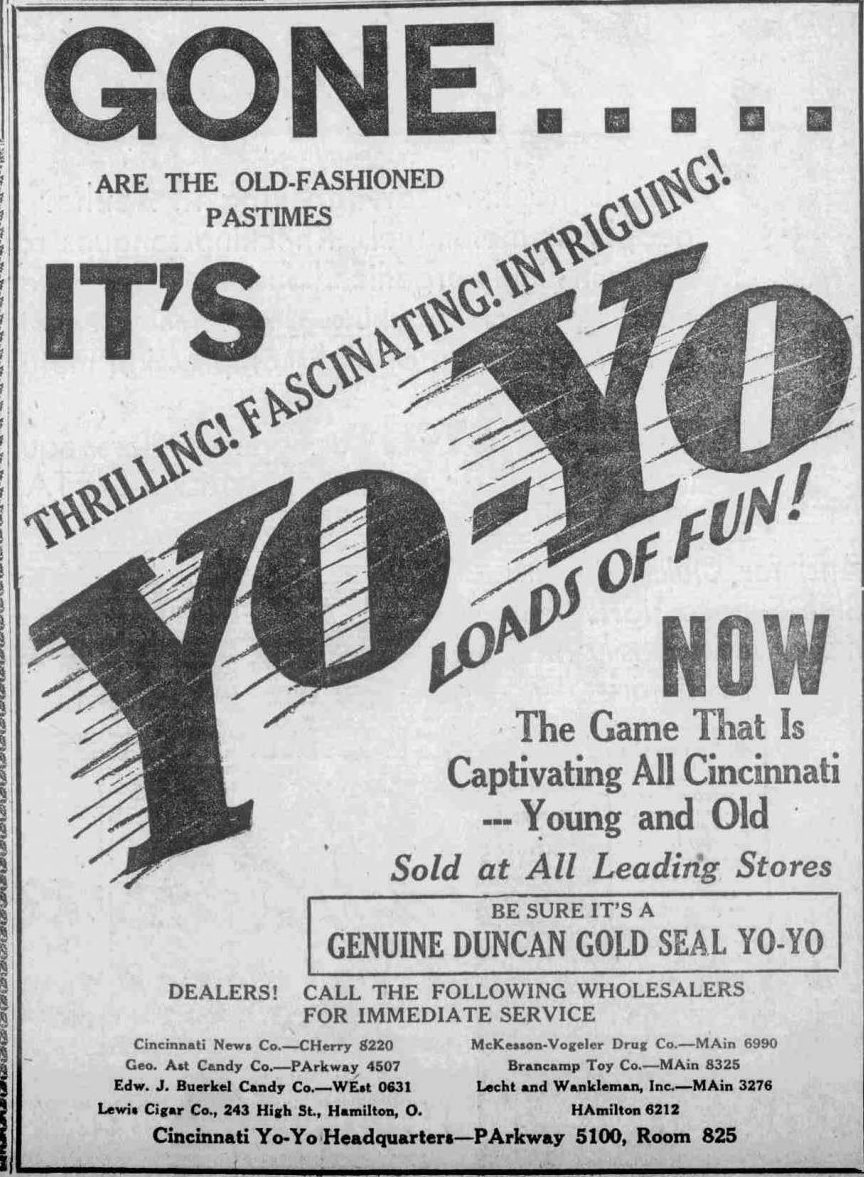
From "Cincinnati Post", December 11, 1931
On September 27, 1929, the Cincinnati Post ran a photograph of a comely young flapper staring at a yo-yo, accompanied by a drawing of the toy in action. Under the headline, “It’s A Yo-Yo,” the newspaper explained:

From "Cincinnati Post", September 27, 1929
“Latest fad sweeping the country, one known in the Philippines for generations, is the yo-yo. A yo-yo is a weighted disc-like spool, with a string wound around its axle. To ‘yo,’ one holds the string and drops the spool. The string unwinds and then the momentum causes it to rewind in the reverse direction, if manipulated properly, causing the spool to climb back up to the hand. Simple—but just try to do it.”
You will notice two things about this squib. First, it points to the Philippines—still a United States territory in 1929—as the point of origin for the toy. Second, the writer dismissed yo-yos as a fad, destined to fade away.
The next decade proved that yo-yos were here to stay. Every Cincinnati movie theater worth its admission price conducted a yo-yo contest. Local nightclubs sponsored “yo-yo dances.” Some fashion accessories were marketed as “yo-yo style.” It wasn’t until World War II that yo-yo sales slumped, to be revived by an advertising campaign aimed at Baby Boomers in the 1960s.
There is, indeed, something to the Philippine origin story. The word yo-yo derives from the Iloco language spoken by the Ilocano people of the Philippine islands. The 1929 introduction of yo-yos to the United States was initiated by a Filipino immigrant named Pedro Flores who opened a large factory in Los Angeles. Within a year, Flores was bought out by a marketing genius named Donald Duncan, who not only founded the Duncan Toy Company, but also built the Good Humor ice cream franchise empire and a parking meter company. All of that 1929 capsule history ignores a century-long history of very similar string-and-spool toys in the United States. In fact, the very first patent for a yo-yo was issued to two Cincinnati men way back in 1866. But they didn’t call it a yo-yo.

U.S. Patent & Trademark Office
James L. Haven and Charles Hettrick (or Hettrich—the patent papers spell it both ways) of Cincinnati were awarded United States patent 59,745 on November 20, 1866 for what they called a “whirligig” or an “improved bandalore.” Bandalores are mentioned in American newspapers at least as far back as 1819, and similar toys are depicted on ancient Greek pottery dating from 440 BC. No one, however, thought to patent the devices.
James Haven was a wealthy manufacturer in Cincinnati. The Haven foundry churned out all sorts of metallic items, from hinges to sconces to cider presses to grain mills to elevators. He even manufactured steam furnaces and parts for buggies and carriages. Some of these contraptions were inventions of Haven himself or one of his workers.
Charles Hettrick (let’s settle on that spelling, which is how he is buried at Spring Grove) was among Haven’s employees. Variously identified as a finisher or hinge-maker, Hettrick would certainly have been familiar with the metalworking skills required to assemble the improved bandalore.
So, curiously, would Hettrick’s son, Charles Hettrich Jr. (for that is the way he spelled his name in the city directories). Junior was a jeweler, employed by the Duhme Company, Cincinnati’s premier jewelry and silverware firm. The patent paperwork does not provide the age of the applicants. Dad would have been 45 years old and Junior 20 in 1866. The two Charleses lived at the same address until about 1880, so it is possible they both had a role in the invention.
Although his name appears on the patent, Haven apparently did not add whirligigs or improved bandalores to the plethora of ironmongery offered for sale from his foundry. A surviving Haven Company catalogue and price list from 1871 includes not a word about this or any other toy. Although the Guinness World Record folks attribute “Earliest patent for A Yo-Yo” to the “Cincinnati, Ohio-based toy company Haven & Hetterick” [sic], there is no record that Haven or Hettrick formed any such company. There is no mention of any such company in any Cincinnati newspaper or city directory in the years following the patent. Further, there is not a single mention of bandalores or whirligig toys in any Cincinnati newspaper from 1866 until 1934 when a horse named Bandalore starting winning races at local tracks.
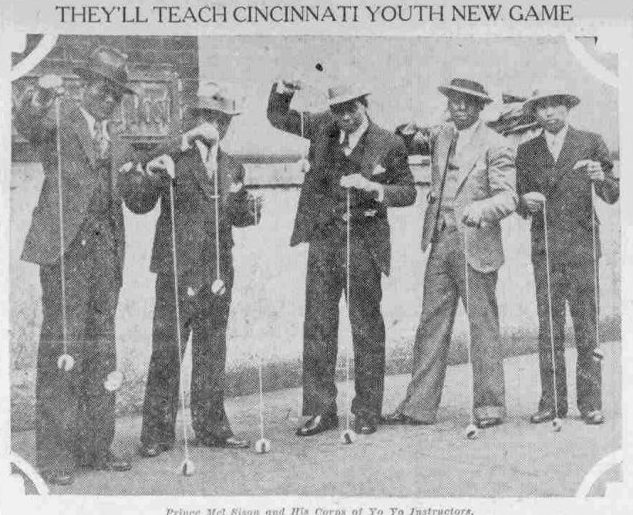
From "Cincinnati Post", December 15, 1931
By then, Cincinnati was deeply invested in the yo-yo craze. Up on Gilbert Avenue, the Mansion Ballroom opened the new year with a “Yo-Yo Dance.” According to the Cincinnati Post:
“And now the Yo Yo will foxtrot and waltz. It will take its lessons from Norma Cox Wheeler when she presents a ‘Yo Yo Dance’ at the Mansion Ballroom Saturday night. Dancers will receive Yo Yos to train and retain as gifts from the management. The Harry Willsey Orchestra will spin some special Yo Yo music.”
And when Cincinnati dives into a fad, especially when dancing is involved, it’s only a matter of time before some salacious dimension emerges. So it was no surprise when the Enquirer [January 5, 1932] reported on a vice raid on a downtown apartment:
“Dominigo Bragado, 24 years old, 134 West Seventh Street, and Joseph Deiera, 25, same address, Philippino Yo-Yo teachers and salesmen, were arrested by Detectives Millard Schath and Andrew Beard and held for promoting juvenile delinquency last night. The officers sent two sixteen-year-old girls, found in the men’s room, to Juvenile Court.”
In a very suspicious coincidence, just two days after the “Yo-Yo-Gate” bust, the Cincinnati Post named the winner of the top prize as Champion Yo-Yo Spinner in Cincinnati. The champ was Robert Beebe, 11 years old. Robert’s home address? None other than that very same 134 West Seventh Street. (At the time, it was a large rooming house.)
Cincinnati’s connection to yo-yos or bandalores is not limited to that earliest patent. On September 15, 2012, Beth Johnson of LaRue, Ohio, demonstrated the world’s largest working yo-yo somewhere around Cincinnati. Measuring nearly 12 feet in diameter and weighing more than two tons, the “Whoa-Yo” disc plunged 120 feet on a rope attached to a gigantic crane before successfully rebounding three times. Johnson had endeavored on three earlier occasions to get her gargantuan toy to function, mostly at locations in Florida, with no success. On one attempt, her yo-yo unrolled, then spun around until its 1.5-inch yacht mooring cable “string” melted, plunging the whole thing to the ground. It’s not clear exactly where in Cincinnati she effectively yoed her yo, or why she made the attempt here and not closer to home or in Florida. All Guinness tells us is she provided evidentiary video of her success.