



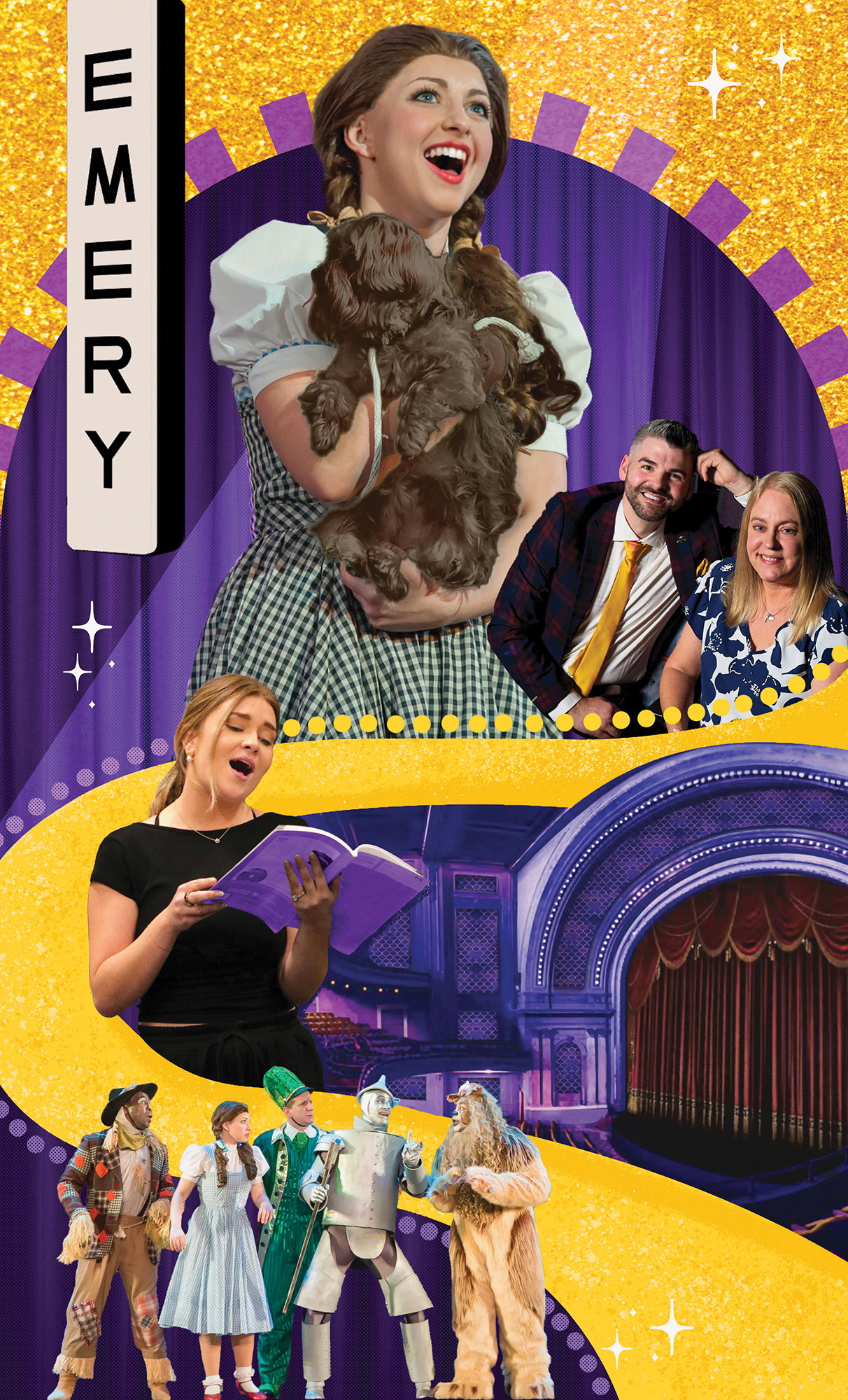
Photographs courtesy TCT/(Kim and Roderick) by Andrew Doench/Collage by Stef Hadiwidjaja
When prolific philanthropist Mary Emery opened the Emery Theater in 1911, it was the most state-of-the-art theater in the country. Located in Over-the-Rhine, it was built to house the Cincinnati Symphony Orchestra and later The Children’s Theatre (TCT) until 1969, when it was gifted to the University of Cincinnati, and the latter sought a new stage.
As the decades rolled by, TCT operated amicably at the Taft Theatre, but it received only 40 performance days per year and was limited in technological capabilities. When UC listed the Emery Theater for sale in 2019, TCT began to dream. “The Emery was our first home,” says Kim Kern, president and CEO of TCT. The possibility of returning was almost kismet.
Kern and her team embarked on a six-year labor of love, from sending proposals and executing the purchase/sale agreement to a capital campaign feasibility study, parking analyses, and even window-shopping other theaters “to make sure we were going down the right path,” says Kern. “All of which pointed to yes.”
The renovation, budgeted at $51.5 million, was greenlit. Thanks to grants; tax credits; and foundation, corporate, private, and individual donors, all but $1.4 million has been raised as of July 2025.
When it reopens, the Emery Theater will once again be the most state-of-the-art theater in the nation. Among its many dazzling new features is a doughnut turntable, which boasts both outer and inner circles that can rotate in opposite directions. A “sliding lids over a trap” feature (fondly nicknamed the SLOAT), will cover the turntable when it’s not in use—a first of its kind in the country. The stage lift function—which required a 20-foot excavation below the stage—allows sets to be stored underground, rather than at the stage wings.
A large video wall with seven projectors will create seamless transitions between set backdrops and a uniquely immersive experience for audiences. The theater will also feature an enhanced flying system—just in time for the flying monkeys of The Wizard of Oz: Youth Edition. “Truly, our productions are Broadway quality,” says Kern, noting that all sets and costumes are produced in-house.
Best of all, the renovated Emery Theater will remain multifunctional to rent by other arts entities, a key part of the company’s stabilization plan. This year, TCT will produce only four of its own productions, gradually increasing its capacity in the coming years while renting the vacant stage time to ensure a steady and sustainable cash flow.
Capacity comes in at just more than 1,500—a Goldilocks number, as TCT performances averaged 1,400 patrons at the Taft Theatre. Annually, TCT welcomes about 90,000 attendees; approximately half come with school-sponsored field trips through a generous subsidy program.
Though it costs the company $30 to put each child in a seat, schools never pay more than $10 per ticket. For schools with more than 50 percent of students on free or reduced lunch programs, tickets are only $5—or no cost at all. Last year, TCT provided more than $1 million in school ticket subsidies.
All MainStage productions are one hour in length and designed to capture the attention and wonder of young audiences. Its touring division annually visits 25,000 students nationwide, and TCT Academy offers classes and camps for aspiring thespians ages 18 months to 18 years old. Through the JumpStart program, area schools can apply to receive funding and training to launch their own theater programs.
As the oldest professional children’s theater in the country, TCT is on a mission to not only enrich young lives with creative entertainment but to also plant seeds in the hearts of future arts patrons. As a niche within the Queen City’s arts world, TCT is wholeheartedly doing its part, as Kern says, to “keep Cincinnati a place where people want to live, work, and play.”
The Emery Theater’s reopening perfectly coincides with the launch of TCT’s 2025-2026 season opener of The Wizard of Oz: Youth Edition on October 10.