



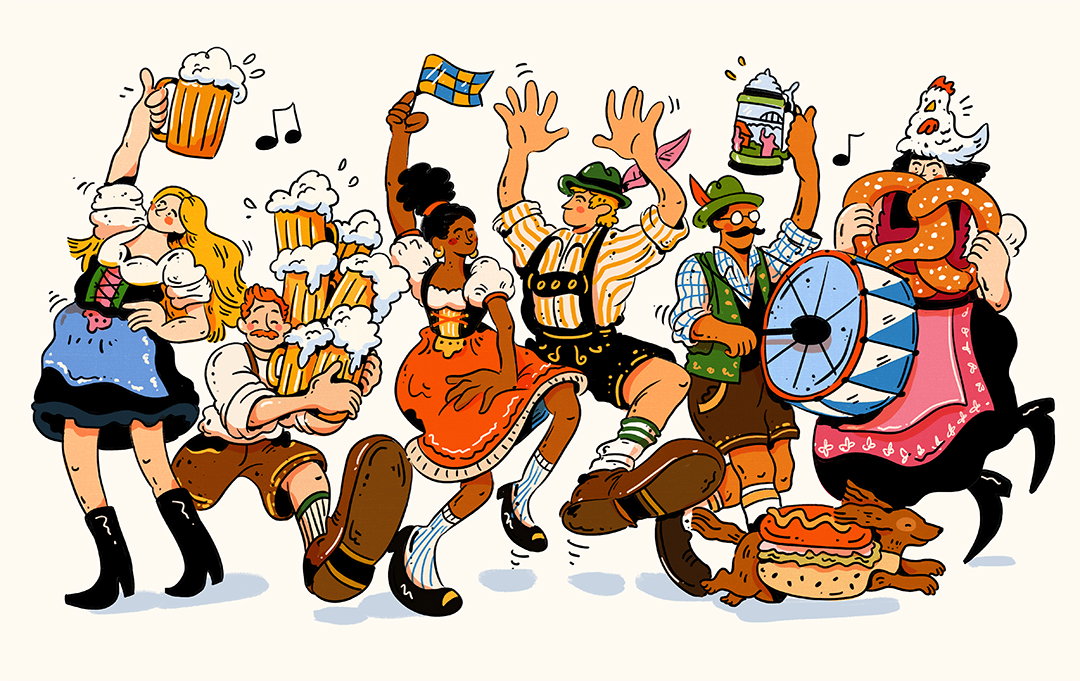
Illustration by Visbii
Way back in 1976, Cincinnati’s Downtown Council announced a brand-new event. With less than a month’s notice, the council decreed that Oktoberfest would occupy Fountain Square and Government Square for a weekend that October. The Enquirer editorialized support for the idea but noted that the proposal was “overdue.” And overdue it most certainly was.
What took Cincinnati—or, excuse me, Zinzinnati—so long? As early as October 1972, City Council adopted a motion by Mayor Thomas Luken to sponsor an annual Oktoberfest. The revival of Oktoberfest in 1976 filled a gap in the Queen City calendar that had historically been occupied by a variety of large annual celebrations.
In 1900 the Cincinnati Chamber of Commerce announced plans for a fall festival and exposition of several weeks’ duration. For the next decade, grander and more spectacular carnivals blossomed each year at Washington Park, drawing visitors numbering in the hundreds of thousands.
After a hiatus blamed on financial panics and World War I, Cincinnati again endeavored to revive the autumn celebrations in 1923. There was one huge attraction missing from the 1923 Fall Festival— beer—this being the dawn of Prohibition. Previous Cincinnati fall festivals trumpeted their selection of fine local brews, served up in booths decorated to look like British pubs or German Bierhäuser. The 1923 event, though successful, was never repeated.
After reviving Cincinnati’s fall celebrations in 1976, the Downtown Council considered its first Oktoberfest a success, but news reports were somewhat lukewarm. According to The Enquirer, “some of the oom-pah music was recorded and the beer was 3.2 percent.”
Within a decade, however, Cincinnati’s Oktoberfest blossomed into the premier regional celebration. By 2014, Fodor’s Travel Guide ranked Cincinnati’s as the largest Oktoberfest celebration in the U.S. and second largest in the world, after only the original extravaganza in Munich.
Blame it on the Chicken Dance. Introduced around 1981, the novelty jig quickly became a crowd favorite, leading to 1994, when Cincinnati’s Oktoberfest broke into the Guinness Book of World Records as 48,000 people flapped their arms and shook their tailfeathers.
That year, the Chicken Dance was led by Luitpold Prinz von Bayern, the crown prince of Bavaria, whose great-great-great-grandfather had created the original Oktoberfest in Munich back in 1810. Since then, leaders of Cincinnati’s Chicken Dance have included Davy Jones of The Monkees, George Takei of Star Trek fame, “Weird Al” Yankovic, trumpeter Al Hirt, the San Diego Chicken, and local favorites such as Jim Scott, Joe Morgan, and Thane Maynard.
That Al Hirt appearance in 1998 marked the Downtown Council’s second attempt to crash the Guinness list with The World’s Largest Kazoo Band. The council distributed 25,000 kazoos and brought Rick Hubbard, the self-proclaimed “King of Kazoo,” to town, but Guinness was unimpressed. Total attendance that year, despite one rainy day, was estimated at 500,000.
In 2007, Oktoberfest went, literally, to the dogs as the inaugural wiener dog races pitted dachshunds strapped into bun-shaped bumpers against each other in a mass waddle across Fountain Square. Since then, the “Running of the Wieners” has become a crowd favorite.
After a hiccup during the dread COVID year of 2020, and despite several relocations, Oktoberfest Zinzinnati has soared back as a highlight of Cincinnati’s festival year and an annual reminder of the city’s Germanic heritage.
For 50 years, Oktoberfest Zinzinnati has oom-pahed its way to the pinnacle of Cincinnati’s festival season. The folks who run the show claim our Oktoberfest to be the largest outside Munich and, with attendance nearing 800,000 in recent years, it’s hard to gainsay them.