


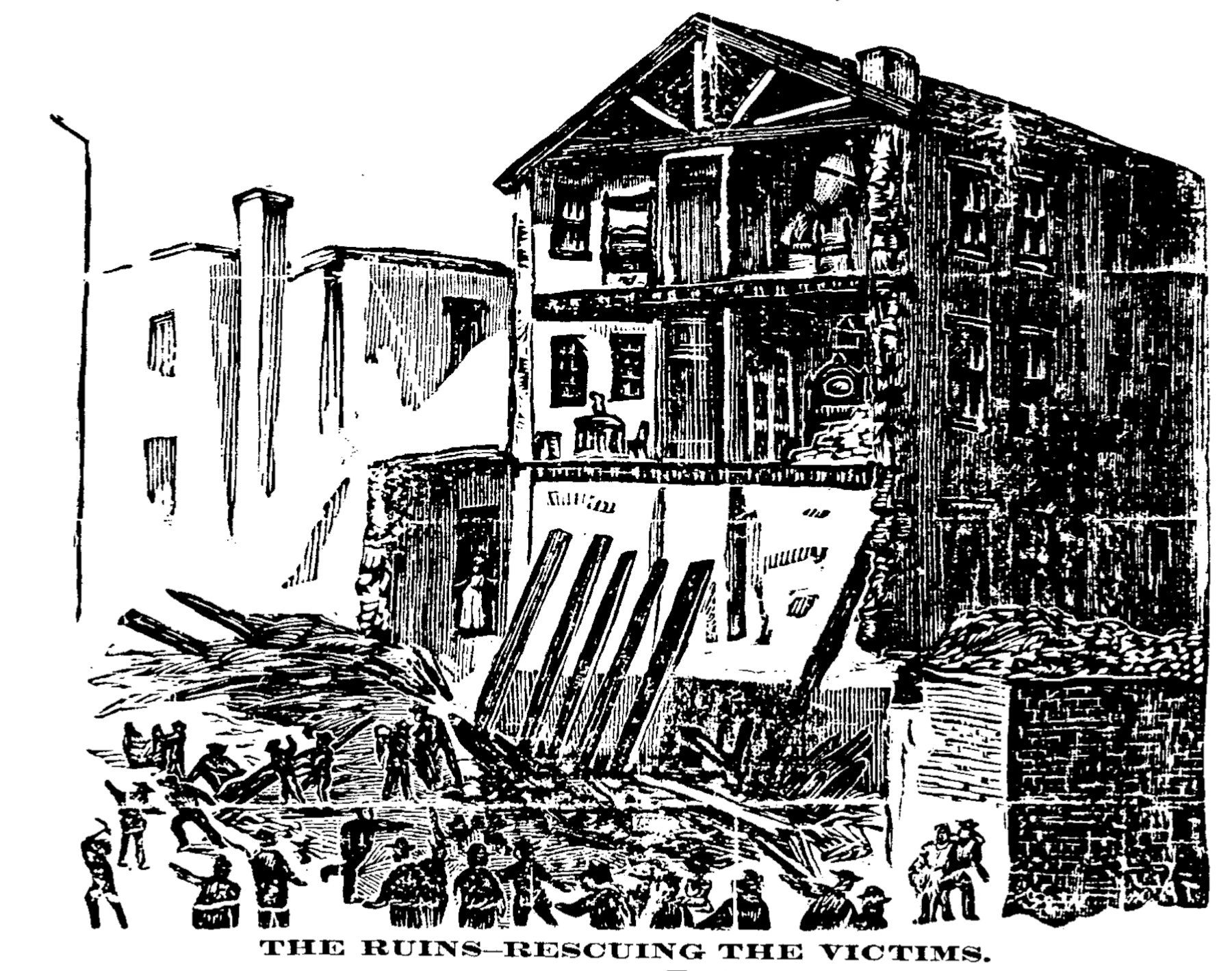
Illustration from "The Cincinnati Enquirer," September 4, 1877
When a “house of ill fame” collapses, secrets spill out. The sort of secrets that embarrass the unclothed clientele, the city’s building inspectors and the wealthy landlord.
Such was the case at 3:00 p.m. on Monday, September 3, 1877 when a very narrow building at 74 Longworth Street collapsed, killing four unfortunate souls. Longworth, a long-vanished Cincinnati street, once ran westward from Vine between Fifth and Sixth streets.
In the autumn of 1877, workmen were engaged in demolishing a building next-door to the Weighell Brothers Excelsior Tobacco Works. The Weighells occupied the northeast corner of Longworth and Elm and planned to expand eastward along Longworth, acquiring and demolishing the building at 76 Longworth.
As that building came down, the workmen noticed that the next building over, at 74 Longworth, was unstable and needed shoring up. It seems that 74 Longworth had relied on the now-demolished building at 76 Longworth as a sort of retaining wall. The Weighells contacted a crew of “house raisers” to shore up 74 Longworth and that crew arrived early in the morning. As the house-raisers prepared to install support beams, the whole structure tumbled into a pile of debris. As it fell, 74 Longworth pulled down the entire west wall of its next-door neighbor, at 72 Longworth, exposing the interior like a gigantic doll’s house.
Buried in the rubble were nine workmen and a dozen occupants of the collapsed building. Cries of the injured drew onlookers and would-be rescuers to the scene. Police and fire companies arrived to contain the crowd and begin salvage efforts. The following facts soon became obvious:
1. Number 74 Longworth St. was a brothel, operated by Madam Susan Ream, who was among the fatalities.
2. Two men caught, as it were, with their pants down, hastily contrived pseudonyms and alibis.
3. The building was shoddily constructed and should never have been occupied to begin with.
4. The landlord of this brothel was Mr. Gilbert Dater, a prominent and wealthy citizen of Cincinnati.
Gilbert Dater (1818-1904) was christened Gebhard Thäder when he was born in the Rheinland-Pfalz region of Germany. He emigrated to Cincinnati as a young man and found work hauling dirt during the excavation of the Miami Erie Canal. He sold produce for a few years and then plowed his profits into pigs. He was among the early pork packers who gave Cincinnati its nickname of Porkopolis. Having made his fortune, Dater and another Cincinnati industrialist, Michael Werk, bought land adjacent to one another in the Western Hills, grew lots of grapes and made wine. Dater’s name lives on in two Cincinnati public schools constructed on property he once owned in Westwood.
The Cincinnati Enquirer [September 4, 1877] was quick to report that 74 Longworth was a deathtrap.
“The causes of the disaster appear to be manifold. First and foremost was the flimsy character of the building, the walls of which were only eight inches thick, and it is asserted that the west wall did not rest squarely on the foundation wall.”
The Enquirer reported the Weighells had contacted Mr. Dater and told him their excavation had destabilized Dater’s building. Although Dater initially claimed to have told the occupants of his building to move out, the surviving tenants denied this. They claimed he did not ask them to evacuate and instead insisted the building was safe. During an inquest, Dater testified that, although the construction crew told him the building was stable, he advised Mrs. Ream to vacate until the work was completed.
Caught in the rubble were two work crews. The first, from Coughlan & Co. house raisers, had just begun work stabilizing the collapsed house. The second, cellar diggers from Conner & Enright, were the crew who originally undermined the collapsed building. They were still excavating the Weighell site while the house raisers endeavored to undo the damage they had caused.
Among the occupants of the collapsed house were Susan Ream, aged, 29, the madam, and her husband, Robert Ream, who worked as a molder. Mr. Ream was away at work that day. Ada Price, who claimed to be a friend of Mrs. Ream and “just visiting,” was also caught in the collapse. Employed as sex workers by Mrs. Ream were Kittie Grant, Laura Miller, Myrtle Gray and Lottie Williams. Two other women in the house, Mrs. Louisa Dowling, described as “a large, fleshy woman,” and an African American girl known only as Mary were probably servants.
In addition, there were two “customers.” One, found in Kittie Grant’s bed in the back room on the second floor, was a railroad brakeman named John Disten. He told reporters that he had encountered Miss Grant just minutes before on Longworth Street and had engaged in conversation “on the strength of an old acquaintance,” before she invited him upstairs. According to the Cincinnati Commercial [September 4, 1877],
“He had not been up a minute, he said, when the walls began to fall and the floor to sink down.”
If that were true, Disten was a very rapid undresser, because the Enquirer reported that, when located “he had no clothes on save drawers and undershirt.”
The other customer was a “friend” of Myrtle Gray, alias Lizzie Nichols, who identified himself as Henry Johnson, although his right name might have been Greenburg or Greening. Johnson, whatever his name, emerged barefoot shortly after the collapse and scrambled over the debris so energetically that some observers initially expressed admiration for his efforts to rescue survivors. The Enquirer, however, had his number:
“This was the chap who lingered around the scene of the catastrophe, and who was in everybody’s way, as he clambered over the pile of rubbish. His shoes and hat were gone; in fact, it is said he struck terra firma without any clothes on to speak of, but borrowed a coat and pantaloons from some kind-hearted individual and then went back to search for his lost goods. He was looking for something besides an old hat, for about five o’clock one of the workmen hauled forth a vest which he at once hooked on to. It contained in one of the pockets twenty-four dollars, a five-dollar gold piece and a heavy gold watch and chain. The valuables were taken by Officer Sullivan to the Chief’s office, where ‘Johnson’ afterward recovered them. His hat, too, was found, and then the firemen, getting tired of seeing him around, hooted him away.”
Miss Gray was excavated from a pile of masonry clad only in a chemise. Not so lucky were Madam Ream and three workmen. Her skull crushed, Mrs. Ream’s corpse was carried out of the debris fairly early, followed over the course of the day by the bodies of two workmen. A third laborer died from his injuries the next day. Also injured was a mule, part of the excavation crew.
Rescue efforts continued long into the night, illuminated by bonfires and hastily erected calcium lights. The inquest found that the building was so shoddily constructed it should never have been occupied. Much of the mortar turned out to be clay rather than cement.
The site of this tragedy is smack in the middle of today’s Elm Street Plaza, midway between Fifth and Sixth streets.