



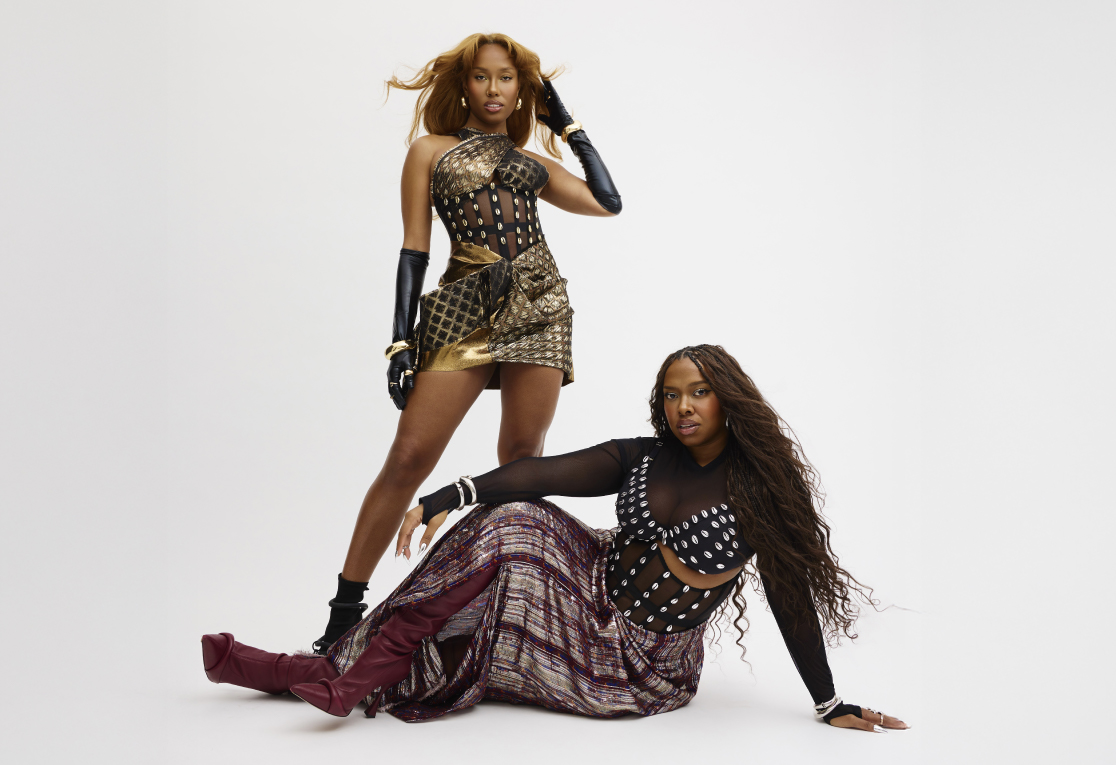
Photograph by Claudia Hershner
Models: ASHA AMA, Ayan Ama Daniels Urbanska
Makeup: Kelly Schroder
Asha’s Hair: Mia Shareese
Ayan’s Hair: Diamond Taylor
Now based in Brooklyn, Cincinnati native ASHA AMA Bias-Daniels has gotten her flowers from all corners of the fashion and art world. From her multiple appearances in the Project Runway franchise to being named the 2021 Taft Museum Duncanson Artist-in-Residence to creating BLINK’s first ever runway show, Daniels has done it all. We sat down with her to discuss her style journey, love of couture, career hardships, and the space she’s trying to curate in the fashion world.
How did you get into design?
Ever since I was a kid, I’ve always loved fashion. But I grew up the daughter of two blue-collar workers in Avondale. I loved being creative. I learned to sew when I was probably 10, because my mom used to sew and design her own clothes and design clothes for me and my sister. But I never thought it was a serious thing that I could do. I had a teacher [at St. Ursula Academy], Allison Probst, who I took a design class with, and she just so plainly put it, like, “You’re a fashion designer.” I’m thinking I’m gonna go to college to be a lawyer or doctor or something and she just kind of opened a whole new world for me. Her husband at the time was the dean at DAAP, and so she made me promise to go do a tour. I went, and I liked it, and the rest is kind of history from there.
How would you describe your design style?
I design for the baddies—the strong women who have a mix of femininity but also don’t take any shit. They’re bold, they walk in a room and everyone’s head turns. I like to say I design pieces that remind us of who we are, and it’s really for people who are strong and bold and willing to take life by the horns and make it their own.
How did you develop your style over time?
I am such a lover of the 1970s. My parents had loads of Jet magazines from the ’70s. I think that was their heyday. I was born in 1988 but they kept that ’70s spirit to them to this day. That really was the age of Black glam. Diana Ross, big hair, diamond sparkles, Bob Mackie, Cher, that kind of thing always has appealed to me. In more recent years in fashion, it’s been quiet luxury, which is basically boring clothes. I have always said that it could be everyone’s last day on earth, and I would have a sickening outfit for it.
And then in present day, I love Beyoncé, I love Orlandria from Love Island, and what they’re doing with style now. I think my favorite fashion movie when I was a kid was Coming to America, which is very Afro-centric, but that, once again, is a nod to my parents, being raised in a very pro-Black era, and my dad gave us African names. That is always built into whatever I make, that pride and sense of self, but also pride in being a woman and being glamorous.
What are your favorite things to design and make?
I love to design a custom piece for a woman who is not afraid of fashion. That is my favorite thing. There’s always going to be metallics, always embellishments. Couture is my first love in fashion. When I was in college, I had done a bunch of different internships, and when I finally got to Marchesa, which was a couture brand that was nowhere on DAAP’s radar as far as co-ops go, I had to reach out and make that connection myself. That’s where I truly fell in love with fashion and the artistry of it. And I feel like my introduction to fashion was very naive. I didn’t really know the designers. I just knew what I liked, and I learned from my mom.
Couture is where I truly fell in love with the artistry and not being practical. That was my number one critique in DAAP. People would be like, “This is beautiful, but where would someone, actually wear this?” And I’d be like, “To the Met Gala, to a photo shoot, a music video shoot, on tour.” I’ve just never been interested in designing for this world. I’ve always just had my head in the clouds, so to speak.
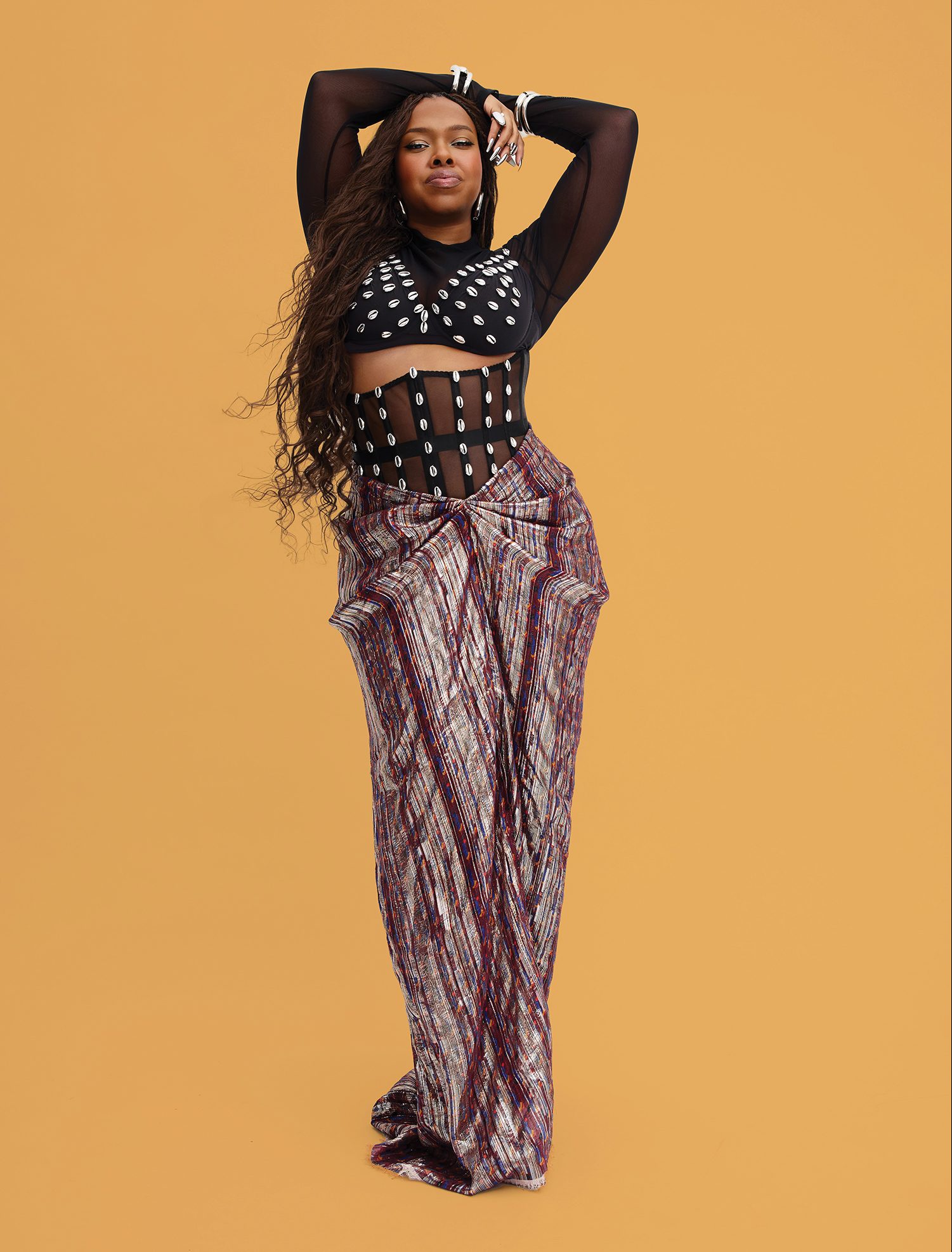
Photograph by Claudia Hershner
Is there a piece that you’ve made that’s your favorite?
My little sister, who’s modeling for me, was my first ever model when I used to hand sew, before my mom taught me how to machine sew. I used to hand sew pieces for her from scraps and make her model them. So I’m blessed that she still models for me to this day. She got married recently, and I made her a few looks. I think my favorite is her reception look. It looked like she was from the ’70s. It’s got gold beaded fringe, it’s a short dress, she looked like she just like emerged from the waters of Tulum and was a mermaid that came to party. It looked really fabulous.
What was your experience like as a Project Runway contestant?
When I interned at Marchesa that was kind of my a-ha moment that I was talented enough to do this. As an intern, I designed their showpiece for their couture collection, which was unheard of. The woman who hired me wasn’t even allowed to talk to the owners, and during my first of two co-ops there, I was working in the studio with them personally. That was the springboard that made me realize I didn’t want to work for anyone else. So, while I was ending my final semester at DAAP, I got an e-mail asking me to audition for Project Runway. Being a free spirit, I was like, Hell yeah, let’s do it! I auditioned. I made it to the final round and didn’t get chosen for that season. Then they called me a few months after and were like, “We got greenlit for a special season, Project Runway: Under the Gunn. Can you do it?” I was like, absolutely. Then they invited me back for Project Runway All Stars.
I’m thankful for the experience, but reality TV is not for the faint of heart. It is honestly torture. You’re being recorded 24/7, you’re being manipulated, gaslit, tested. You could have the most beautiful piece walk down the runway and if it works for the drama of that episode, they will rip it apart and make you think that you know nothing. I was blessed enough to go into it like I love reality TV, so I knew the type of shenanigans that could happen. I knew I didn’t want to embarrass my parents, and I just wanted to make everyone proud. I was blessed enough to have that foresight. The producers didn’t really mess with me, but it was pretty traumatic. I think I still have PTSD from it, but I’m grateful I did it. One of the things I’m most proud of is that I won both celebrity challenges on both seasons, and the celebrities actually wore my pieces. To me, that was the most validating thing. It set me up to know that this is what I was meant to do, but it honestly also threw me into a really tough mental space. I’m old enough now where I can appreciate it, but at the time, it was a lot.
How were you affected by your tumultuous experience with Lizzo?
It started off as something so beautiful, [and] it ended terribly. When I look back through the whole situation, at the beginning of it I was coming off doing a fashion show to benefit the LGBTQIA+ community in Boston, and my mentor asked me to take over this Lizzo project. I was happy to do it. I stepped in and I really made a miracle happen. They had, like, 10 plus size dancers and they needed two outfits each in a little over a week, which was unheard of. I wasn’t living in New York at the time, so I was able to sleep in my sister’s office, set up shop, use my friends who I had connections with from college, who lived in New York, to get a lot of seamstresses in house. I basically stayed up 24/7 and got it done. Her team was super grateful, and that led to more design work. Ultimately it led to them saying, “Asha, please come on tour with us. We need someone to look over the wardrobe you created.” I did. I’ve lived through some pretty toxic experiences between Project Runway, DAAP, everything in between, and I tell you it was the most toxic work environment I’ve ever been in.
Part of why I signed up to do it was everything that Lizzo stood for. Black women empowerment, plus size women empowerment, all these things I stand behind as well. I really just naively thought the environment would reflect that, and it couldn’t be more opposite. I was honestly in fight-or-flight mode every day, but I stayed there to be protective of the Black women that she had on tour, her dancers, her opening act. And I’m proud of myself for sticking it out. I almost sent one of the young women that I mentor in place of me because I wasn’t interested in going on tour. I’m grateful I did it instead of them, and I am proud to be where I am in my journey and my career, where I know better and I am strong enough to speak up for myself and for other women and not allow us to be treated that way. It’s bittersweet. It’s reminded me that I have a community of women who have really supported me and have championed me.
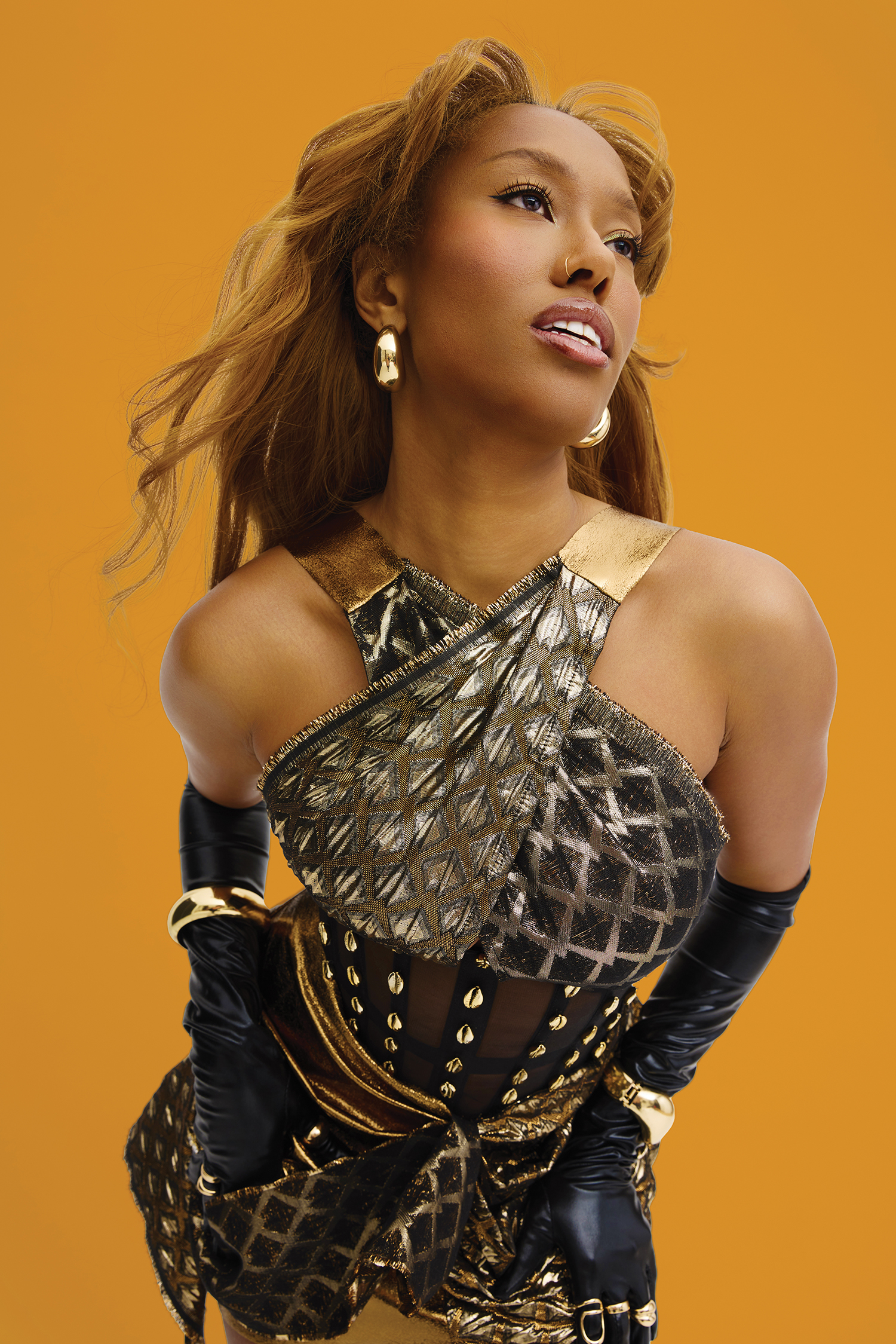
Photograph by Claudia Hershner
So you’re based in New York now but you’re still active in Cincinnati?
I’m in Brooklyn, but you know, Cincinnati has my heart. I’m here all the time for work.
What is it like to be recognized by so many local institutions like the Ballet, BLINK, and the Taft with the Duncanson Program?
It’s such an honor. I’ve had this journey of being a little girl who didn’t feel like she belonged in fashion and didn’t feel understood, or that I knew how to pronounce the names or set the trends. Then I left and came back to everyone getting it and really giving me my flowers. And it’s honestly been a true blessing. I feel like my home really understands who I am. More important than even just the fashion, Cincinnati has really gotten behind my mission to just bring pride to people. It’s not just about a trendy, cute moment. It’s about empowering the people who wear it and the people who see it and the people who come to the museums or the fashion shows.
Is there anything else that you want to say about the fashion world?
I hate this idea that fashion has to be this catty, mean-spirited thing. I really am happy to have my own table that I can sit at and create my own fashion world. I don’t have to play the game that I did when I was in college in my early 20s. I just want to encourage people to create safe spaces for each other, specifically women, specifically the queer community, specifically people who are usually on the fringes. We all have a home because fashion is really about what’s different. So often what’s different about us is co-opted into being a trend, but we can’t participate in what we created.
I want to see fashion turn into a safe space for people that are different. It might not look like fashion has always looked, but guess what? It’s really boring, and that’s why the old-fashioned model isn’t working. I hope more young people learn to speak up for themselves, do their own thing, realize they don’t have to follow the rules. If they are working for someone else, I hope they have enough strength in a support system to not allow themselves to be abused in those spaces.