



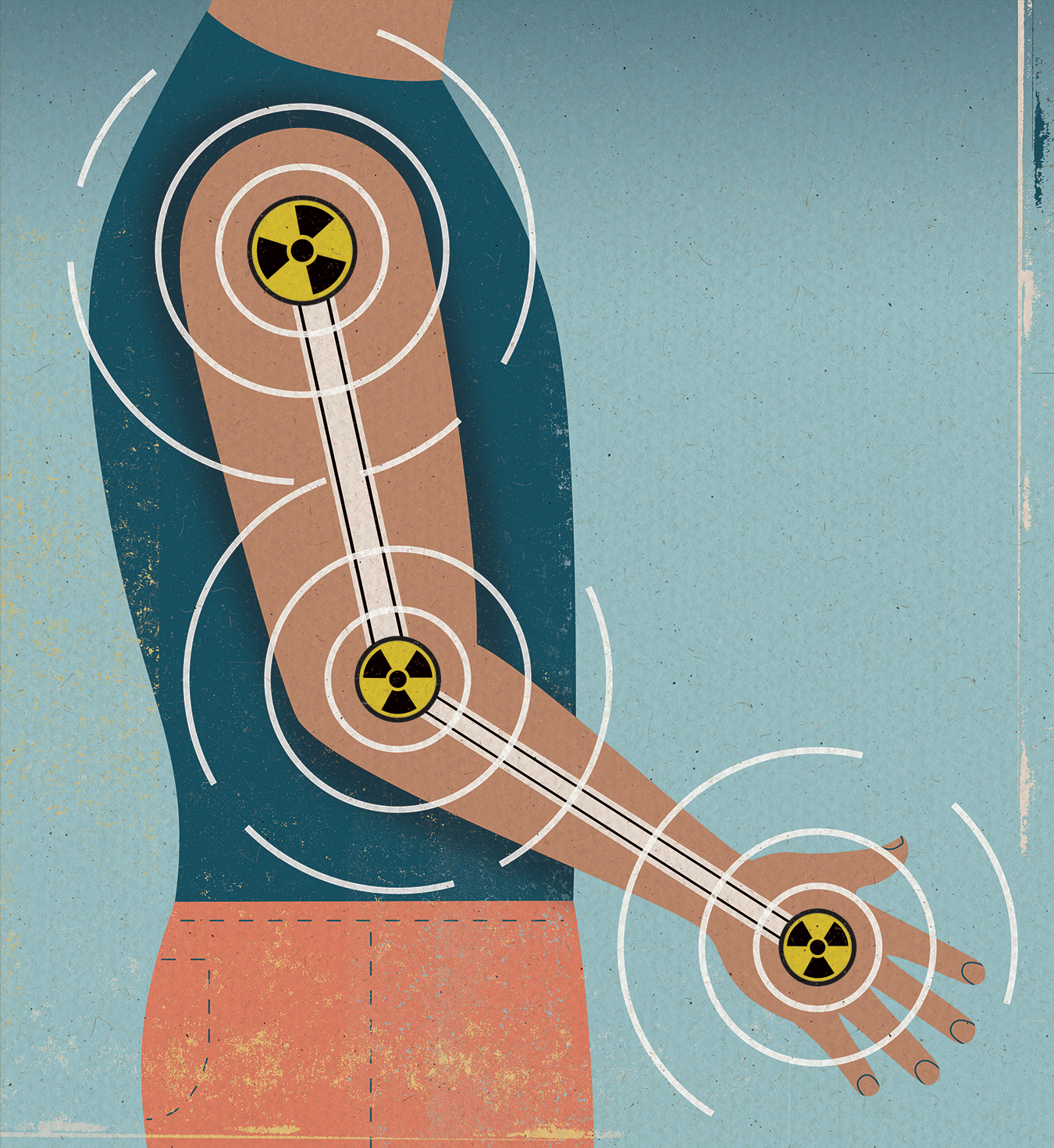
Illustration by Blair Kelly
While we’ve all woken up with an inexplicably sore neck or back pain, osteoarthritis is something completely different. It’s the most common form of arthritis, or joint pain, in adults, resulting from the chronic breakdown of cartilage between bones and leading to inflammation. In severe cases, the cartilage erodes away completely, resulting in “bone on bone” pain in a joint.
Osteoarthritis is usually diagnosed by a primary care physician and often involves X-ray imaging to zoom in on joint space narrowing and bone spurs in order to diagnose and develop a treatment plan. That’s historically included weight loss and physical therapy, with other common treatments (anti-inflammatories, pain relievers, and steroid injections) targeting symptoms rather than the underlying cause, says Timothy Struve, M.D., UC Cancer Center radiation oncologist and associate professor of radiation oncology at the University of Cincinnati College of Medicine. “Eventually, joint replacement surgery may be needed,” he says.
Struve says that radiotherapy has been used to treat osteoarthritis since just after the discovery of X-rays in the late 1800s, but it hasn’t been common practice in the U.S. until recently. In Europe, meanwhile, Low-Dose Radiation Therapy (LDRT) for conditions like osteoarthritis constitute about a third of patients in radiotherapy departments. Struve claims the reasons for the different approaches are complex and might relate to U.S. insurance coverage, but he also says, “Germans don’t seem to share the same ‘radiophobia’ that Americans do. Over time we’ve learned that high exposure to radiation is potentially very harmful, which, combined with the arrival of atomic weapons, understandably caused radiotherapy to fall out of favor with the American public.”
Americans are becoming more open to unconventional medical treatments these days, says Bailey Nelson, M.D., UC Cancer Center radiation oncologist and assistant professor of radiation oncology at UC’s College of Medicine. She and Struve are leading a new program at UC Health to study LDRT’s impact as a noninvasive treatment for osteoarthritis symptoms that’s more robust than oral anti-inflammatories but less invasive than steroid injections and surgery.
LDRT isn’t a first-line treatment, says Nelson. “We meet patients in consultation to make sure they’re appropriate candidates for LDRT, and if it’s recommended the patient will then have a CT simulation, or planning CT scan, where we create a personalized immobilization device for the affected joint to ensure limited movement and reproducibility during the radiation treatments.”
Once the treatment plan is designed and approved, the patient will receive six radiation treatments delivered twice weekly on non-consecutive days. “Door-to-door, the patient is in the Radiation Oncology department for about 20 to 30 minutes, but the treatment itself is quick and painless,” says Nelson.
There’s still skepticism surrounding LDRT, of course, but the groundwork has been laid, especially as patients see positive results. From missed work to chronic pain, osteoarthritis can have a profoundly negative mental and physical effect on quality of life. “One of the primary missions of any physician is to reduce the suffering of our community members,” says Struve. “Osteoarthritis causes a great amount of unnecessary suffering, and patients are looking for alternatives to medical therapies and surgery. I hope low-dose radiotherapy can help fill that gap here in Cincinnati.”