



Photograph courtesy collection of the Smithsonian National Museum of African American History and Culture
Ten years after Louis Daguerre revealed his process of exposing a chemical-embedded plate to light to create photography, a young man named James Presley Ball brought a daguerreotype camera to Cincinnati. J.P., as he called himself, had learned the inventor’s process in Virginia.
Ball, a free man of color, opened a one-room photo studio in Cincinnati in 1845, but the business soon folded. He honed his skills as an itinerant daguerreotypist, travelling throughout Ohio and Virginia before making his way back to Cincinnati in 1849. This time, he made a big splash.
With business partners and family members, Ball opened at least 10 studios in downtown Cincinnati, employing a whole team of Black artists. On the border that delineated bondage from freedom for 4.4 million enslaved people, he rose to prominence as one of the greatest photographers in the West. Cincinnati was a major hub on the Underground Railroad, and Ball used his camera to support the abolitionist cause.
“Cincinnati was the sixth largest city in the nation at that point and growing tremendously,” says Theresa Leininger-Miller, an art historian and professor in the University of Cincinnati’s DAAP program. It also became a hotbed of early photographic innovation. In 1848, the year before Ball’s return, photographers Charles Fontayne and William S. Porter made an eight-plate panorama of the Cincinnati waterfront that many have called the “Mona Lisa of daguerreotypes.”
Cincinnati of the mid-19th century could be volatile, with pro-slavery mobs attacking the homes and businesses of abolitionists. While Ball was born to free Black parents, “he had to have papers saying that he was free,” says Leininger-Miller, who has cabinets of files tracking Ball through historical records and newspapers. For example, he was in Virginia in December 1847 in order to register his certificate of freedom.
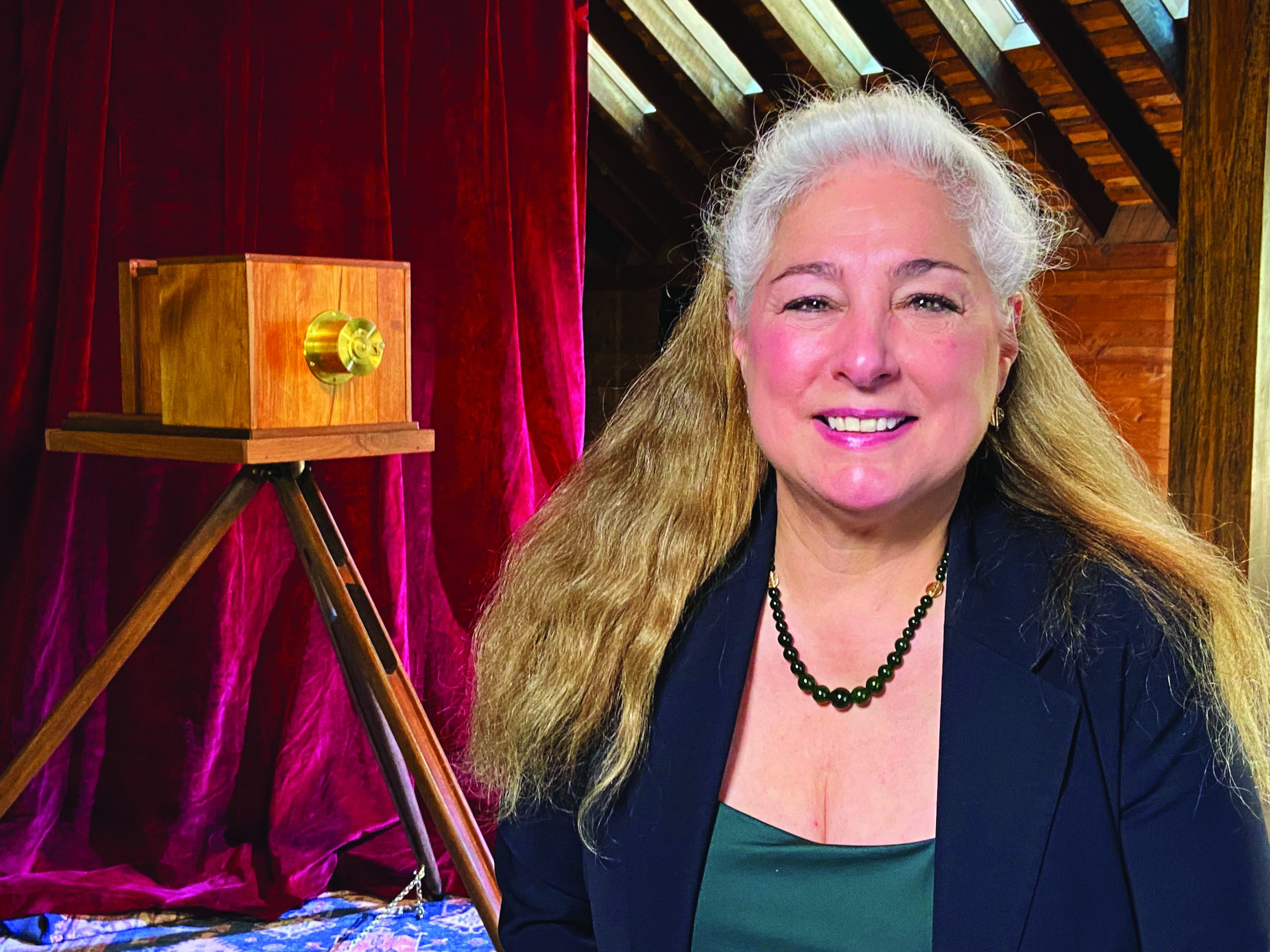
Leininger-Miller’s fascination with Ball began while she was working on a Yale University doctoral dissertation about African American artists in Paris. At the Schomburg Center for Research in Black Culture, she befriended Deborah Willis, author of the 1993 book J.P. Ball, Daguerrean and Studio Photographer, credited with reinvigorating interest in him. But Willis hadn’t come to Cincinnati to research Ball, so when Leinenger-Miller returned to Cincinnati for a job at DAAP she thought, Well, cast down your bucket where you are. I should see what’s here.
She was soon integrating Ball into her UC curriculum, writing and lecturing on his work. She visited everywhere Ball lived: Mississippi, Louisiana, Minneapolis, St. Louis, Montana, Seattle, Honolulu, and London. Yet, despite the hundreds of images he left, Ball remains enigmatic. “The problem is that there’s no collective body of his papers and there’s no correspondence,” she says. “What we know mostly comes from newspapers, which can sometimes be false and misleading. So no matter what’s published in the papers, you kind of have to take it with a grain of salt.”
Photograph courtesy Theresa Leininger-Miller
On top of that, there was only one known photograph of Ball himself, published in Esther Hall Mumford’s Seattle’s Black Victorians: 1852–1901. The image is grainy, but he’s balding and light-skinned with a flowing beard fastidiously groomed. That’s the image on which illustrator Taron Jordan based the ArtWorks mural tribute to Ball on Race Street between Fourth and Fifth, close to where the prodigious artist, entrepreneur, and activist operated his photo studios.
The mural, last time I biked past, was slightly defaced. Ball’s name is crossed out and replaced with the question “Where?” That feels apropos, given the mystery surrounding an artist who—despite leaving hundreds, perhaps thousands of images—remains an elusive and restless figure.
Interest in early Black photographers has spiked in recent decades, with collectors and museums seeking out work by Ball and his peers. In 1992, a rare 1850s Cincinnati street scene by Ball sold to a private collector for the then-record price of $63,800. In 2021 and 2023, the Smithsonian American Art Museum acquired collections centered on Ball and his contemporaries, Glenalvin Goodridge and Augustus Washington. The museum also hosted an exhibition in 2023 exploring Ball’s collaboration with Cincinnati-based landscape painter Robert Seldon Duncanson, considered one of the most important landscape painters of the era. Duncanson and other artists worked in Ball’s studios, adding touches of color and gold to photo portraits.
Beyond their rarity and beauty, Ball’s images bear witness to a taken-for-granted aspect of our Instagram age: the photograph’s ability to change the viewer. At its dawn, the medium had profound social, cultural, and psychological implications for those who couldn’t previously afford painted portraiture. Ball and his contemporaries gave their subjects new agency over their own image, which was especially strong for Blacks who had endured centuries of negative imagery designed to justify and perpetuate their subjugation.
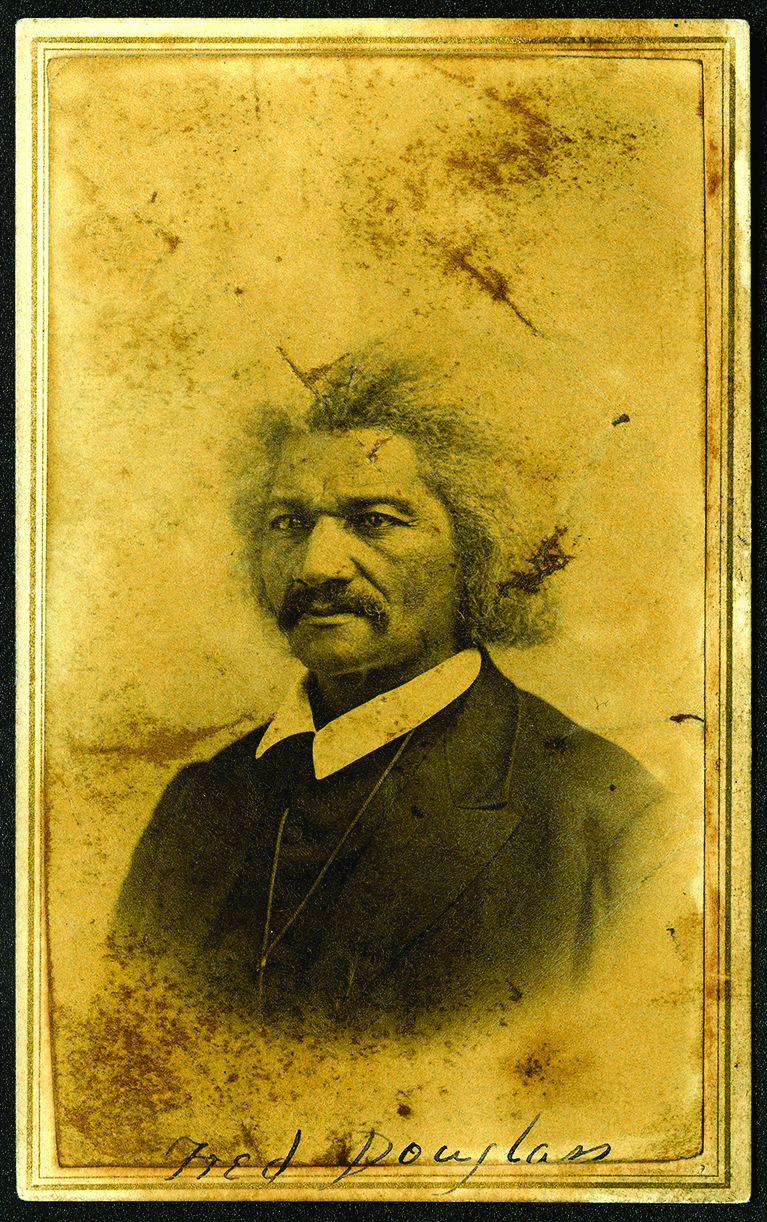
The most photographed man of the 19th century, Frederick Douglass, gave eloquent voice to this influence in lectures about photography, the first of which he delivered at Boston’s Tremont Theatre a year after being physically assaulted on its stage. “The humbled servant girl whose income is but a few shillings per week,” writes Douglass in that lecture, titled Pictures and Progress, “may now possess a more perfect likeness of herself than noble ladies and court royalty.”
Photograph courtesy collection of the Smithsonian National Museum of African American History and Culture
An 1855 Cincinnati directory puts Ball’s home address at the Dumas House on Fourth Street, where Western & Southern is today. The Black-owned hotel was “station number 1” on the Underground Railroad. Business partners included Ball’s brothers; his brother-in-law Alexander Thomas; and Robert Harlan, who was born enslaved, made a fortune in the gold rush, and became a civil rights activist and politician.
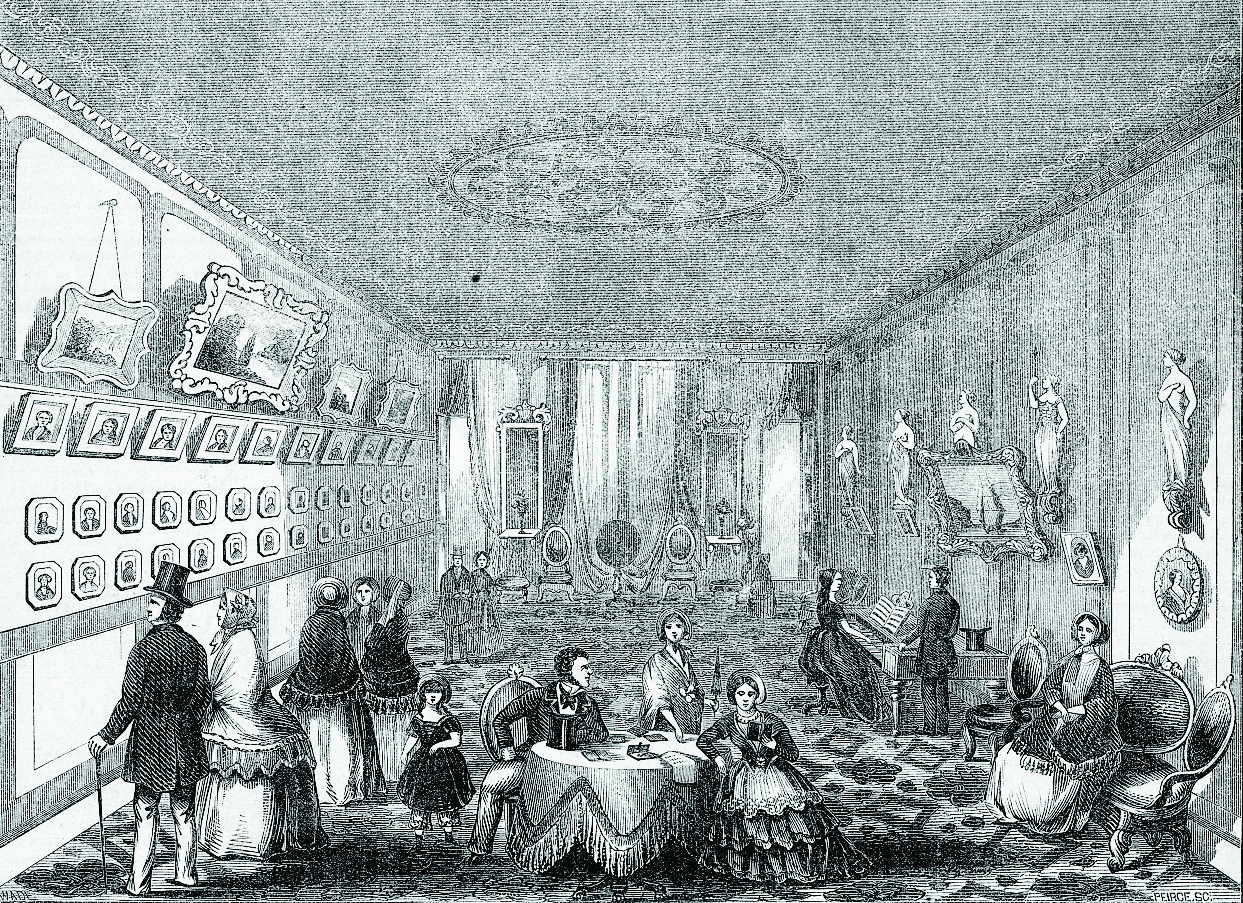
On New Year’s Day 1851, Ball opened his grandest enterprise, a magnificent three floor studio-gallery at 30 W. Fourth St. The building’s footprint sits under the long, skylit atrium of what is now the Mercantile Apartments. Fire insurance maps show that building had enormous skylights too, essential for taking photographs in those years before electric light.
Ball’s Great Daguerrean Gallery of the West epitomized his knack for marrying opulence with affordability. The April 1, 1854, issue of Gleason’s Pictorial Drawing Room Companion describes how guests would enter a gallery with flesh-toned walls “bordered with gold leaf and flowers” and hung with statues of goddesses and hundreds of daguerreotype portraits, including one of the Swedish Opera singer Jenny Lind. There were vistas of Niagara Falls and paintings by Duncanson. One studio was fitted for taking pictures of infants and children.
The 1850s and ’60s saw rapid developments in photographic technology. Metal and glass plate daguerreotypes, ambrotypes, and tintypes were followed by much more affordable albumen prints on cardboard or paper. The first mass-produced photos, or “cartes-de-visites” (calling cards), became popular in the 1860s and sold in the millions to Civil War soldiers and their loved ones.
The Cincinnati Museum Center holds one of the nation’s largest collections of studio portraits by Ball and his business partners, says Arabeth Balasko, the museum’s curator of photographs, prints, and media. They have “the Ball family album,” she says. “We have J.P.’s brother Tom and his father. We have his mother, who they called Grandma Ball, and his sister. We have his brother-in-law. We have his nieces and nephews.” The collection is a who’s who of Cincinnati history. There’s Ben Piatt in a Union soldier uniform. UC President Robert Buchanan is there, as is General William Haines Lytle and a young William P. Devou. There are abolitionists and those sympathetic to the cause, including Timothy Day Crane and Mary Matilda Bates Wood Laboiteaux, whose family was involved in the Underground Railroad.
In the preface to Levi Coffin’s memoir there’s mention of a cherished group portrait by Ball. Coffin, known as the “Reputed President of the Underground Railroad,” stands shoulder-to-shoulder with abolitionists William Brisbane and Edward Harwood. In an another image, Mr. and Mrs. Coffin share the frame with the Reverend Henry M. Storrs and 10 unnamed “Escapees to Freedom on the Underground Railroad.”
Equal parts artist, entrepreneur, and activist, Ball had a bit of the showman about him à la P.T. Barnum, another of his famous subjects. In 1855, he plowed some of his profits into a panorama of his own, Ball’s Splendid Mammoth Pictorial Tour of the United States, a 2,400-square-yard canvas that scrolled before viewers, displaying scenes of the passage of African Blacks into enslavement in “the land of the free and home of the slave.” But no photographs of the massive painting survive. “How could such a massive painting disappear?” says Leininger-Miller. “How could there not be photographs or prints of it at least? I mean, that’s mind-blowing to me.”
After being shown in Cincinnati, Ball’s panorama made its Boston debut on April 30, 1855. In November, William Cooper Nell advertised it for sale at the address of the Massachusetts Anti-Slavery Society. Did he find a buyer? Are fragments languishing in some attic? We don’t know.
And then there’s the mystery of photos Ball was said to have taken, while living in England in 1856–57, of Charles Dickens and Queen Victoria. One of his daughters was born in London and was named Estella Victoria, he said, after the abolitionist-minded monarch. American newspapers printed that The London Times reported Ball had photographed both, but the portraits have never surfaced.
While much about Ball remains shrouded in mystery, his support of fellow Black artists shines through. Ella Sheppard came to Cincinnati around 1860 fearing re-enslavement following the death of her father, who had purchased her freedom. She went on to become a founding member of the seminal Fisk Jubilee Singers, who made important strides in popularizing Black spirituals with white Northerners. When Sheppard’s family arrived destitute in Cincinnati, Ball “adopted” her, she said, and “offered to give me a thorough musical education, with the understanding that I was to repay him at some future day.”
Photograph courtesy Cincinnati Museum Center
In the 1860s, Ball went bankrupt in Cincinnati, possibly due to some failed investments. A Cincinnati Enquirer article from October 8, 1862, reported that Ball’s wife, Virginia, from whom he had been separated for several months, attacked a girl in his studio “with whom Mr. B. is charged with being unusually intimate.” When Ball tried to stop her, Virginia drew a knife and cut him above his temple.
Ball moved south. In Greenville, Mississippi, he was nominated as president of the Board of Supervisors of Washington County at the 1871 Mississippi Republican convention. Two years later, though, he and his son were implicated in a scandal and he was sentenced to three years in prison; his son fled to Vidalia, Louisiana, where he actually worked for the local courts. It’s unclear whether Ball served that entire three-year prison term. He rejoined his son in Louisiana. Tragedy visited the Ball family in 1882, when two young women in the family, newly married, one with her 6-week-old infant, perished when a steamboat burned and sank, killing 21.
From there the Balls moved to Missouri and then to Minneapolis, where he was the official photographer of the 25th anniversary of the Emancipation Proclamation. In October 1887, they moved westward to Helena, Montana, where Ball—with his son, daughter, and daughter-in-law—opened a studio. There he photographed civil leaders, immigrants, and pioneers, many of them Blacks forging new lives on the frontier.
Ball continued to be active in politics and civic affairs in Helena and was a founding member of the city’s AME church. There’s a lightness and optimism to the photos Ball took of frontier strivers and up-and-comers, though he also documented several executions, including that of William Biggerstaff, a Black man who pleaded self-defense for killing someone. Ball was involved in a clemency campaign to save Biggerstaff. When he went to the gallows, Ball created a haunting triptych of his execution.
In 1900, Ball followed his son to Seattle, where J.P. Jr. had opened photography studios and established a law practice. The elder Ball kept active in civic affairs, but his health declined. Perhaps seeking relief for his severe rheumatism, the family relocated to Honolulu, Hawaii, where they opened a studio in his home. Ball died there in 1904 at the age of 79.
Looking back on his life’s work, there is an immediacy to Ball’s portraits and an unusual casualness to his subjects. They seemed to feel right at home before his camera, these faces that lived through turbulent years.
Despite his own flaws and falling afoul of a flawed system, Ball seems to have had a sort of faith in America. A newspaper story recounts an episode from his Cincinnati years in which Ball gave a toast, a rare instance of his words being set down. It was a meeting of the Lincoln Memorial Club commemorating the 62nd anniversary of President Lincoln’s birth. Ball’s younger brother, who was president of the club, and his brother-and-law, Alexander Thomas, also spoke to a room that included luminaries of Cincinnati’s Black community such as Peter H. Clark and civil war hero Powhatan Beatty. When it was Ball’s turn to toast “the great emancipator,” he said, “The American Flag, the banner of beauty and glory. Beautiful ever to the loyal sons of the Republic, hateful only to traitors. It has seen dark hours, may see them again; but ever at the darkest moment there will rise again some Sheridan to save the day.”
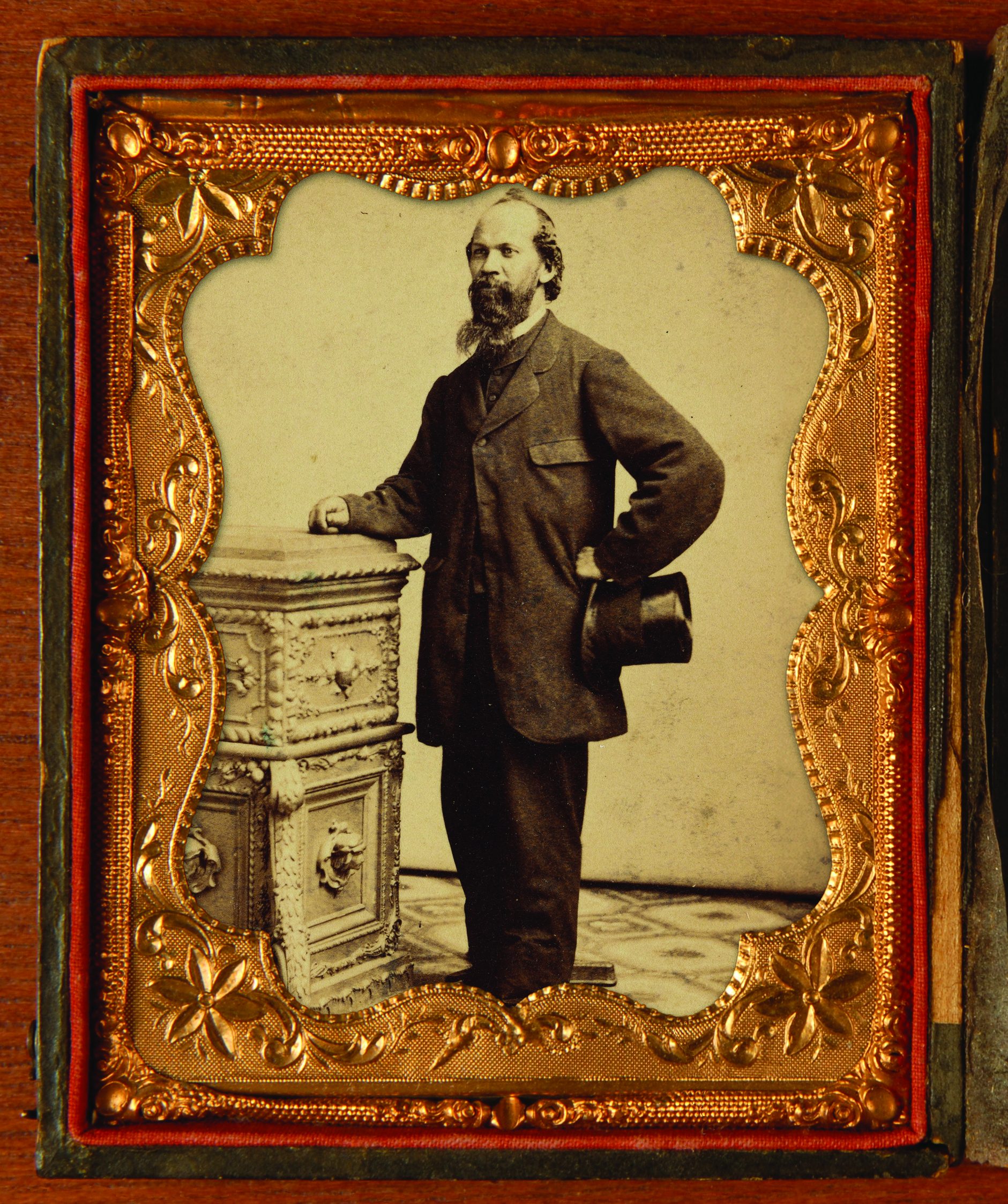
A second photograph of J.P. Ball surfaced in a March 2023 auction by Swann Galleries. While Swann respects the confidentiality of its customers, the company passed along a message to the buyer conveying my interest in the whereabouts of this “new” Ball portrait. I expected no response but got an e-mail from Doug Remley at the Smithsonian’s National Museum of African American History and Culture in Washington, D.C. Nicknamed the “Blacksonian,” the museum acquired the photograph—and Remley sent me high resolution scans of the image and a detailed description.
It’s a print of albumen and silver nitrate, a 3.5-by-2 inch cardboard carte-de-visite portrait. Ball stands at an angle to the camera, looking off into the distance with a glint in his eye. Wearing a dark frock coat, he holds a jaunty stovepipe hat against his hip. His hand rests on an ornate column, and the hand is closed. I wish I could see his fingers. Behind his feet you can just make out the iron brace used in many 19th century photographs to hold subjects steady for the long exposures early photography required.
The image, attributed to “J.P. Ball & Son,” was, according to Swann Gallery website, expected to net between $6,000 and $9,000 but instead went for $125,000. The calling card is signed on its reverse in flowing, dip-pen script: “Respectfully J.P. Ball.”
One hundred and seventy years after introducing photography to Cincinnati, Ball is still finding ways to surprise us.