



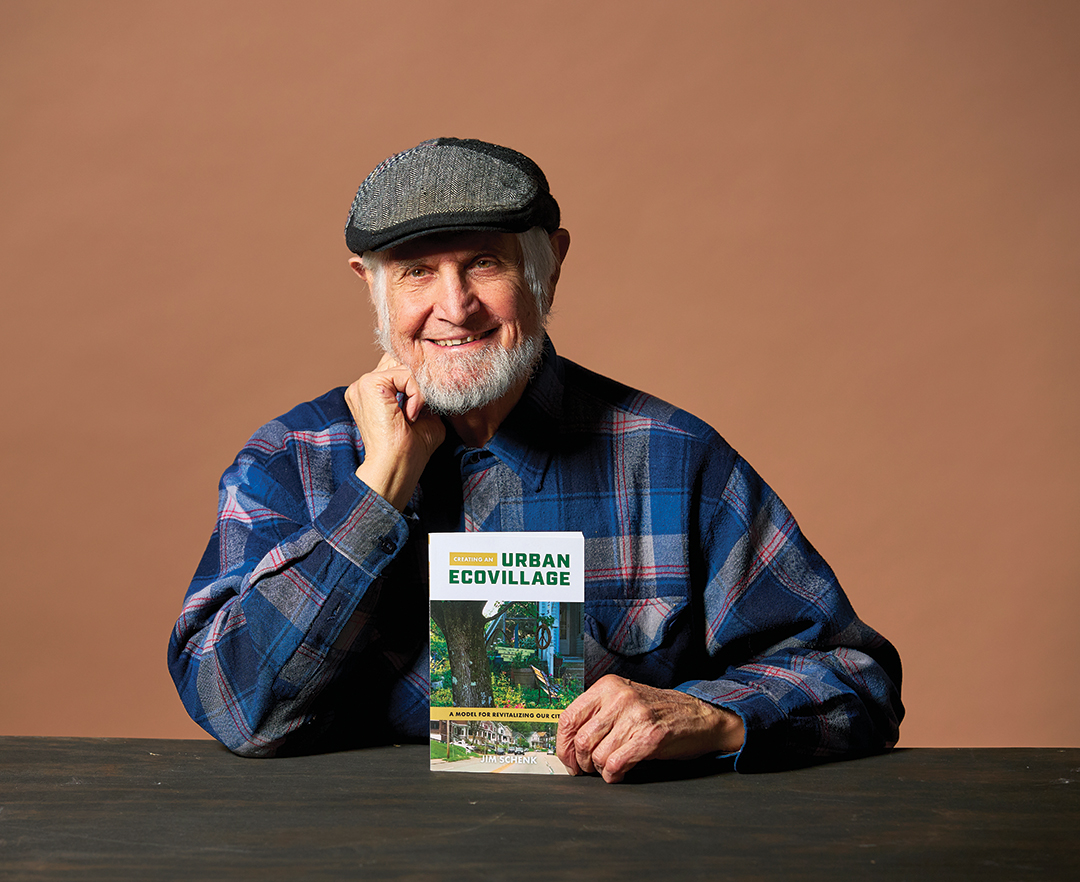
Photograph by Andrew Doench
If there’s one notion central to homesteading, it’s the idea of growth—growing food, growing stronger, growing self-reliance. But what too often gets lost in our era of hyper-individualism is how critical it is to grow community when pursuing sustainability.
Growing together is central to East Price Hill’s Enright Ridge Urban Ecovillage, officially founded in 2004 when residents of Enright Avenue decided to join forces to pursue ecological living. According to Jim Schenk, cofounder of Imago and Community Earth Alliance, the idea had been percolating for years before actually taking root. “Imago had written a grant in 1998 to develop an ecovillage in a different part of Price Hill,” he says. “Then basically one morning I woke up and said, Huh, Enright Avenue is not too large.” Schenk invited 25 people to meet and discuss the idea. “Nineteen people came, and in one evening we started an ecovillage.”
According to longtime resident Deborah Jordan, who publishes the Central Ohio River Valley [CORV] Local Food Guide, the foundation was already set for such a move. “A number of people were living here because they were interested in ecological community,” she says. “Most people were gardening already, and we support each other. The vision of extending it and organizing it just really helped further the dream.”
The ecovillage grew quickly, and today Schenk estimates there are about 250 people living in it. A committee of residents used to run a community-supported agriculture program while others worked to rehab neighborhood houses using as much recycled material as possible. The community scaled back initiatives in recent years, though Schenk notes previously launched rainwater and solar panel projects. “We’re working on pulling it all back together again,” he says, adding that the ecovillage model has never been more important. “Research I’ve done is saying that community is going to be essential in the future in order to survive. We’ve started a resiliency group to look at how we can support each other as we go along.”
Jordan says the community’s emotional and material support is critical. “There are a lot of homesteaders in our neighborhood, and we support each other,” she says. “A lot of people have alternative yards, and a lot of people garden.” Schenk adds that residents also keep sheep and chickens.
If all of this activity makes you want to move to Price Hill, you aren’t alone. While the ecovillage’s popularity means houses rarely become available, Schenk encourages people to implement ecovillage concepts where they live. He’s even written a book, Creating an Urban Ecovillage: A Model for Revitalizing Our Cities, to help folks get started. “If you have two or three other families who have similar values, pull them together,” he says. “Call yourself an ecovillage and just do it.”
“Sharing food is big, too,” says Jordan. “Sharing a meal is a good way to get informal conversation going. Or invite neighbors to come to a presentation that might interest a few of you. Just start getting together.”