


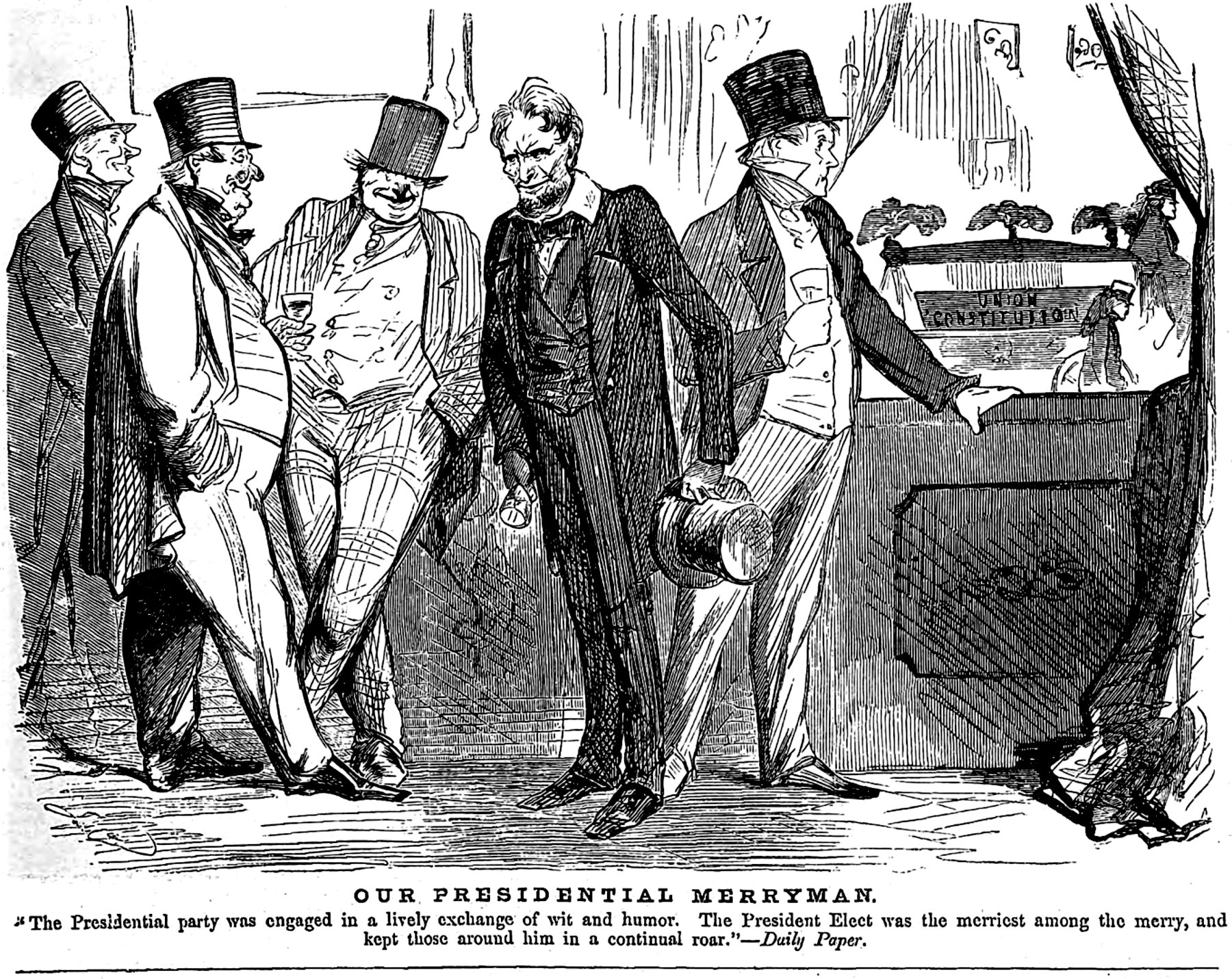
From "Harper’s Weekly", March 2, 1861
Abraham Lincoln arrived in Cincinnati on his birthday, February 12, 1861. He was traveling to his inauguration as President of the United States. According to some accounts, Lincoln barely escaped death in the Queen City.
The election of 1860 was the most contentious in United States history, conducted under the certainty that Civil War was inevitable. Although Lincoln won the election by carrying 18 of the 33 states, he earned less than 40 percent of the popular vote. It is no coincidence that those 18 states were the only non-slave states in the union. Lincoln did not carry a single one of the 15 states that allowed slavery.
Lincoln’s victory was assured by platform debates that ripped the Democratic Party into two competing factions. The Northern Democrats nominated Stephen Douglas, who had defeated Lincoln in the race for Illinois’ U.S. Senate seat, while the Southern Democrats nominated John C. Breckenridge, the sitting Vice President. The remnants of the defunct Whig and Know Nothing parties cobbled together a Constitutional Union Party and tossed a fourth candidate into the race, former Tennessee Senator John Bell.
Although Lincoln won the election, it was obvious his presidency would be tumultuous. South Carolina announced a month after the election that it planned to secede from the United States. Before Lincoln took the oath of office on March 4, 1861, Mississippi, Florida, Alabama, Georgia, Louisiana and Texas followed suit.
Although it officially remained neutral throughout the war, Kentucky teetered on the brink of secession. The president-elect reportedly said, “I hope to have God on my side, but I must have Kentucky.” Lincoln was disappointed that his route from his home in Illinois to the inauguration in Washington did not pass through the Blue Grass State, but he prepared two speeches expressing his devotion to Kentucky, the state where he was born. One was to be delivered at Lawrenceburg, Indiana, and one in Cincinnati – two stops from which he could see Kentucky across the Ohio River. According to Ted Widmer, author of “Lincoln on the Verge: Thirteen Days to Washington” (2020), the Kentuckians who crowded around Lincoln in Cincinnati were highly suspect:
“[Lincoln’s Secretary John] Hay noted that ‘a large number of Kentuckians are here,’ and that some, ‘dark of aspect,’ gathered in groups and scowled darkly.”
If some Kentuckians actively opposed Lincoln, parts of Ohio—notably Cincinnati—were little more than lukewarm. Lincoln carried Hamilton County, but barely, with less than 50 percent of the vote. The Cincinnati Enquirer was blatantly anti-Lincoln and pro-South. On the day Lincoln’s train rolled into the Queen City, the Enquirer trashed the speech he had given the day before in Indianapolis:
“The comparison he drew between himself and Washington was in most execrable taste. Washington and Lincoln! A hyperion and a satyr! Washington helped make the Government; Lincoln, we fear, has been the instrument of its destruction.”
As Lincoln paraded through the Queen City and delivered his speeches from a balcony at Burnet House, a young operative of Allan Pinkerton’s detective agency rushed toward Cincinnati with dire news from the nation’s capital. Pinkerton’s agents had uncovered a far-reaching and insidious plot to prevent Lincoln from ever taking office. According to Widmer:
“The conspirators were fixated on Lincoln’s train and wanted to know every detail of its route into Baltimore. They were also eager to plan a disruption in Washington. One agent, speaking with a bartender, learned of a plan to ‘blow up the Capitol on the day that the [Electoral College] votes were counted.”
Historian Michael J. Kline explored this conspiracy in his “The Baltimore Plot: The First Conspiracy to Assassinate Abraham Lincoln” (2008). Kline reveals how America’s first private detective, Allan Pinkerton, and a separate undercover operation by New York City detectives uncovered startling evidence of a conspiracy to assassinate Lincoln during his penultimate stop in Baltimore.
There was no Secret Service in 1861. That agency did not begin its best-known role of protecting the President until 1901. Although accompanied by some military personnel, Lincoln’s personal security was provided by a self-appointed bodyguard, an Illinois friend of Lincoln’s named Ward Hill Lamon. Pinkerton and Lamon clashed bitterly and frequently. Pinkerton called Lamon “a brainless, egotistical fool,” and it’s hard to argue with that appraisal. While Lincoln was in Cincinnati, the New York Times reported:
“A queer-looking box was left at the hotel for [Lincoln] this afternoon, under suspicious circumstances, and was given to the police.”

From "Leslie’s Illustrated Weekly", March 2, 1861
Despite scowling Kentuckians, queer-looking packages and an openly hostile major newspaper, Lamon left his charge so unguarded that another reporter, unchallenged, walked right up to the very room in which Lincoln was sleeping. The journalist did nothing more than inform his readers about Abe’s shoe size by measuring the calf-skin boots, left out in the hallway to be polished, but he could have done much more, and much worse. That bit of journalistic frivolity exposed Lamon’s inability to maintain security around the president-elect.
A week after Lincoln departed Cincinnati, the Syracuse, New York, Herald [26 February 1861] broke a shocking story sourced from unidentified companions among the Lincoln party:
“We have been informed by gentlemen connected with the party of Mr. Lincoln since he left home for Washington, that there were several attempts to take his life made during the journey through Indiana and Ohio. The one which threatened the most serious consequences took place on the Presidential train leaving Cincinnati, when a grenade of the most destructive character was discovered in the car occupied by Mr. Lincoln, his family and personal friends. It was found in a small carpet bag, which had been deposited in a seat of the car by some unknown person. Attention was drawn to it from the fact that no baggage was allowed in the cars. On examination, the grenade concealed in the carpet bag was discovered to be ignited, and so arranged that within fifteen minutes it would have exploded with a force sufficient to have demolished the car and destroyed the lives of all persons in it. Of course the ‘infernal machine’ was speedily removed and properly disposed of.”
The Herald claimed that the assassination attempt had been kept secret “for reasons that may be readily appreciated” and only revealed because the president-elect had by then safely arrived in Washington. Kline, in his book, says that Lincoln’s bodyguard Lamon debunked that report as an invention “of the press’s fertile imagination.” Lamon, recall, was under constant scrutiny by Pinkerton and would, of course, have discounted the idea that he had allowed a bomb to slip past his watchful eye. Widmer, in his book, allows that the incident might have, indeed, been based in fact:
“Was Lincoln nearly blown up on the third day of his journey? To this day, the historic record presents a kaleidoscopic confusion about what, exactly, took place from moment to moment on Lincoln’s trip. Clearly no single person, including Lincoln, knew everything that was happening as the Special barreled toward Washington.”