


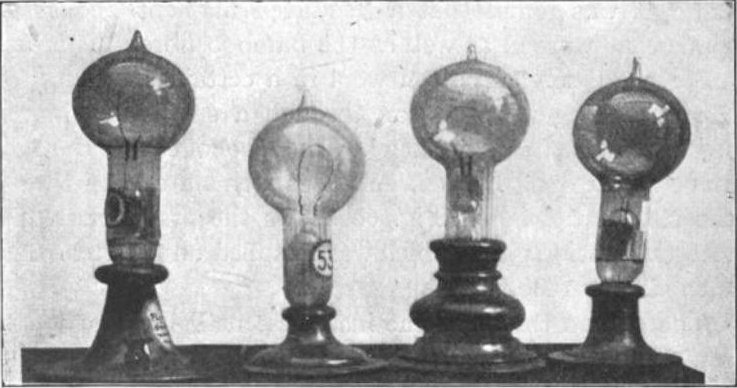
Photograph courtesy Wikicommons
Who invented the electric light? You are forgiven if you think it was Thomas Edison. The so-called “Wizard of Menlo Park” certainly made some important refinements, but did you know Edison’s patent application for the light bulb was initially rejected? The acclaimed journal, Scientific American [January 18, 1879] knew why:
“A telegram from Washington, to the effect that Edison’s application for a patent upon a divisible electric light had been rejected at the Patent Office, was published in the daily papers of November 21. The ground alleged for the refusal of the patent, says the Operator, was that Edison’s invention was an infringement upon that of John W. Starr, of Cincinnati, who filed a caveat for a divisible light in 1845.”
In other words, a Cincinnati man invented a working electric light bulb 33 years before Thomas Edison. (Edison’s patent was eventually granted.)
John Wellington Starr was born in Cincinnati around 1825. It is possible that he worked as a “soap boiler” in one of the many factories making soap, tallow and candles in Porkopolis. Scientific American reported that he manufactured “philosophical instruments” (telescopes, microscopes, surveying tools and the like) but there is no local evidence for that claim.
Starr was not yet 20 years old when he went to Washington D.C. in 1844 to file a “caveat,” or claim that he was preparing to file for a patent. From this initial filing, we can see that Starr was very well versed in experiments involving electric lighting. He specifically mentions the 1841 British patent awarded to Frederick de Moleyns, who had created a crude incandescent light using a platinum filament in a vacuum.
Among the difficulties faced by de Moleyns and other previous inventors was the need for a battery to power their light bulbs. Batteries back then were expensive, toxic and corrosive. Starr’s Cincinnati-developed light was powered by a revolutionary new electric generator designed by Starr and a Dayton-based journalist and medical student named John Milton Sanders. The Cincinnati Advertiser was enthusiastic, as reported by historian Charles D. Wrege, writing in the Summer 1976 issue of the Cincinnati Historical Society Bulletin (Volume 34, No. 2):
“According to the paper the light was operated by electricity from a magneto-electric generator, containing twenty permanent magnets, which had been designed and constructed by the two inventors. The intensity of the light was described as so brilliant that it ‘is unsupportable to the naked eye,’ and if it were mounted on a high tower a light equal to the intensity of daylight could be diffused over the city of Cincinnati.”
You heard right. Starr claimed that the entire city of Cincinnati could be illuminated by just one of his electric lights mounted on a 200-foot tower. Cincinnati never got to see the demonstration. Newspapers reported that Starr and Sanders needed 6,000 feet of cotton-insulated wire and could not get it in Cincinnati.
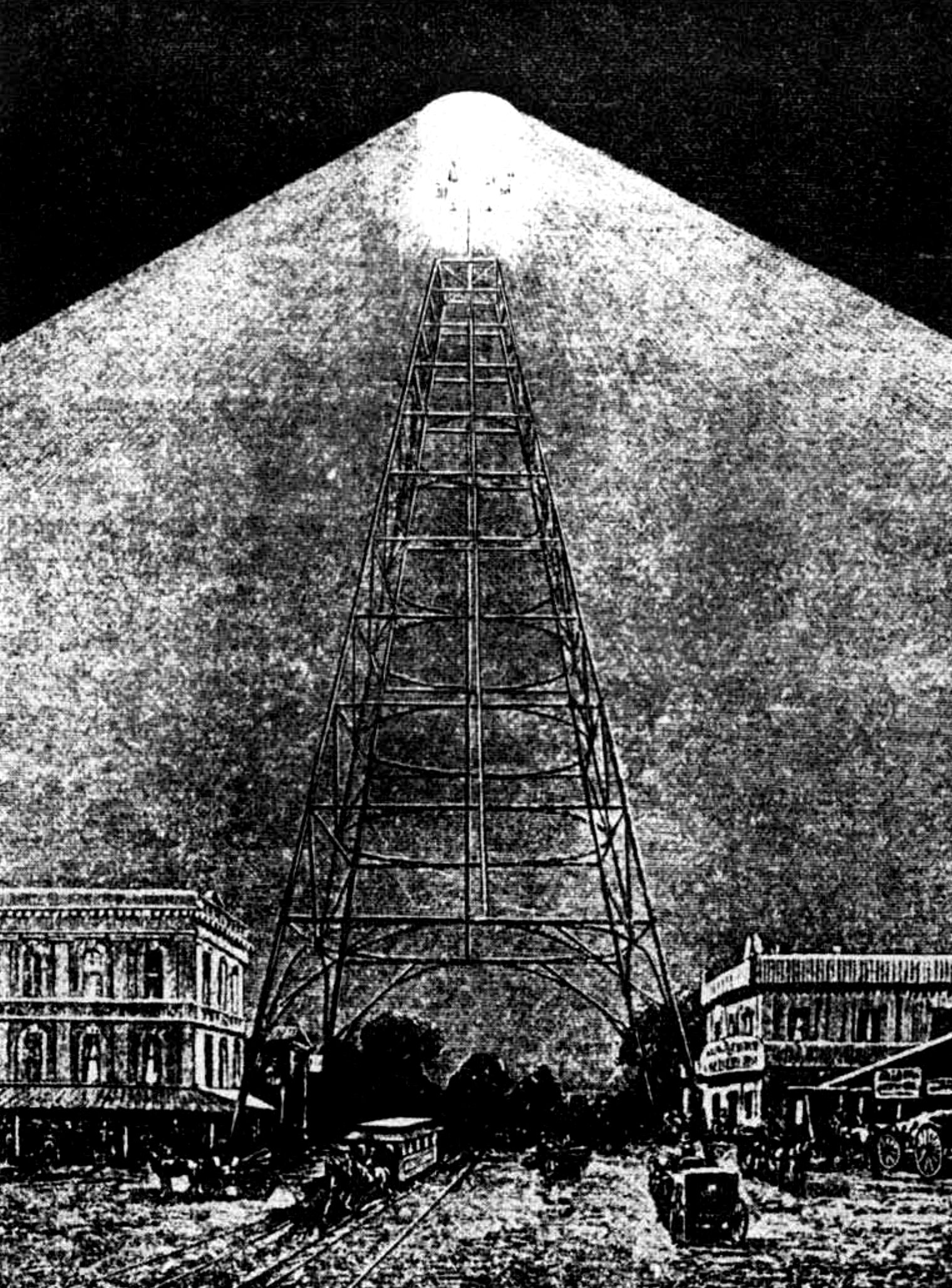
Image from Cincinnati History Library and Archives
Sanders contacted some of his journalistic colleagues in Dayton for assistance. These men were Edward King and Joseph McCorkle, who edited the Western Empire newspaper, and Peter Lowe, who owned half of the Dayton Journal and Advertiser. All three were prominent citizens of Dayton and they formed a stock company to promote the “Magnetic Light” illumination system developed by Starr and Sanders. According to Wrege:
“In fact, after viewing Starr’s lamp they believed that its high intensity, cheapness and obvious safety would ‘in the course of a few months, render gas an obsolete idea’.”
Starr’s 1844 patent caveat protected United States rights for one year, so the Dayton stock company sent Starr and Sanders to Europe, accompanied by King, who acted as their attorney, to secure patents in England and France. Over the course of the next year, the British government issued patents (in King’s name) for Starr’s incandescent light (Patent 10,919) and for the generator invented by Starr and Sanders (Patent 11,188).
Starr was busy throughout this year making improvements to his design, working with a London-based scientific equipment maker named William Mattieu Williams, who described Starr as “about the ablest experimental investigator I have ever known.” On September 2, 1845, Edward King wrote to his investment partner, Peter Lowe, in Dayton, with exceptional good news:
“I do not write to you for any of the usual purposes of letter writing, but to afford you the pleasure, as I presume it will be, of receiving the first letter written by electric light. I am writing about ten feet from an electric light which is equal to from thirty to forty candles. It has been in operation some time, and is perfectly regular and steady. It is a very beautiful, white light, and very pleasant to the eye. This light we consider a very moderate sized one. We shall have one much larger in proportion in a few days.”
In order to make this larger lamp and to prepare for commercial production, J.W. Starr visited England’s manufacturing center of Birmingham, while King and Sanders took care of the patent paperwork in London. The London Mining Journal [May 9, 1846] expressed complete satisfaction with Starr’s light bulb:
“The various suggestions which have from time to time appeared, as to the application of electric light to different purposes, have evidently originated with those unacquainted with the great obstacle to its practical use. The difficulty is entirely overcome by the novel and important invention of Mr. John W. Starr, patented by Mr. King. It will be perceived, from an examination of the specification, that Mr. Starr avails himself of an entirely different principle from that hitherto employed. This principle is the ignition of a continuous conductor, so arranged that an extended surface is presented glowing with the most brilliant light.”
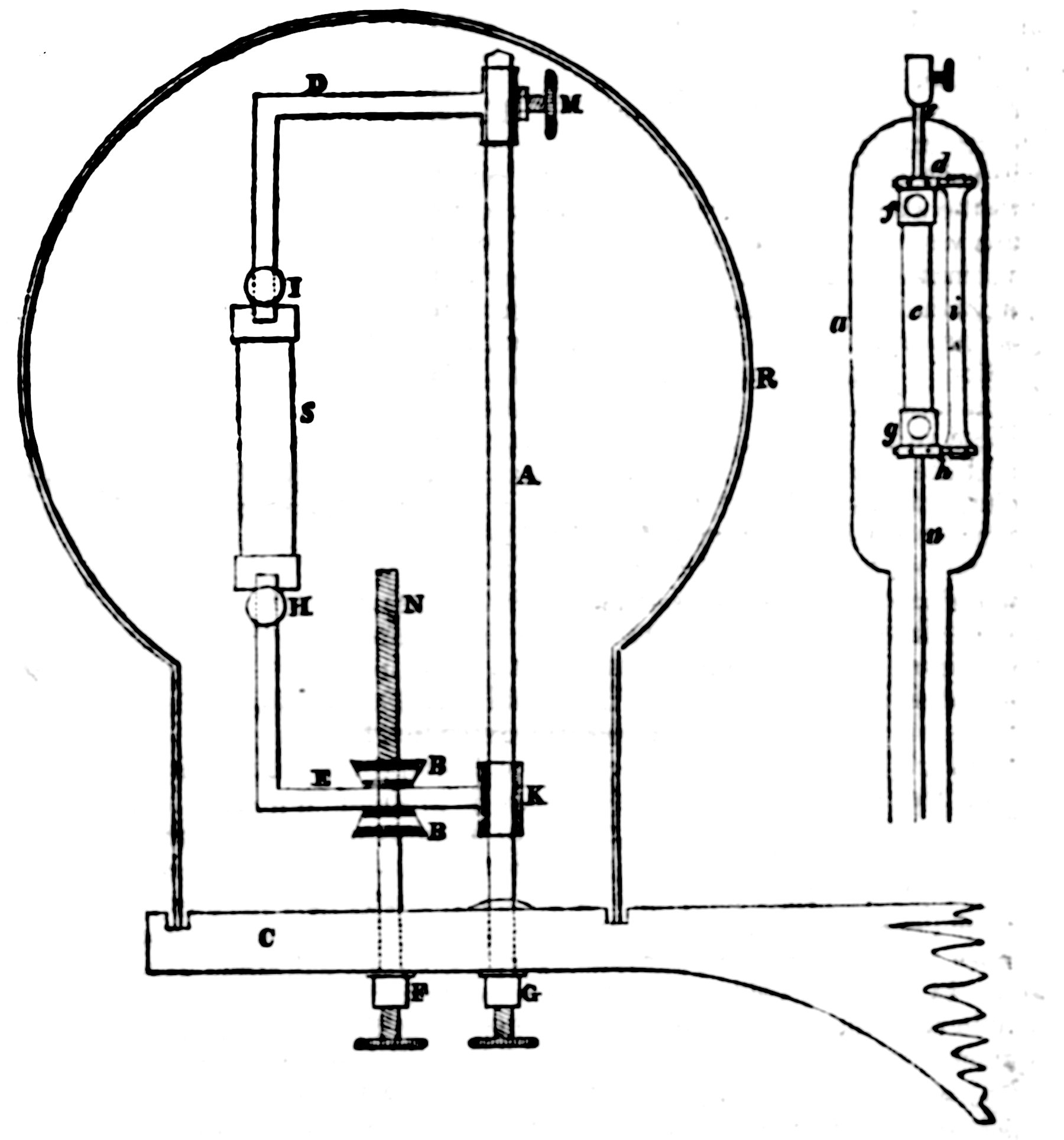
Image from "The Mining Journal And Atmospheric Railway Gazette", May 9, 1846
It was in Birmingham that the entire enterprise collapsed, because John Wellington Starr died of tuberculosis on November 21, 1846. He was only 21. A Birmingham lamp maker had him buried in an unmarked grave in Birmingham’s Key Hill Cemetery. The Enquirer [December 29, 1846] mourned Starr’s unfulfilled potential:
“In the death of young Starr Cincinnati has lost one of her sons, whose beginning had already extended and elevated her reputation as the fostering mother of science as well as art, and whose career, had life been granted him, would have been honorable to himself, and useful to his kind.”
King and Sanders returned to America. King rode off on a military career with service in the Mexican War and the Civil War. He was killed at Chickamauga in 1863. Sanders continued to write and edit. He taught chemistry at colleges in Memphis and Cincinnati and disappeared in 1877 after traveling to Santo Domingo to spend the winter on a plantation.
In the 1870s, as Thomas Edison worked to patent his own incandescent bulb, one of his financial backers, Robert Cutting Jr., grew impatient and gave Edison a copy of a book (since lost) in which Starr described his lamp. Cutting told Edison:
“I have read Starr’s book, and it seems to me that it would have been better to spend a few dollars for a copy of it and to begin where he left off rather than spend $50,000 coming independently to the same stopping points.”