



Illustration by Jessica Dunham
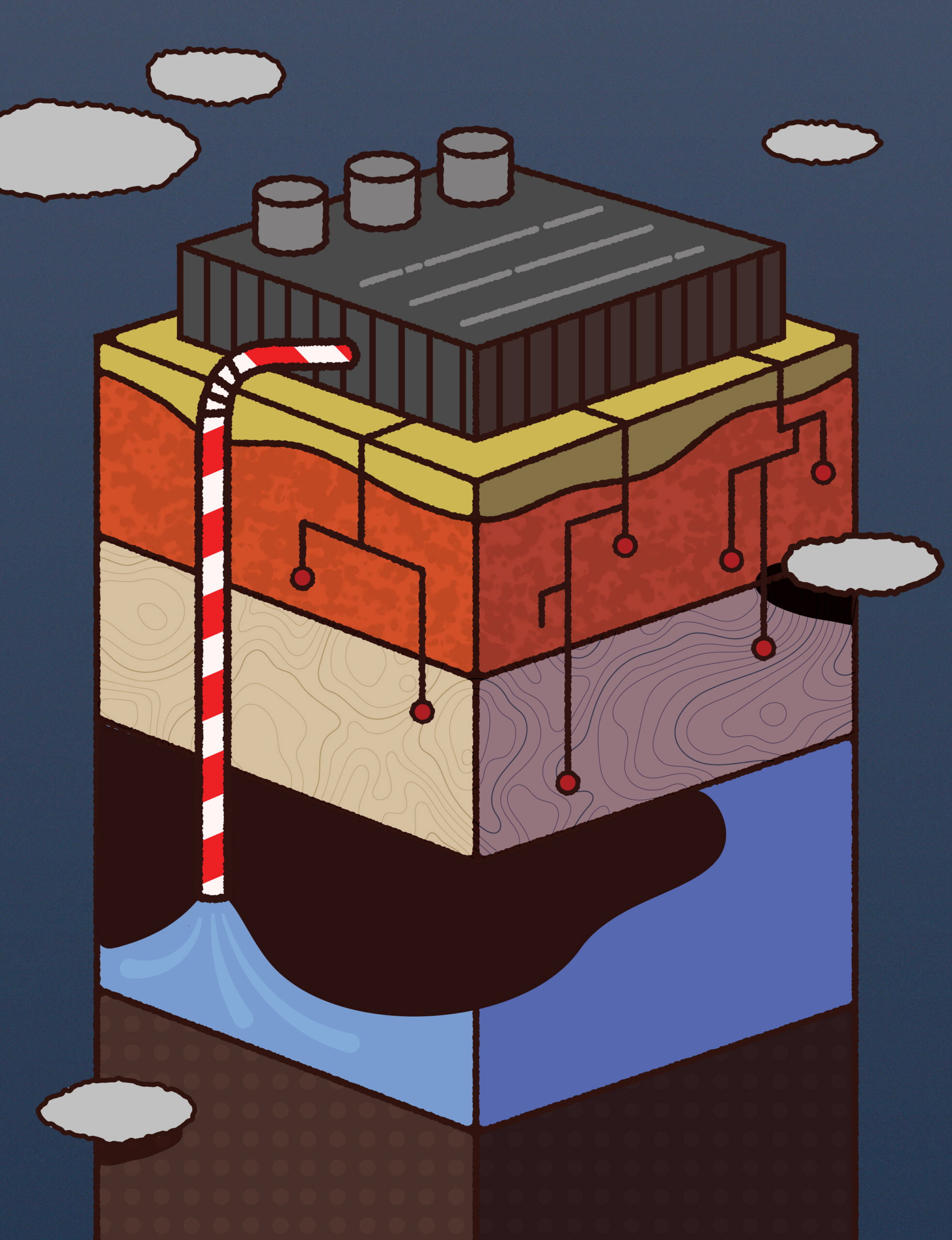
Concerns over groundwater have surfaced in many Ohioans’ minds with “forever chemicals” turning up in private wells and fracking waste bubbling out of the ground in some parts of the state. Now a construction boom in data centers, which often use large amounts of water for cooling as they consume gigawatts of power in service of AI, is adding to worries about this vital but invisible resource.
Bordering Middletown just west of the Great Miami River, Trenton is ground zero in groundwater concerns. The town of 13,000 sits atop the Great Miami Buried Valley Aquifer, which stretches from north of Dayton to the Ohio River in western Hamilton County and holds as much as 1.5 trillion gallons of fresh water. In places it’s miles wide and hundreds of feet deep.
One data center is currently under construction in Trenton, with another on the way. Prologis, the world’s largest real estate and warehouse owner, is building a nearly 900,000-square-foot facility for Amazon Web Services, while Amazon itself has proposed a $5 billion, 18-building campus just outside of Trenton on 600 acres the city was attempting to annex.
“We’ve been told stories that the data centers are going to need two million gallons of water a day,” says Trenton resident Barry Blankenship, who helps run the Woodsdale and Trenton Environmental Resistance (or W.A.T.E.R.) group opposing the new centers. “Water is very important to us, since a lot of people around here still farm and have actual ground wells where they get their drinking water,” says Blankenship. “A couple of them already had to re-drill wells prior to the data center industry coming in, because other industrial users dropped the aquifer’s water level down to where their original wells became obsolete. What really puzzled us at first about the data centers was, Why Trenton? It’s because we sit right on top of that aquifer.”
Data centers are being built all across the U.S. to store and process vast amounts of data, thanks to exploding AI and cloud computing demand. They bring new construction and permanent jobs to farmland in small communities, but their huge energy and water consumption often strain local resources.
With groundwater supplies nationally and globally in decline, even as studies show southwest Ohio’s major aquifer is holding relatively steady, it’s a good time to discuss whether water is a right or a privilege for residents and businesses. Given that we all depend on groundwater, how do you balance growth and basic need? How do you manage a renewable resource so that short-term gain doesn’t destroy long-term viability?
The aquifer—an essential source of drinking water for 2.3 million people in southwest Ohio and the sole water source for many cities, including Dayton—must surely have ironclad protections, right? Think again.
It turns out there’s much we still don’t know about that vast and ancient reservoir beneath our feet.
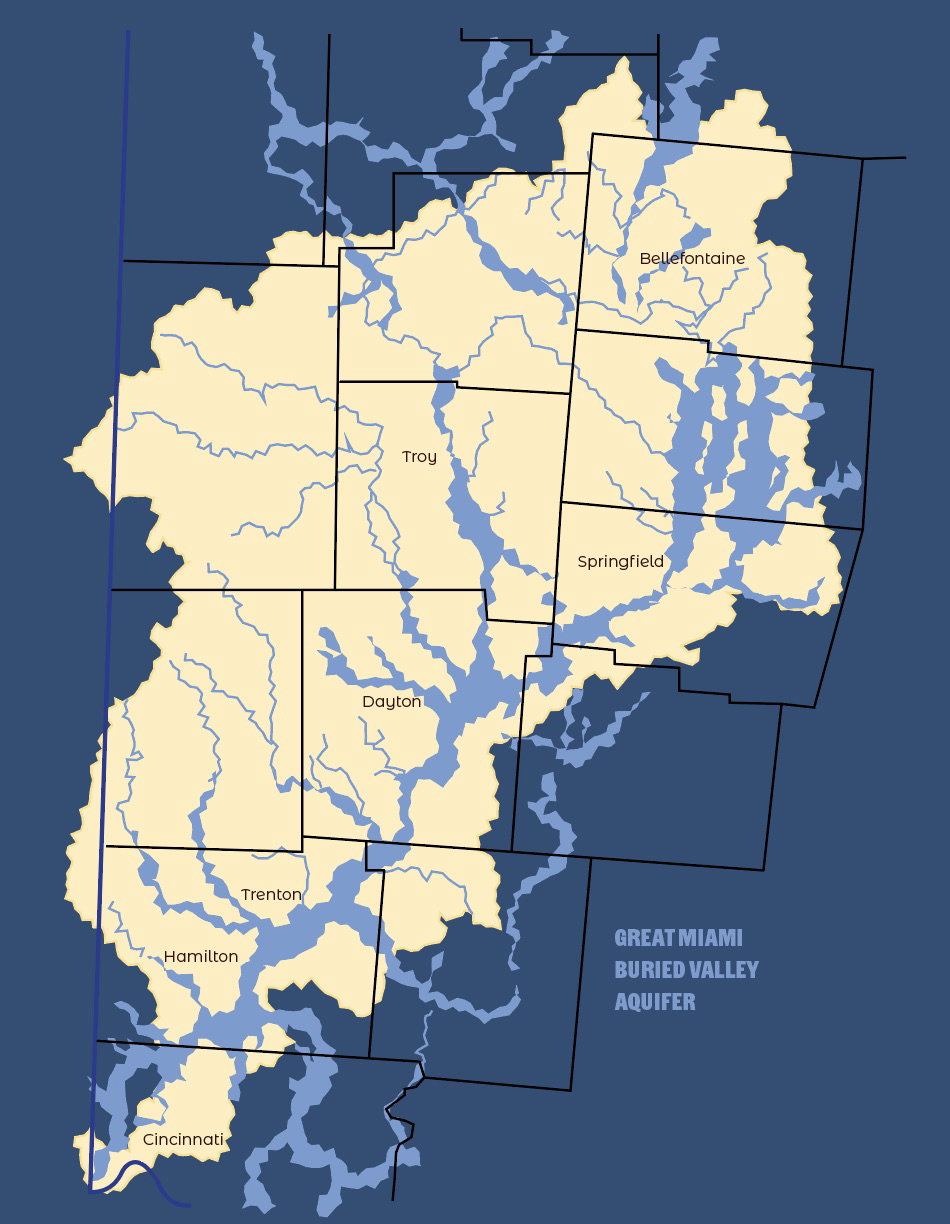
Illustration by Jessica Dunham
The Great Miami Buried Valley Aquifer is indeed great. Millions of years ago, the ancient Teays River system carved valleys into the bedrock. Mile-thick glaciers flattened much of Ohio during a later series of ice ages, burying and filling those valleys with silt, gravel, boulders, and sand. Rainwater and runoff from surface rivers and streams seeps continuously through that material and collects in permeable underground pockets and trenches.
“Across the region, we have what we call losing streams,” says Tim McLelland, manager of the Hamilton to New Baltimore Groundwater Consortium, a public-private partnership charged with protecting the aquifer. “During high water events, like if there’s a lot of precipitation in the area, rainfall starts filling up the aquifer and can push up into the Great Miami River and its tributaries. It’s a constant fluctuation of water resources.”
One such losing stream, Paddy’s Run, crosses the former Fernald uranium enrichment facility, from which radioactive material leached into the ground, requiring extensive and costly cleanup. And there’s the problem: The aquifer’s connection to the surface is both its source of renewal and its Achilles heel. Downward percolating surface water makes it susceptible to contamination from spills, agriculture, industry, and all sorts of human activity.
There are pockets of legacy pollution throughout the aquifer, but also a network of monitoring wells, what McLelland calls “our early warning network for potential risks and contaminants,” that the Groundwater Consortium samples regularly. On average, surface water follows gravity by traveling about 12 inches a year depending on the density of underground soil. The glacial fill that naturally filters water ranges in consistency from boulders to golf ball– and pea-sized gravel to sand and silt.
One of the best layers for pumping water has a wet, sandy consistency, says McLelland, “similar to if you’re at the beach with your kid making a sandcastle.” Wells in some parts of the aquifer can pump up to 3,000 gallons per minute. And in many areas, like Hamilton, the drinking water is of such superior quality that it regularly wins gold medals in tasting competitions and is considered some of the best in the world.
If your region benefits from a massive, naturally filtering reservoir from which award-winning water can be sipped and bottled au naturale, you likely want to keep it that way. So the Groundwater Consortium co-chairs river cleanups and stream-bank stabilization projects to prevent runoff from adversely affecting the aquifer’s health. For example, McLelland participates in table-top exercises with companies who operate in sensitive areas, including pipeline operator Mid-Valley Oil, to plan emergency responses should a spill happen near an active well. If wells aren’t quickly cut off near a spill, their pumping action could reciprocally draw harmful materials down into the aquifer.
“The crude oil pipeline was one of those situations where I felt like working with the pipeline company we were true collaborating partners,” says McLelland. “Of course, they’re looking at us from the standpoint of we’re just this little area and they have a pipeline running from Longview, Texas, all the way up to Michigan. It passes through a lot of different watersheds.”
The Groundwater Consortium is not a regulatory organization, but members monitor, educate, and do what they can to protect the aquifer’s physical makeup.
“The only time you can actually see groundwater is if you’re near one of the open gravel pits in our area,” McLelland says. Sand and gravel operations along the Great Miami River mine the aquifer’s naturally filtering sand and gravel with suction dredges, sometimes all the way down to the bedrock. “The reality is that sand and gravel is rebuilding I-75 and I-275 and supplying construction projects all over the tri-state area,” he says. “These are obviously a necessary part of our economy. We don’t want to stop the sand and gravel mining, but we’re trying to work together.”
On the whole, he says, regional businesses are cooperative because they too understand the importance of natural resources. “They get how important drinking water is for our whole region,” says McLelland. “We don’t see data centers as being that different from any other business wanting to expand their well field. Or some other industry like Molson Coors.”
The brewing company’s Trenton location is world-renowned for its freshwater stewardship and is a Groundwater Consortium partner. Data centers need to partner in a way that’s going to not impact other water users, including homeowners, he says.
Photograph courtesy Andrew Higley/UC Marketing
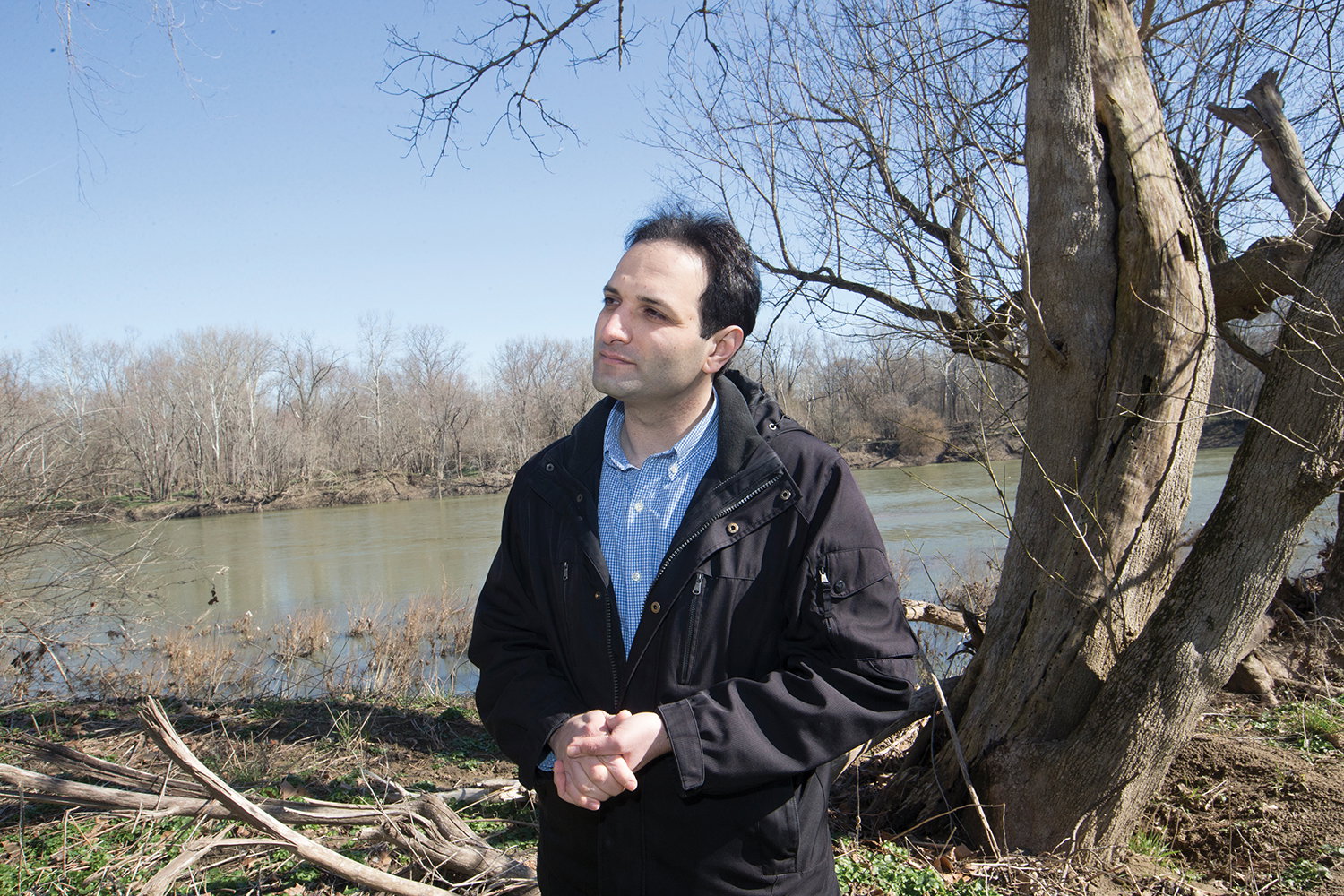
Along the Great Miami River in Crosby Township stands a tower that looks like a space station planted itself in the silt. This is the University of Cincinnati’s Theis-Nash Environmental Monitoring and Modeling Site (TEMMS), which studies how the aquifer and surface water interacts and how they process and transport chemicals, nutrient runoff, and other pollutants.
The project is directed by UC Professor of Subsurface Energy and Hydrogeology Reza Soltanian, who, growing up in Iran, learned firsthand what water shortages look like. Part of the reason he got into studying groundwater, he says, is that “there wasn’t much water where I grew up. The government could close your water down depending on usage.”
Data gathered at the observatory is used to model the aquifer’s shape and how water and other substances move through it. It was recently selected as a testbed for the U.S. Department of Energy’s Genesis Mission, which aims to accelerate scientific discovery through artificial intelligence.
“I tell my students we need to call groundwater the silent victim, because people don’t see it when it’s contaminated,” says Soltanian. “If you dump something in the Ohio River, it creates a huge plume as it moves downstream. People see it. With groundwater, if there is a contamination issue it’s not really observable, and that geologic complexity really scares people. Even right now with all our advanced technologies, when you have a contaminant leak, you have to do a lot of site investigation to understand how far the contaminant moved and how to remediate it.”
While scientists study the aquifer’s processes down to a molecular level, another organization uses that information to see the bigger picture and inform water-policy decisions.
The Miami Conservancy District (MCD) was created as a regional flood control agency in response to the Great Dayton Flood of 1913 that killed 360 people and led to the nation’s first regional flood control system. MCD’s mandate has expanded to include water stewardship, including its Aquifer Preservation Subdistrict. They operate 101 water observation wells in the 3,630-square mile Great Miami watershed, 60 of which are in the aquifer system itself.
“The aquifer has very little protection,” says Sarah Hippensteel Hall, MCD’s manager of communications, outreach, and stewardship. “There are some state regulations, but they’re pretty conservative.”
Having grown up enjoying water sports, Hall is an impassioned advocate for how every aspect of life relates to water. Today she sits on the board of the Ohio River Basin Alliance, a 17-state organization that advocates for water issues, and actively pursues federal investment in the Ohio River Basin, which includes the Great Miami watershed and its aquifer.
Before data centers started making headlines, MCD had already embarked on a study to see what would happen if the aquifer’s water was exported to other regions. This region currently does not have an agreement akin to the Great Lakes Compact, which stipulates that Texas, for example, can’t come to the Great Lakes and start sucking them dry. Interest in recommending similar protections here, as well as developing sustainable management practices, prompted the MCD study.
“We’re developing a ‘water budget’ for the Great Miami watershed,” says Hall, “so that if a layer of protection needs to be added, we can go to our communities and say, Hey, if you want to protect your aquifer properly, here’s what you’re going to need to do. And then here come the data centers.”
The study has not been completed, but a recent short-term study commissioned by the Ohio Chamber of Commerce suggests that there’s plenty of water—at least in the near future—to support industrial growth, though it points to bottlenecks in wastewater infrastructure and energy production. That report, which projects out only to 2030, says of the Cincinnati- Dayton region that even if energy demands multiply ten-fold “forecasted cooling demand remains small relative to the region’s broader water uses, especially power generation,” and that southwest Ohio’s “large groundwater resources provide meaningful supply headroom.”
Hall points out that federal regulations have had crucial impacts on the aquifer’s health, starting with the Clean Water Act in 1972. “We absolutely would not be where we are today without that act,” she says. “We would not be here drinking clean water if we did not have those regulations.”
But federal groundwater protections have recently been eroded, notably by the U.S. Environmental Protection Agency’s 2025 rule redefining protections for the “Waters of the United States” as extending only to bodies connected by a “direct, navigable surface connection.” Italics are mine. That new distinction overlooks so many important parts of any healthy watershed and fails to recognize a host of subtle hydrological connections.
Like the Groundwater Consortium, MCD does not differentiate data centers from any other industrial water user. The bottom line, says Hall, is “large water users are not exempt from complying with state and federal law. But the funny thing about data centers is that, from what we understand, they use water for cooling, which then gets discharged almost immediately back into the ground. They’re not sending it away. And if they follow current state and federal requirements and use best practices and regulatory requirements for proper discharge, then it’s replenishing back to our aquifer. We don’t want it discharged out to surface water so it can flow downstream.”
To better understand the potential impacts on water customers if the aquifer gets stretched thin by increased use, I reach out to Bruce Whitteberry, superintendent of the water quality and treatment division at Greater Cincinnati Water Works (GCWW).
He says concerns voiced by groups like W.A.T.E.R. are questions that should be asked during the design and approval process at whatever stage is appropriate. One concern many Ohioans share is that data centers tapping their groundwater might raise home water bills.
“It’s a hard question to give a blanket answer to,” says Whitteberry. “Additional customers can actually lower the rates of customers in some situations. For instance, GCWW is a larger utility and we have a plentiful supply of water when you look at both of our sources together.”
The utility draws most of its water from the Ohio River and just 12 percent from the Great Miami Buried Valley Aquifer. “We have some benefit of scale so that homeowners do not have to pay as high rates because the cost is spread out over many customers,” he says. “If you have a smaller utility, when a large customer comes in and requires significant upgrades to the water utility to be able to supply that facility and if the facility is not the one paying for those, or if they just pass the costs on to the customer, that could be an issue.”
Plans for the Prologis data center call for its wastewater to be discharged into Trenton’s municipal sewer system. Citing a pending presentation by its Board of Commissioners, Butler Water & Sewer declined to comment on whether infrastructure upgrades were planned to meet this additional projected demand.
What regulations are in place regarding tapping the aquifer?
“You don’t actually need a permit to withdraw the water itself,” says Whitteberry. Large capacity water users do need to register with Ohio Department of Natural Resources and report the amount of withdrawal, he says, “but the way the water law is in Ohio, there is no state requirement, although there may be some specific local requirements to drill and install wells. If it’s shown that you adversely impact another water user, though, that’s when you run into legal issues on the quantity side.”
The good news is that the Great Miami Buried Valley Aquifer has held relatively steady over the past two decades, says Hall, but that doesn’t mean we should lapse into complacency regarding an essential resource. “We’re asking increasingly sophisticated questions,” she says. “The next generation of questions isn’t simply ‘Where is the groundwater?’ It’s what happens under increased withdrawals? What happens during severe drought? What happens with multiple withdrawals in the same area?”
Taking and returning water can change the aquifer’s composition locally, says UC’s Soltanian. “If you’re injecting it back, typically you are injecting more oxidized water into a reducing environment,” he says, meaning an environment low in oxygen, “which does release naturally occurring arsenic in some part of the aquifer. But I’m sure when these facilities are in place there will be some type of monitoring to look at arsenic, trace metal mobility, and things like that.”
With regard to “forever chemicals,” he says, “they’re not widely distributed. Most of the time it’s localized, and that’s because it goes through sorption into what we call high-organic matter material.”
When Soltanian and his colleagues sample for contaminants at the UC observatory site, he says, PFAS “is below the detection limit. For now, I think, things don’t look that bad. Sometimes there’s nitrate, your fertilizer. Sometimes there is E. coli. And the road salt is also a problem.”
Soltanian says his ultimate goal for the UC project is to be able to make predictions about the aquifer’s future health and warning signs, though, he says, “the problem is you want to predict something that you cannot see.”
AI might provide a lens into this vast and fluid underground system, but Soltanian also worries that not enough students are entering the geosciences to meet this ongoing challenge. Despite all our technological leaps and bounds, he also tells his students, “we know more about what stars look like than how to remediate a contaminated site.”
If there’s something a bit circular—like the water cycle itself—in gathering data to protect an aquifer being tapped to cool a data center storing and disseminating data, there’s also something a little ironic about data companies asking local government leaders to sign nondisclosure agreements regarding their projected water use so the public doesn’t find out.
Whitteberry remains circumspect about the overall relationship. “I’m a fan of anything that gives us more information about the aquifer, because the more information we have, the better we can utilize it and the better we can protect it,” he says. “We drive cars and we use products that are made in factories, and all of those construction processes have environmental impacts. We have to strike that balance of taking advantage of the data technology while not allowing it to consume or damage our resources.”
Blankenship and his W.A.T.E.R. group recently won the right to have Trenton residents decide if the city will allow future data centers to build in their community. The Ohio Supreme Court ruled in their favor September 1 over a dispute about petition signatures they collected to amend the city charter to ban new data centers over 25 megawatts (the Prologis facility will be 250 megawatts).
Trenton voters will see the amendment question on their November 3 ballot.