


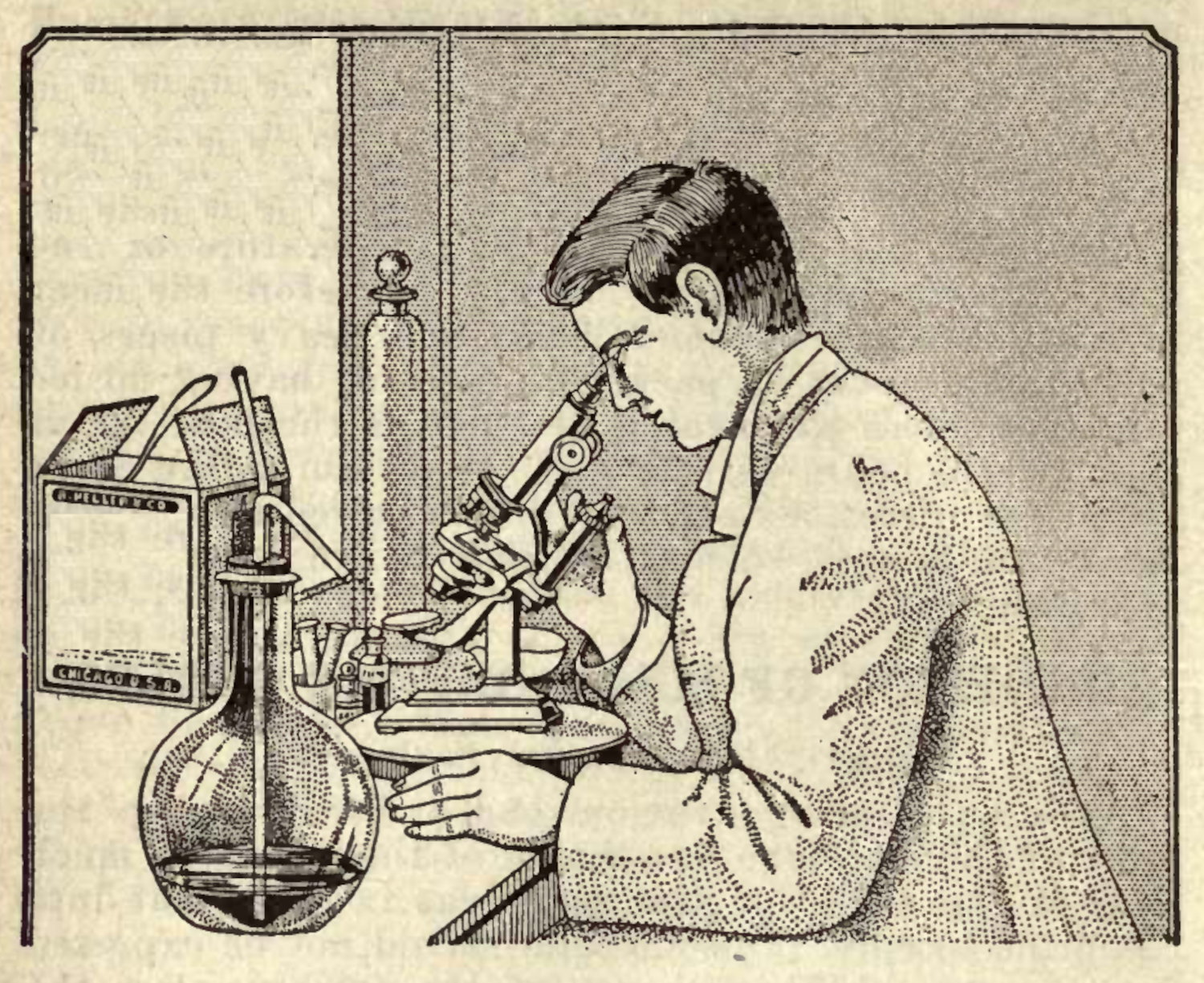
Illustration from From “Secrets of Meat Curing and Sausage Making”, 1922
The Cincinnati Board of Health was mightily confused in 1915. The board clerk handed president George Fackler a request to approve the purchase of something called “Dimethylparaphenylenediamine.”
John O’Neil, clerk of the board, mumbled a shaky attempt at pronunciation. Fackler, a bona fide medical doctor, asked the clerk what that unpronounceable something was. Health Officer John Landis, who was also a physician, and board members Dr. Gustav Zinke and Dr. Samuel Allen confessed ignorance. William Breed, a stockbroker, pointed to the only other layman on the board, A. Clifford Shinkle, president of the Covington & Cincinnati Bridge Company, and said, “If you fellows don’t know, how do you expect Mr. Shinkle and me to know?”
The board summoned the person who requested the mystery item, and a rather perturbed gentleman, wearing a stained laboratory smock and obviously distracted from his test tubes, appeared in the boardroom. According to the Cincinnati Post [April 6, 1915]:
“Chief Chemist Clarence Bahlman, who asked for a one-fourth ounce of the stuff, not only pronounced it, to the utter amazement of those around him, but also explained that it is a coal-tar product used to color pepper, and that he required it in making chemical tests. He was told to get the stuff and say nothing more about it.”
Bahlman must have had quite a few unpronounceable chemicals in his laboratory because he fielded some fairly curious questions. Did you suspect that your wife was trying to poison your coffee? Did that chewing tobacco you picked up at the saloon make you sick? Did you think the air in the local movie show was unhealthy? In 1915, those inquiries were forwarded to Cincinnati’s City Chemist. Yes, once upon a time, Cincinnati had an official City Chemist. In the early 1900s, that position was held by Clarence Bahlman. Clarence worked for the city’s Health Department and he issued annual reports.
In 1915, Clarence reported that Cincinnati ice cream was of mostly good quality, with only 4.5 percent of the ice cream dispensed locally considered substandard, compared to 10 percent substandard ice cream in other cities. He found that dairy farms outside the Cincinnati city limits were shipping a great deal of adulterated milk into the city. And he tested some guy’s coffee cup. According to the Cincinnati Enquirer [March 9, 1915]:
“A man brought a cup of coffee to Bahlman, declaring that he had seen his wife pour something into the cup. The analysis proved carbolic acid had been mixed with the beverage.”
Despite this particular case, Bahlman reported that almost all of the suspect samples brought to his department were totally pure, and that the suspicions were due to “imagination and spite.”
Bahlman sounded the alarm when tainted food products were sold in the city. The most common adulterants found in Cincinnati food were acetic acid added to vinegar, coffee cut with roasted chicory and sugar water added to honey. In 1915, Bahlman reported, almost one-third of the food products sold in Cincinnati were adulterated in some manner.

Photograph from From University of Cincinnati “Cincinnatian” yearbook of 1904
Clarence Bahlman, son of Cora Pfau and Felix Bahlman, was born in Cincinnati in 1881. He attended the University of Cincinnati and graduated in 1904. The 1904 UC yearbook captures Clarence’s dedication to research:
“Bahlman is one of those chemical conundrums who have puzzled us loafers so much. They never come out of their holes in Hanna Hall except for food, and then hurry by as if going to cash a check; in fact, we always thought Bahlman worked on the night shift, until rightly informed. For the benefit of academic students, we wish that he would bend his professional efforts to analyzing his own species.”
Bahlman got to analyze many of his own species while working for the city. In 1914, he found sugar of lead (otherwise known as the sweet-tasting lead acetate) in a bottle of milk. The Cincinnati Post [Aug 20, 1914] quoted the suspicious husband who provided the sample:
“I saw my wife sprinkle some white powder in the milk. I believe she wants to kill me.”
In 1917, Bahlman announced that a barrel of candy found abandoned at the B&O Warehouse (now known as Longworth Hall) was so loaded with poison that each individual piece of candy had enough arsenic to kill an adult man. He discovered that five dairy employees had died on the job because of poisonous gases generated by spoiled grain, rotting in cisterns, intended for the dairy’s delivery horses. A group of women known as the Twentieth Century Club recruited Bahlman to confirm that poor air circulation in movie theaters led to dangerous levels of carbon dioxide. Bahlman pointed to tainted salt blocks as the cause of death for a dozen cows at another local dairy.
Bahlman’s highest-profile case came at the height of anti-German hysteria generated by the U.S. entry into World War I. In March 1918, more than 250 artillery horses quartered in Covington died under mysterious circumstances. Cincinnati’s Clarence Bahlman was called across the river to investigate. Bahlman found no evidence of poisoning, but his scientific exoneration was unable to prevent random outbreaks of violence against the Germans living in Northern Kentucky.
With samples from so many sources landing in his laboratory at City Hall, Bahlman had to contend with curiosity seekers from nearby offices. In one experiment, Bahlman aimed to prove that “scientific ice cream” of exceptional purity could be churned from pasteurized milk. He made a gallon for testing but forgot to lock the lab door. The Cincinnati Times-Star [March 25, 1914] reported the outcome:
“Practically every girl stenographer in the building heard the ‘good news’ and participated in the ‘raid’ that followed. When Bahlman returned, he found that his experiment was being eaten up and that the world might never know of the success of his scientific cream. He worked his way through the crowd and managed to get about a pint of the cream for analytical purposes before he was brushed aside.”
Another purloined sample dashed the city’s case against a bootlegger. Police handed Bahlman a pint of what they were certain was illegal hooch. Bahlman placed it in a test tube for processing but when he arrived at his lab next morning only a few drops remained. The chemist told the frustrated police detective that he couldn’t testify that the residue in his test tube was the same as the sample he had been given the day before. The bootlegger walked.
Bahlman eventually moved on to a job at the city’s water works, where he remained Superintendent of Filtration until his death in 1943. He is buried in Spring Grove Cemetery.