



Collage by Stef Hadiwidjaja
Sydney Barnes stepped into Mt. Airy Forest on a beautiful afternoon in April, having survived what seemed like an endless winter. She would be leading an public tour the next day and couldn’t wait to see who had decided to wake up in this section of the 1,459-acre woods that make up Cincinnati’s largest park.
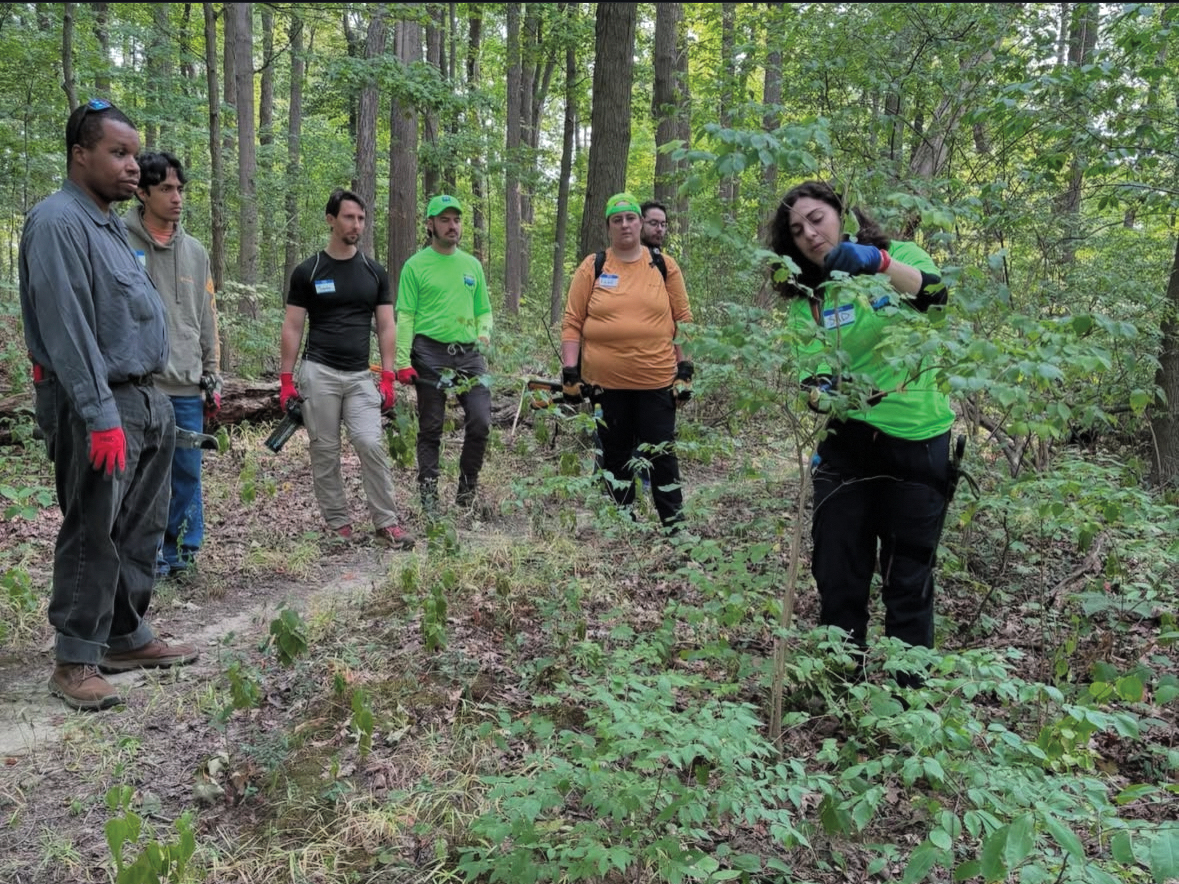
For three years, Barnes has led a volunteer effort called Mt. Airy West Conservation. Group members cut back amur honeysuckle and other invasive plants on the park’s western side from late summer to spring and host community events. Amur honeysuckle is native to Asia but was planted in southwestern Ohio starting in the late 1950s for wildlife food and cover and erosion control. Unfortunately, the shrub spreads rapidly in our regional climate and soils and without human intervention can effectively crowd out native plant species.
Hiking down to a hillside her group had been clearing for years, Barnes recalls smiling at the Dutchman’s Breeches, a spring wildflower resembling little white pants, growing in thicker patches than she’d ever seen there. She likened her path to “a walk through a hall of trophies,” taking in numerous native varieties whose seeds had been dormant and waiting for the right conditions. She came upon a new project area, cleared just once a few months prior, and her jaw dropped.
Photograph courtesy Mt. Airy West Conservation
“Scattered tufts of wild blue phlox and bold purple dwarf larkspur,” says Barnes. “The fuzzy cool greens and teals of waterleaf just pushing out of the ground.” Then she came across a white trout lily with its mottled leaves, strikingly similar to a trout’s pattern. Barnes had never seen one in this part of Mt. Airy Forest. “I cried. I’ll never forget that feeling.”
Reset and rebirth are happening in a lot of corners in Cincinnati Parks. After a decade and a half marked by turbulence and turnover, leaders of the park system—which encompasses 10 percent of the city—say the organization has learned from its past and is ready to move forward focused on transparency and intentionality.
Beyond new conservation and land management efforts, Cincinnati Parks has been putting together a new three-year plan. The organization’s hiring, with more than 20 jobs posted as of this writing, and it has gone through a series of reforms in its finance and operations divisions, some of which were recommended by state and internal city auditors over the past 15 years. During that time, leadership at the parks has changed hands numerous times, with all but one seat turning over on its governing board, the Park Board of Commissioners, and seven different executive directors.
But park and city leaders say the ship is steadying under Director Jason Barron, who just completed his third year in the job. Barron says the organization is positioning itself to upgrade the 5,000-acre parks system with the help of an additional $7 million to $12 million a year in capital funds awarded in the most recent city budget.
City Manager Sheryl Long says she fully trusts the Park Board with public funds, including 9 percent of what the city plans to spend from the first year of investment interest after selling the Cincinnati Southern Railway system. The railroad fund is a new revenue stream for the city that can be spent only on infrastructure improvements, as outlined by the ballot issue passed by Cincinnati voters in 2023. Long’s recommended biennial budget grows Parks capital dollars by more than 200 percent starting next year and up 550 percent by 2031, adjusted for inflation. These funds do not include two big-ticket projects: bank stabilization at Smale Riverfront Park and a riverfront marina that’s been in the works for years.
Even as Cincinnati Parks is ranked the fourth best U.S. park system this year by the Trust for Public Lands, Park Board President Molly North says the organization has its hands full with an millions in deferred maintenance scattered across eight regional parks, 70 neighborhood parks, 34 preserves and natural areas, five parkways, 65 miles of hiking trails, six nature centers, 18 scenic overlooks, 52 playgrounds, 500 landscaped gardens, and more than 100 picnic areas.

Photograph courtesy Cincinnati Parks
“I wanted to get involved in the parks not just because I love them and enjoy my time in them but because they need improvements,” says North, CEO of the commercial development firm Merus that formerly did business as Al. Neyer. She was appointed to the board by Mayor John Cranley in 2021 and became president last year. “It’s a very old park system with aging infrastructure and aging facilities, and many parks haven’t met the more modern demands of parkgoers.”
North says the new three-year plan is helping everyone get on the same page and manage expectations as the organization undergoes a process of setting its primary objectives to be “the guiding light of our work.” Separately, parks staff went through a series of exercises this summer to determine their shared values and desired work culture. “Once that’s complete it will help inform an outward-facing objectives discussion,” says Parks Division Manager for Commnunications Engagement and Volunteers Rocky Merz. “We will definitely want to get lots of public feedback and input.”
In 1906, Cincinnati City Council selected five prominent local men to sit on a New Park Commission, giving them $15,000 to develop plans for a future system of public spaces. The commissioners hired George E. Kessler & Co., a landscape architect who’d gained recognition for the design of a popular “pleasure park” for a railroad company in Kansas, which garnered him commissions for Roland Park in Baltimore, Euclid Heights in Cleveland, and park systems in Memphis and Kansas City.
There was a movement across the U.S. in those years to establish national and urban parks, forests, and reserves with “open space planning.” Kessler’s plan called for a system of current park properties and future ones connected by parkways, or “pleasure highways,” that linked and encircled different parts of the city. At the time, Cincinnati was the 11th largest U.S. city but ranked 40th in designated parkland.
City Council approved Kessler’s plan in 1907, agreeing the city should work to acquire “unspoiled properties such as the Mt. Echo lands on the western hills, the hillside reaching along Mt. Auburn from Burnet Woods to Eden Park and the hill slopes along Columbia Avenue to the promontory above Columbia and that at Red Bank,” among others. The next year, city voters approved the creation of an independent Park Board, and when the voting public approved a new city charter in 1926 they preserved the Park Board’s independence but built in checks and balances at City Hall.
Not all of Kessler’s plan was realized, but much of it was, says Barron, who worked as public affairs and communications director for Mayor Mark Mallory and then founded the city’s bikeshare program, Red Bike, before being hired by the Park Board in 2022. “Park after park, you can hear the story of citizens saying, This isn’t going to be anything but a park,” Barron says. “They gave it to us. Having the park board commissioners helps create that trust.”
Early donors included Levi Addison Ault, a founding park commissioner and owner of an ink manufacturing company. He and his wife Ida May gifted the city much of the land that makes up Ault Park in Mt. Lookout. There was Frederick H. Alms, co-owner of Alms and Doepke, the largest wholesale and retail department store in the entire state of Ohio. Alms and his wife Eleanora left the Park Board enough money in their private estate to purchase the land that became Alms Park in Columbia-Tusculum.

Photograph courtesy Cincinnati Parks Foundation
Most of the potential parkland identified in Kessler’s plan was acquired by the early 1920s, and the system built more than half of its 135 structures between 1929 and 1943. Through the 1950s and 1960s the Park Board fought highway plans that threatened to cross into parks and city residents turned down two ballot issues aimed at combining Cincinnati’s parks and recreation departments.
New master plans were created in 1992 and 2007, with the latter proposing a future tax levy for parks, placing an emphasis on the importance of parks in attracting residents and businesses back to the city from the growing suburbs. By 1995, the Cincinnati Park Foundation had been formed to help the parks raise private funds.
City and park leaders decided to ask voters to approve a new property tax in 2015 to directly fund improvements to and maintenance of Cincinnati Parks. As levy supporters campaigned for a permanent 1 mill property tax, local media began reporting some questionable spending, including a $200,000 donation to the levy campaign, a big no-no for a public agency. The Park Board rescinded its donation, receiving the money back within days. (Note: I covered Cincinnati Parks during that period for The Enquirer.)
Other media investigations revealed that then-Parks Executive Director Willie Carden was spending money out of private endowment funds, many of them left to the parks by prominent Cincinnatians in their wills, for expenses like a car allowance, a private club membership, and credit card charges. Those expenses included a trip to Las Vegas, where Carden and his financial manager flew first class and ran up a $9,000 bill that included steak dinners, alcohol, and a helicopter ride over the Grand Canyon, according to a Fox19 investigation. Parks leaders said the trip was taken in preparation to host an upcoming BBQ competition in a Cincinnati park.
Leaders at City Hall, including Cranley, weren’t aware of this sort of spending. He called for an internal audit and a temporary moratorium on any discretionary spending but continued to advocate for the tax levy.
City voters defeated the parks levy, but the heat stayed on park leaders. In 2016, the city and public learned that the Park Board had used no-bid contracts for $40 million worth of publicly funded work to build Smale Riverfront Park. Harry Black, city manager at the time, said, “When you circumvent policies, procedures, and rules, you put the governmental entity at risk, which means you put the public at risk.”
An annual state audit in 2017 showed the parks leaders weren’t documenting the use of credit cards and gift cards, had been using private endowments for salary bonuses, and said its financial operations “increases the risk that errors, theft, and fraud could occur.”
The city hired an outside accounting firm to improve financial controls. Both Carden and Finance Manager Marijane Klug retired later that year. Cranley continued to push for more transparency, and in 2018 a legal agreement known as a Memorandum of Understanding was signed between the Park Board, City Hall, and the Park Foundation giving City Hall more oversight on how private donations get spent.
North says that today “all of the Park Board members are well tuned in to the lack of transparency that may have existed in the years before,” but all the members “take very seriously” their responsibility to follow public records laws and other rules that govern public agencies, meetings, and boards. “I don’t feel that there’s any public concern at this point about transparency.”
Since becoming city manager in 2022, Long and her staff have worked with Barron and park commissioners to align their priorities with hers and Mayor Aftab Pureval’s. “We can see where we’ve put resources and the parks that have gotten money,” says Long. “We are trying to make sure all of our park spaces are being utilized to their full capacity, and the railroad fund is a perfect opportunity for us to focus on those segments of the city that have not been paid attention to.”
Earlier this year, City Council approved Long’s budget for Cincinnati Parks in its entirety, raising the capital budget from $2.1 million this year to $7.2 million in 2026. Next year, the largest portion of those funds, $2.7 million, will rehabilitate park infrastructure, covering costs for general upgrades such as electrical, HVAC, lighting, and plumbing work as well as improvements to roadways, walks, retaining walls, and other structures. Projects will be prioritized based on safety concerns and the infrastructure’s life cycle.
Other projects in next year’s capital budget include completing rehabilitation of Owl’s Nest Park in Evanston, including reopening its historic pavilion; fixing safety issues on a popular bike trail connecting Sawyer Point and Yeatman’s Cove; renovating park structures and hardscapes like roofs, masonry, walkways, fencing, and more based on priority; restoring Glenway Park in East Price Hill; repairing the Gibson House’s historic roof in Avondale (rented for weddings and corporate events); starting the process of a full renovation of Krohn Conservatory in Eden Park; and renovating McEvoy Park in College Hill.
Long’s budget spans six years and steadily increases the parks’ capital allocation to nearly $15.3 million in 2031. Projects over those years will include an adventure playground in Mt. Airy Forest, restoration of Inwood Park’s pavilion, rotating playground renovations around the system, overlook stabilizations in Bellevue and Fairview parks, and renovation of MLK Jr. Park in Avondale.

Photograph by Liz Dufour/Cincinnati Enquirer
Long says she’s also happy with park leaders’ commitment to growing the city’s tree canopy and other parts of the Green Cincinnati Plan. They recently won a grant to build their own biochar facility and are renovating a nursery to grow more of the parks’ own plants. Long also approved a new Cincinnati Parks position focusing on teen programming. “Having collaboration at the director level is very helpful for us, because he could easily say, Well, I don’t report to you,” she says. “But Jason has said, I’m going to be a partner.”
These funds don’t include what Barron said is one of his top priorities: stabilizing Smale Riverfront Park on the Ohio River. Currently in the design phase with U.S. Army Corps of Engineers, he won’t know the total budget until that’s complete but estimates the project, which includes at least a partial hard-edge at the river, to cost $13 million to $15 million. That funding has been secured, with the cost being shared between the Army Corps and the city.
Cincinnati Parks receives an operating budget from the city to pay salaries and run the park system. That figure will be $26.5 million in 2026, up 23 percent since 2017 when adjusted for inflation. The Park Board also spends millions of additional dollars each year out of its own endowment funds and direct donations from the Cincinnati Parks Foundation.
The foundation has raised $110 million for parks over the past 30 years, according to Foundation Chair Brian L. Tiffany, who says the sometimes rocky relationship with the Park Board is now strong and productive. “Over years when the Park Board was going through a lot of upheaval, with several different executive directors, it was difficult to see the direction,” he says. “Now, between our two organizations, we can manage the expectations of donors, and it’s OK to say to someone, That’s a great idea, but here’s something that’s on the list of the Park Board and is there a way that we bring that person into it?”
These improvements sound well and good, says Rachel Wells, but she wants to know what happened in Burnet Woods. Out of the windows in her condominium on Jefferson Avenue she sees a new dog park—but more than that, she sees the many ways that park leaders have failed her.
“Whether I hear a dog barking or go stand at the bus stop right by it or walk through the park, it’s a daily reminder of the lack of care and concern for existing communities there, including ones I’m a part of,” says Wells, a member of the Burnet Woods Parks Advisory Council who has been in opposition to the development proposals in Burnet Woods for years.
The recent conflict began with a proposal to build the new Clifton Cultural Arts Center in Burnet Woods in 2018. Neighbors and park lovers showed up in force to oppose the idea in public meetings, saying they didn’t want the peaceful nature of the park—one of the nation’s few remaining urban old-growth forests—to be disturbed by new crowds and traffic. Others argued for the health and safety of the birds, insects, and animals that call 90-acre park home. Ultimately, the Park Board voted against the project and the arts center was built elsewhere.
Around that time, another development was proposed by the Camping and Education Foundation, which wanted to operate an urban wilderness program for youth in Burnet Woods. Again, neighbors rallied in opposition and the Park Board declined to move forward with it. A second attempt to locate the Camping and Education Foundation inside the park was made in 2020, this time by renovating an underutilized park building, but the foundation withdrew its proposal for lack of community support.
“Burnet Woods used to be twice its size, because literally all of UC’s campus is sitting on what was Burnet Woods,” says Cynthia Duval, who helped launch an opposition group, Preserve Burnet Woods. “It’s got to process all the street oils, all the litter, all the things that come from us just being humans around it. In terms of giving one up for the public good, I think Burnet Woods has given its fair share.”
Duval lives half a mile from the park and began visiting it when she was 12 years old. She had just completed training to become an Ohio Certified Volunteer Naturalist when she heard about the proposal for the new arts center. “I would like to think that city leaders appointed to such important positions have higher priorities than vindictiveness,” she says, but instead of addressing existing concerns in Burnet Woods—like sewage overflows, dilapidated infrastructure, and closed trails—she says they opted to build a $500,000 dog park that community members again fought.
Duval says she and others experienced bullying and hostility from some park leaders, including board member Jim Goetz, whom Pureval replaced last year. “I think it’s more of the same,” says Duval. “I hope this dog park will check the right box, whether it was ego or a grudge, and then park leaders can focus on fixing the walkway and railing around the Burnet Woods lake, repairing the potholes leading to the bandstand, and the flooding.”
Preserve Burnet Woods has since disbanded, but Duval and many others are organizing around a push to overhaul how parks are managed in Cincinnati. “As much as it was designed to be a system free of politics, it’s now a very politicized and influencer-led system,” says Duval. “It feels like whoever writes them a letter and says, I’m willing to give you money to do this or I’m willing to fund-raise for that, they get time with the board.”
North says there were plenty of supporters for the Burnet Woods dog park and it’s time to move on. The Park Board compromised, she says, deciding not to install artificial turf, as opponents asked.
“Not putting a sheet of plastic in your wooded park feels like an incredibly low bar,” says Wells. “What we’ve lost is not only a really nice green space that was flexible for its use, whether it’s building a snowman, tossing a ball, going to sit in the sun, reading, or meeting friends to sit on a picnic blanket. It was a gathering space. And, in the process of eliminating that space, existing communities of people who would gather in the park have been dismissed.”
Barron says his greatest challenge as executive director can sometimes be the level at which people love their Cincinnati parks. “And that is awesome, but it also means people have very high standards,” he says. “I came in and everybody was like, Here are 40 projects we need to tackle. How? We can do only so many projects at once.”
That was the impetus of the three-year-plan, says Barron. It’s also why North wants to set the Park Board’s values this year with input from the public and from City Hall. Doing that “helps us have a filter on what we will or won’t consider when we get inbound calls saying, We want a dog park. We want a skate rink. There’s an unlimited amount of interest in parks doing something.”
North says reforms have been instituted in the past 10 years, including the public’s ability to watch Parks Board meetings on its YouTube channel and review meeting agendas and minutes online.
In the finance division, Director Herta Fairbanks has been working with a committee to roll out updated budget-tracking documents, complete an extensive review of endowment distributions, and develop a process for ongoing fixed-asset reporting. Next up is reconciliation of various expense accounts, according to a report she presented to the board in July.
As his team prepares to accept a boost in funding, Barron says the organization will take on its big capital projects and tackle long-deferred maintenance issues while creating a schedule for ongoing maintenance so the system doesn’t fall behind again.
At the end of the day, Barron says Cincinnati Parks isn’t trying to be better than the systems in Nashville, Cleveland, Louisville St. Louis, or anywhere else. They’re looking inward instead. “We want to continue to try to get better at being us.”