


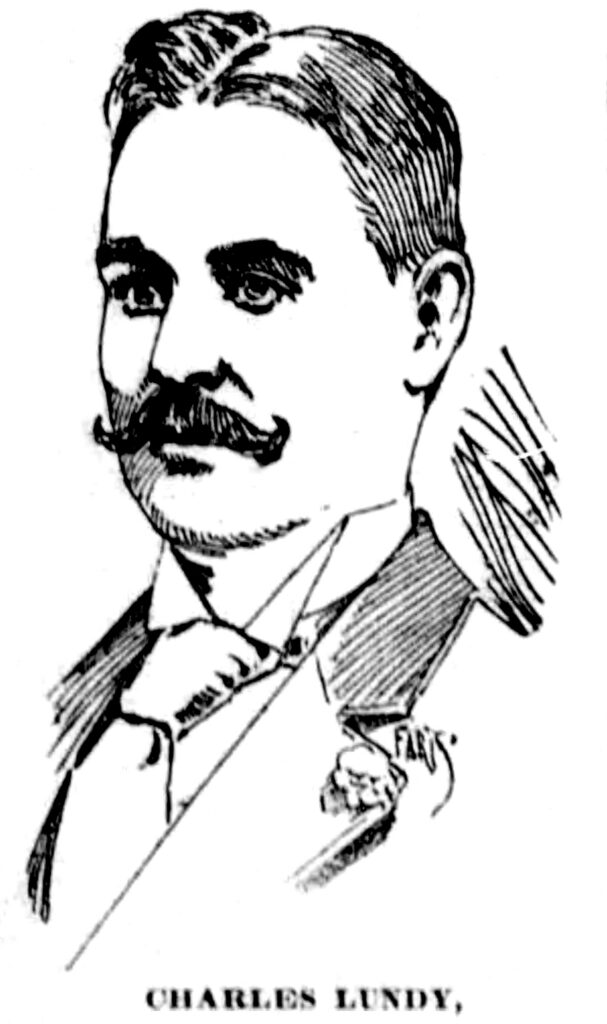
Illustration from "Cincinnati Post", May 5, 1897
Back in old Cincinnati, the practice of law could be a contact sport, especially for a shyster like Charles Leo Lundy. In a meandering circumlocution, the Cincinnati Commercial Gazette [December 3, 1892] summed up Lundy’s unpleasant professional image:
“Lundy is by no means the most popular man in the city among those whom circumstances compel to acknowledge him as a brother in the legal profession.”
This occasionally disbarred attorney survived at least two knife fights and a couple rounds of courtroom fisticuffs as he established his rather unsavory reputation. Both of Lundy’s knife fights erupted from his representation of wives divorcing their husbands.
One such altercation involved a traveling salesman named Andrew Barnhart who lived in Hartwell. In 1890, Barnhart, aged 50, married a milliner named Mildred De Aubrey Corbin McClure, aged 27. Insanely jealous of his much younger wife, Barnhart threw her out of the house when he suspected her of looking at another man. Mildred, homeless and destitute, consulted attorney Lundy about recovering her sewing machine and notions. Lundy accompanied her to the suburb but, as soon as he knocked on Barnhart’s door, the old man charged out, swinging an “ugly-looking knife” and slashed at the lawyer. Lundy managed to dodge the blow, suffering only a scratch, and knocked Barnhart down repeatedly until several neighbors rushed to the scene and subdued him.
Five years later, another divorce case led to another knifing. Louisa Rothacker, neglected wife of a dissolute clerk named Charles Victor Hugo “Vic” Rothacker, contacted Lundy to force her husband to pay court-ordered alimony. The Cincinnati Enquirer [August 18, 1896] reported that she warned the attorney about her husband’s violent temper, saying:
“Now be mighty careful, Mr. Lundy, for he said that he would kill any attorney that took my case.”
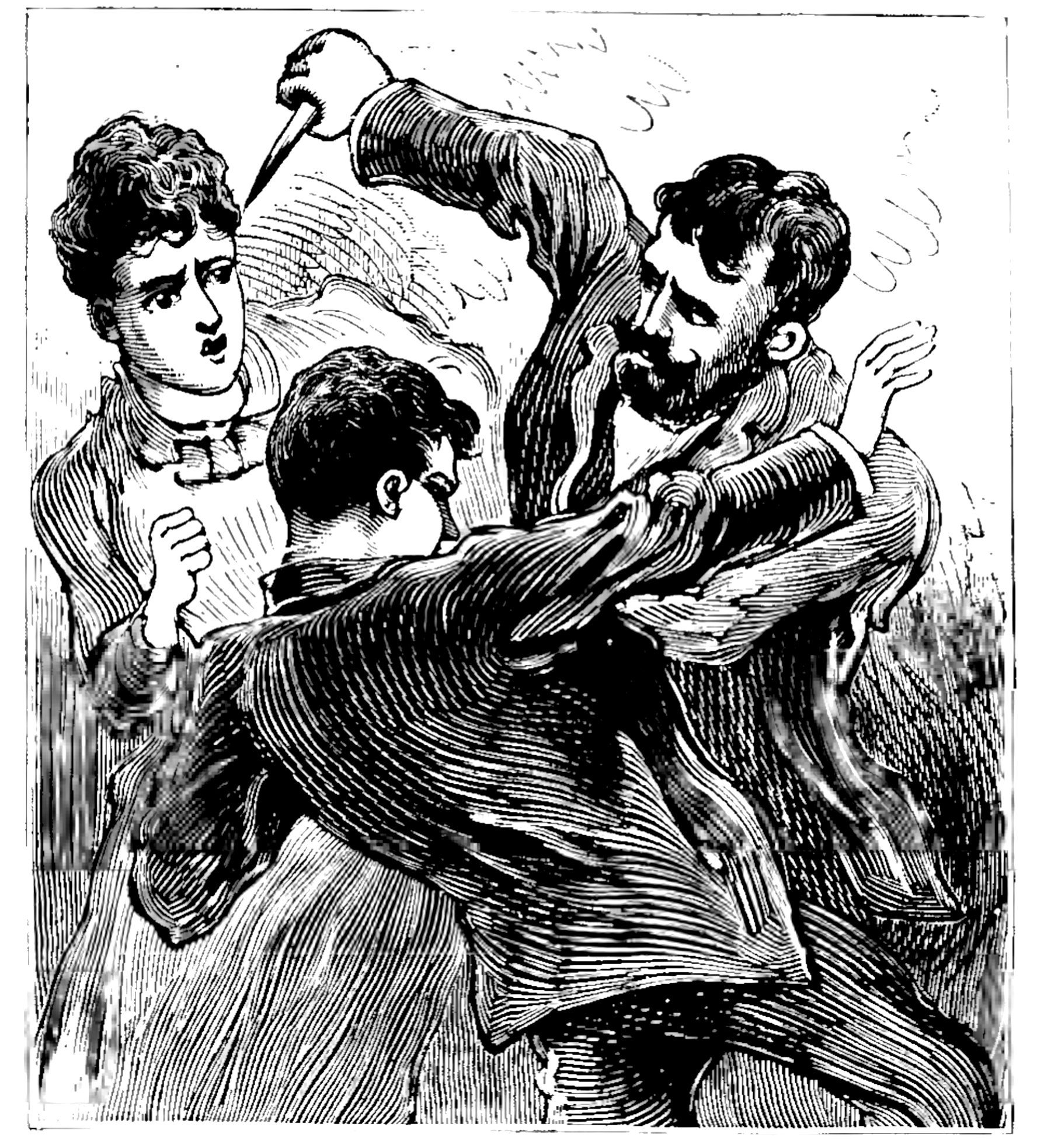
Illustration from "National Police Gazette", May 28, 1892, Page 12
Lundy arranged a settlement, but Rothacker ignored it. One evening in 1896, Lundy rode the streetcar uphill to Mount Auburn, where he lived with his aged mother. Among the passengers was Vic Rothacker and his brother, Frank, who pestered Lundy to such an extent that the conductor asked Lundy to ride on the rear platform to avoid any further confrontation. When Lundy alighted at his stop, the Rothacker brothers attacked and soon had him on his knees. Lundy pulled a pocketknife from his jacket and stabbed blindly, plunging the blade into Frank Rothacker. The brothers backed off and Lundy stumbled home. Police found Frank lying on the sidewalk bleeding. They located Vic, prostrate in a drunken stupor, several blocks away. Frank died at the hospital. Although charged in the death, Lundy was cleared on the basis of self-defense.
Once, when Lundy was in court trying to get approval for his fees in defending a thief, the opposing attorney, Charles Baker, questioned Lundy’s character and Lundy replied with a right hook. His antagonist responded in kind and soon the court constable, one William Williams, jumped into the fray and a full-blown donnybrook rumbled Judge Philip Winkler’s courtroom. The Commercial Tribune [July 14, 1900] tried to sort it out:
“It was difficult to say whether the scrimmage was between Baker and Lundy, Baker and Williams, Lundy and Williams, or whether Baker and Lundy were trying to whip Williams or Williams trying to whip both Baker and Lundy.”
Two years later, Justice of the Peace Charles Dumont heard a case in which a Cincinnati madam sued a local gentleman, Fred Allen, for not paying rent on his girlfriend’s apartment in her establishment. Lundy represented the madam. Allen was represented by his brother Harry. Again, words were said, and Harry Allen, a retired boxer, sent Lundy sprawling to the floor. Lundy brushed himself off and asked the judge for permission to clear the courtroom so he could settle things privately with Allen. Permission denied.
Lundy’s less-than-honorable reputation was largely based on playing both ends against the middle. In one notorious example, Lundy escorted his friend H.B. Miller to Gertie Broadwell’s “resort” on Court Street. There, Lundy introduced Miller to a young cyprian named Edith Murray. Miller was entranced and spent that night and many subsequent evenings in her boudoir.
Some weeks later, Miller received a letter from Edith Murray, in which she claimed that she had contracted a disease from him and desired a substantial payment. Should he ignore the request, she said, a lot of people would soon learn the details of their trysts. Miller, recognizing a shakedown, asked Lundy for advice. Lundy advised Miller to sue and offered to represent him. They took the letter to Justice of the Peace Edward Wilson, asking for Murray’s arrest on the charge of blackmail.
A constable arrested Edith Murray and brought her to Wilson’s courtroom where the Justice set her bail at $500. To Wilson’s and Miller’s exasperation, Lundy announced that, although he was already representing Miller, he would guarantee the young woman’s bond and also represent her in court. Justice Wilson at this point recalled that Attorney Lundy had once invited him to dinner at the very same Court Street brothel where Edith Murray resided and had remarked several times that he and the “landlady” were on friendly terms.
It emerged that Lundy himself had dictated the blackmailing letter to Murray and encouraged her to mail it. The judge, smelling a rat, fined Edith Murray $10 (paid by Lundy) and closed the whole case. Miller thought he had been vindicated until Lundy hit him with an exorbitant invoice for services, under threat of circulating the letter publicly.
That night, Edith Murray knocked on Justice Wilson’s door. She held an envelope containing $17.50 that Lundy told her the Justice had requested. Wilson knew Lundy was trying to trap him into accepting a bribe and sent Murray and the payoff away.
In another scheme, Lundy allied with a group of anti-saloon crusaders who tricked guileless people—usually widowed landladies—into serving beer at unlicensed addresses. Although innocent, it appeared they had violated the liquor laws. When the dry agents threatened prison, Lundy swooped in with an offer to settle things for a price. He then shared the proceeds with the tee-totaling vigilantes.
True love brought an end to Charles Lundy’s legal shenanigans in Cincinnati. Lundy was an avid sportsman and raised hunting dogs as a hobby. He discovered that Adelaide Nielen, daughter of a Fourth Street merchant, was just as devoted to hunting and to the hounds as he was. Adelaide’s family so opposed Lundy that her father shipped her off on an extended tour of the western United States.
Despite his bride’s family’s and even his own mother’s objections, Lundy followed her to the coast, where he and Adelaide were married in 1902. He was 47; Adelaide was 19. It looks like Lundy largely gave up the law and made his living raising hunting dogs. He became a humane officer and chaplain of the local Elks lodge in Carpinteria, California. Regardless of the age gap, the marriage survived until Charles Lundy’s death in 1925. Adelaide followed him into eternity in 1952. They were united at Spring Grove cemetery.