


Photograph by Ian Bolender/Collage by Carlie Burton
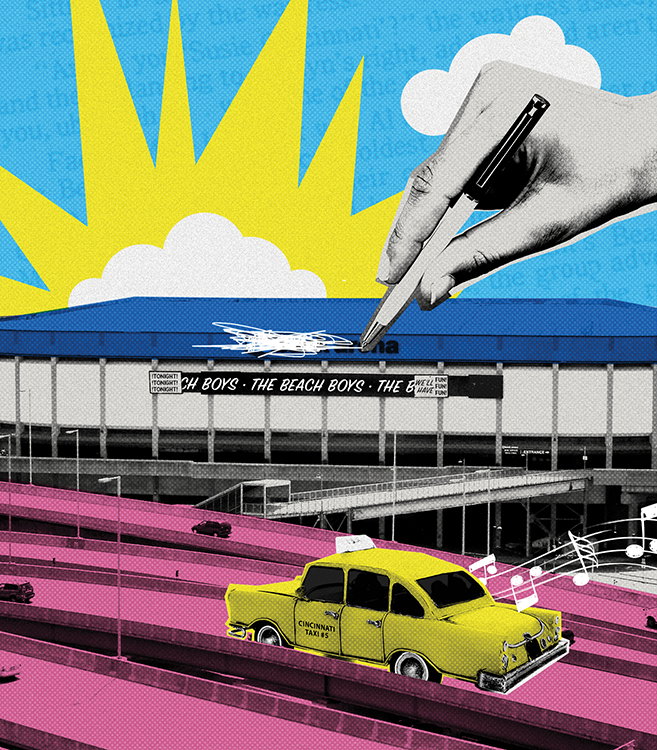
In 1971, a woman cab driver at CVG Airport was still an unusual thing, maybe even a little dangerous late at night. But Joellyn Lambert felt fine about the three guys who crammed into her backseat. They all made friends quickly, laughed their way across the Brent Spence Bridge, and said goodbye at a downtown hotel.
Lambert soon forgot about the guys, because it didn’t really register that she’d just bonded with three of the Beach Boys. They, however, remembered everything. And when the Beach Boys returned five years later for a concert at Cincinnati’s Riverfront Coliseum, they brought her onstage.
That cab ride had inspired the band’s latest single, “Susie Cincinnati,” which they sang to her in front of 13,350 fans. Finding Lambert hadn’t been easy; the band placed ads in local newspapers and hadn’t located her until the last minute. The crowd roared, Joellyn beamed, and Cincinnati felt like it was basking in California sunshine.
Oh, if only that magical night could have been the most memorable thing to ever happen at Riverfront Coliseum—the one event everyone thinks of when they hear that venue’s name. But it’s not, is it?
Cincinnati is now observing the 50th anniversary of Riverfront Coliseum / The Crown / Firstar Center / U.S. Bank Arena / Heritage Bank Center, a place that’s changed its name more times than Snoop Dogg. Even though it’s hosted a half-century’s worth of concerts, sporting events, circuses, conventions, monster truck shows, and more, all of that is forever eclipsed by one terrible night in 1979. That sad 50th anniversary is four years away, so I will not make it the centerpiece of this story. There are many other events of significance worth remembering from Cincinnati’s middle-aged, weary white elephant. Let us recall them now.
Some stories are fun, like Lambert’s. Some are embarrassing. One story almost sent a group of people to prison, and many locals still think it should have. A Coliseum employee went into the basement, filed open the rear hinges on all of the electrical boxes, drilled through the seals on the meters, rigged them to under-report the amount of electricity consumed, and then performed the same mischief on the water meters, all of which added up to almost $1 million in stolen utilities over seven years. You would think that guy went to prison. He wasn’t even fired.
His bosses, who insisted that an employee shouldn’t be punished for a scheme they’d approved themselves, maybe they went to prison? Nope, everybody was sentenced to fines, probation, and community service. Part of the reason they got off easy is because, well, let’s go back to the beginning. You might even feel some sympathy for them.
The arena name proposed to the city in 1972 was Riverfront Sports Coliseum. Concerts and other events were going to be a distant second to the venue’s true purpose: a magnet for major and minor league hockey and home to professional and college basketball. Other sports would follow. Neighboring our recently completed Riverfront Stadium, the new facility would turn Cincinnati into the Midwest’s capital for all types of athletic competition. Every category of city life would benefit from Riverfront Sports Coliseum. Just sign right here.
That’s not how things turned out, or even how things began. Hamilton County and Cincinnati city officials—still sore from funding construction of Riverfront Stadium—refused to ante up with tax breaks and such. The Coliseum’s $20 million financing package had to be cobbled together from various banks and investors; that was the first of many financial strains. Then, just as construction began in late 1973, war in the Middle East and an Arab oil embargo created the first major U.S. energy crisis. Supplies plunged, and prices skyrocketed. The Coliseum had planned for a natural gas system to heat 346,100 square feet of space but was forced to go all-electric. Monthly energy bills looked like ransom notes.
Even more worse-than-usual problems accumulated, making the entire project seem cursed. A crane lost its grip on a 130- ton steel frame that plummeted 100 feet and crashed into the building’s outer shell, causing $100,000 in damages and adding several months of delay. Then came a dizzying four-dimensional alphabet soup of hockey and basketball leagues and franchises—all in the process of merging, moving, or folding—who collectively offered, begged, or threatened to join, rent, or snub the unfinished Coliseum. Fewer teams signed up than hoped, and the word “sports” quietly disappeared from the facility’s name.
Concerts and big events became more central to the operational plan, but even those faced headwinds. The Reds and Bengals had veto power over anything the Coliseum wanted to book on the same day as a Riverfront Stadium game, and while the Bengals usually said yes, the Reds almost always said no. Some juicy events never came to town.
Riverfront Coliseum finally celebrated its grand opening on September 9, 1975, with a sold-out concert by the Allman Brothers Band. Everything went well. Maybe the curse had ended.
Three weeks later, the venue saw its first rock concert death. A teenager had taunted some cops outside of a Jethro Tull show, jumped over a railing while running from them, and fell 50 feet to the street. No one was blamed for that tragedy, but it wasn’t long before complaints arose over “certain kinds” of Coliseum events. Troublesome crowds often began forming several hours before concerts that were general admission (it’s called “festival seating” in the Euphemism Hall of Fame) with drinking, litter, urination, and fights as the norm.
Cincinnati City Councilman Jerry Springer, who was freshly re-elected after having resigned in a prostitution scandal two years earlier, publicly complained about a “climate of disorder” at rock concerts. Coliseum officials declined to respond, saying that Springer was not someone qualified to comment on people’s behavior. (“Haha!” said The Future.)
Other officials agreed with Springer. The Fire Department accused the Coliseum of ignoring unruly audiences. Cops said they couldn’t stop people who were setting popcorn boxes on fire and lighting firecrackers, because the aisles were clogged by oversized crowds. Something really bad was going to happen if this kind of stuff wasn’t stopped, they warned.
The city of Cincinnati eventually sued Coliseum executives personally for not addressing repeated fire and safety violations. Legal tangles increased over other issues like unpaid bills and shoddy construction, but all those attorney fees were nothing compared with what came next.
While I will keep my promise to not concentrate on the events of December 3, 1979, and their emotional toll, the story of Riverfront Coliseum itself must include the reverberations from that tragedy’s long shadow. Legal expenses exploded, draining the facility’s coffers for years. They don’t excuse, but might explain, the owners’ crazy idea that drilling holes in electric meters might somehow mitigate their financial problems.
Everyone pleaded guilty when they were caught. Lawyers told the sentencing judge that his clients were good people who’d become desperate because “the corporation has run into nothing but bad luck since its inception.” That isn’t a completely unreasonable claim. It might be a reason why no one went to jail. But that one guy with the drill should have at least been fired, right?
Four decades and four name changes have gone by since the roller-coaster of Riverfront Coliseum’s first years. Many millions of dollars have been invested in various upgrades to the building’s amenities and infrastructure, but it’s always seemed to be not enough or not in time or something. Newer arenas in other cities have more luxury suites and high-tech toys, and we lose out.
To be fair, event planners who decline to come to Cincinnati have said our hotels and nightlife were lacking, but they also cited our arena as “shabby” and “outdated.” Cincinnati had been in the running for things like the 2016 Republican National Convention and 2022 NCAA March Madness, but planners passed after considering the Coliseum/Crown/Voldemort/Whatever. So did Adele, and other entertainers.
As the facility now known as Heritage Bank Center begins its second half-century, its future is uncertain. The likelihood that it will ever undertake a complete makeover diminishes with every new TQL Stadium, Brady Center, MegaCorp Pavilion, Farmer Music Center, or something similar.
Fifty years ago, Riverfront Coliseum was Cincinnati’s big bet on itself, a place where a late-night cab driver could become a rock star for a night. It has weathered scandals, tragedy, and enough bad luck to make you wonder if it was built on an ancient burial ground.
As we toast its 50th, let’s say a prayer that its next transformation will break the curse. Or at least have better parking.