



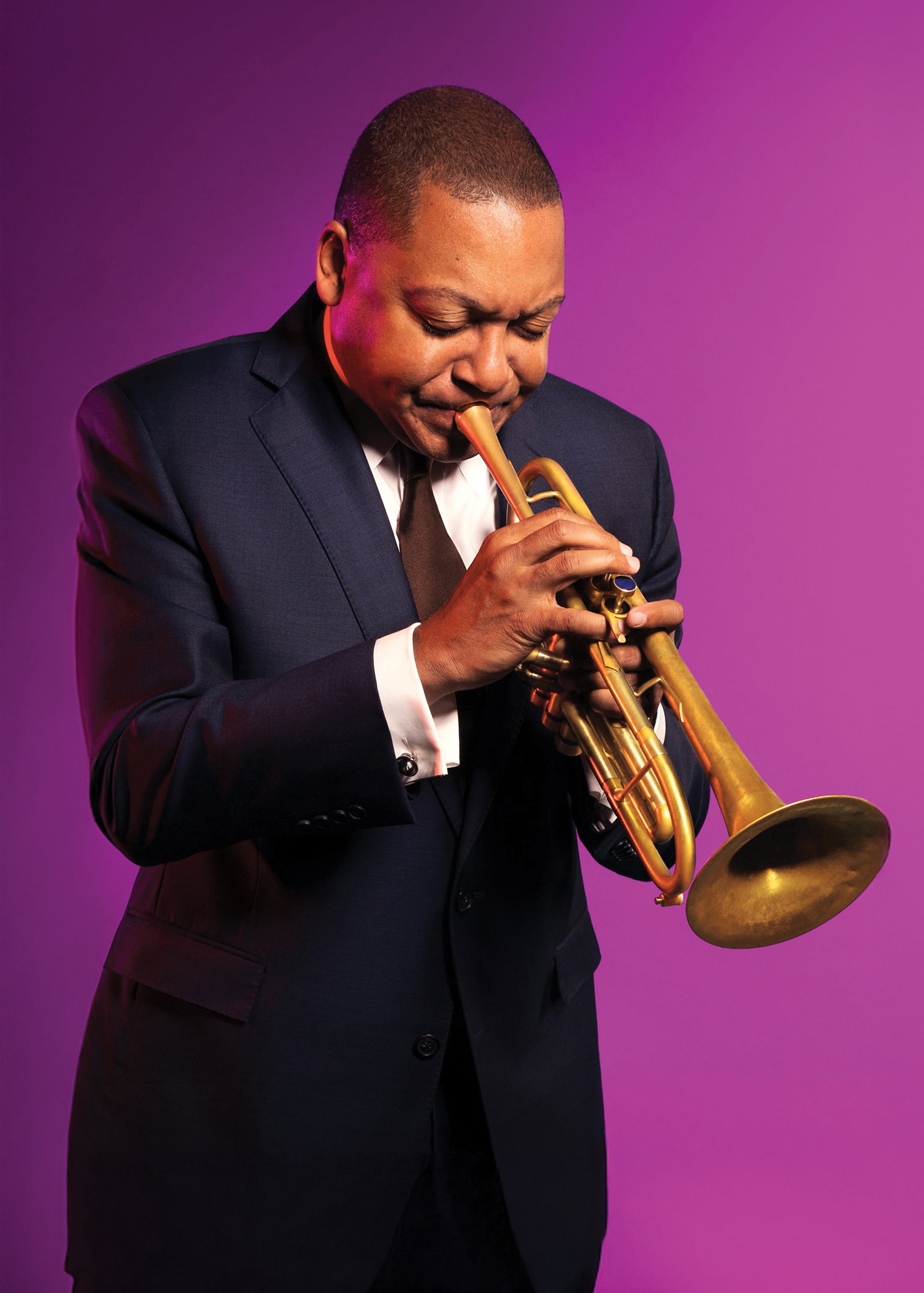
Photograph courtesy Piper Ferguson
What is the sound of America? Jazz icon Wynton Marsalis, 64, has been probing that question for most of his life. From his Pulitzer Prize-winning 1997 oratorio Blood on the Fields, which told the history of slavery, to Liberty, a new piece he wrote to celebrate the nation’s 250th anniversary, the New Orleans native has had an ear firmly fixed on telling the story of our nation, from triumph to tragedy and 340 million shades in between.
That charge is especially relevant in a celebratory year when the nation’s 250th has felt fraught with the weight of partisanship, division, and at times a loaded view of what defines an American. Which is why Marsalis says the battles he’s fought over the past half-century—in favor of cultural education and against vulgarity in music—are part of what he sees as a “long-standing struggle” to liberate his audience, sometimes against their own will if necessary.
“It’s been a blessing for me to have these struggles and to be able to talk about our education system and our politics and the choices we make,” he says about what inspired him to write his Symphony No. 5 (Liberty), which he’ll perform at Music Hall with his Jazz at Lincoln Center Orchestra on October 2. “And to try and liberate us from our prejudices and our ignorances and break free from the shackles that we have accepted.”
The trumpeter, composer, and nine-time Grammy winner is the second eldest of six sons born to pianist and music teacher Ellis Marsalis Jr. and Dolores Marsalis. He’s spent much of this year focused on the music that made this country. After announcing that he planned to step down as artistic director of the Jazz at Lincoln Center, four decades after founding the organization, he’s hitting the road this fall to premiere his latest original symphonic piece.
Liberty premieres September 12 at Wolftrap in Vienna, Virginia, and gets its second airing at Music Hall under the baton of Cincinnati Symphony Music Director Cristian Macelaru, an old friend and colleague of Marsalis’s whose enthusiasm about the co-commissioned piece is unbounded. “I really think that Wynton has become, for me, perhaps the most important voice today that’s able to comment on the American experience and the America of today, but in the language of music,” says Macelaru. “He has consistently spoken of the importance and beauty of democracy and liberty, but at the same time he does not shy away from criticizing the things we can do better.”
For Macelaru, Marsalis’s unique musical and stylistic language—neither just jazz nor just classical, but a “melange” of the two that comes from his birthplace and birthright—makes him a a “philosopher about the American experience.”
In this case, Macelaru says his job is less to conduct than to listen while working with Marsalis and the brass-heavy, 14-piece Lincoln Center orchestra. And despite the brief rehearsal period they’ll have to work out the piece, he has no worries about connecting with his longtime friend and Marsalis’s airtight ensemble. “When they perform, they don’t really rely on a conductor and the visuals of a conductor but more on purely listening to each other, which makes it fun for me because I don’t have as much responsibility,” says Macelaru. “I can be a bit more playful and funny and enjoy the music like the audience.”
Plus, because Macelaru and Marsalis have been close friends for more than a decade, the CSO leader is perfectly fine with putting the “huge amount of blind trust” in the hands of Marsalis. He won’t hear Liberty performed in the room until rehearsals begin with the Lincoln Center Orchestra.
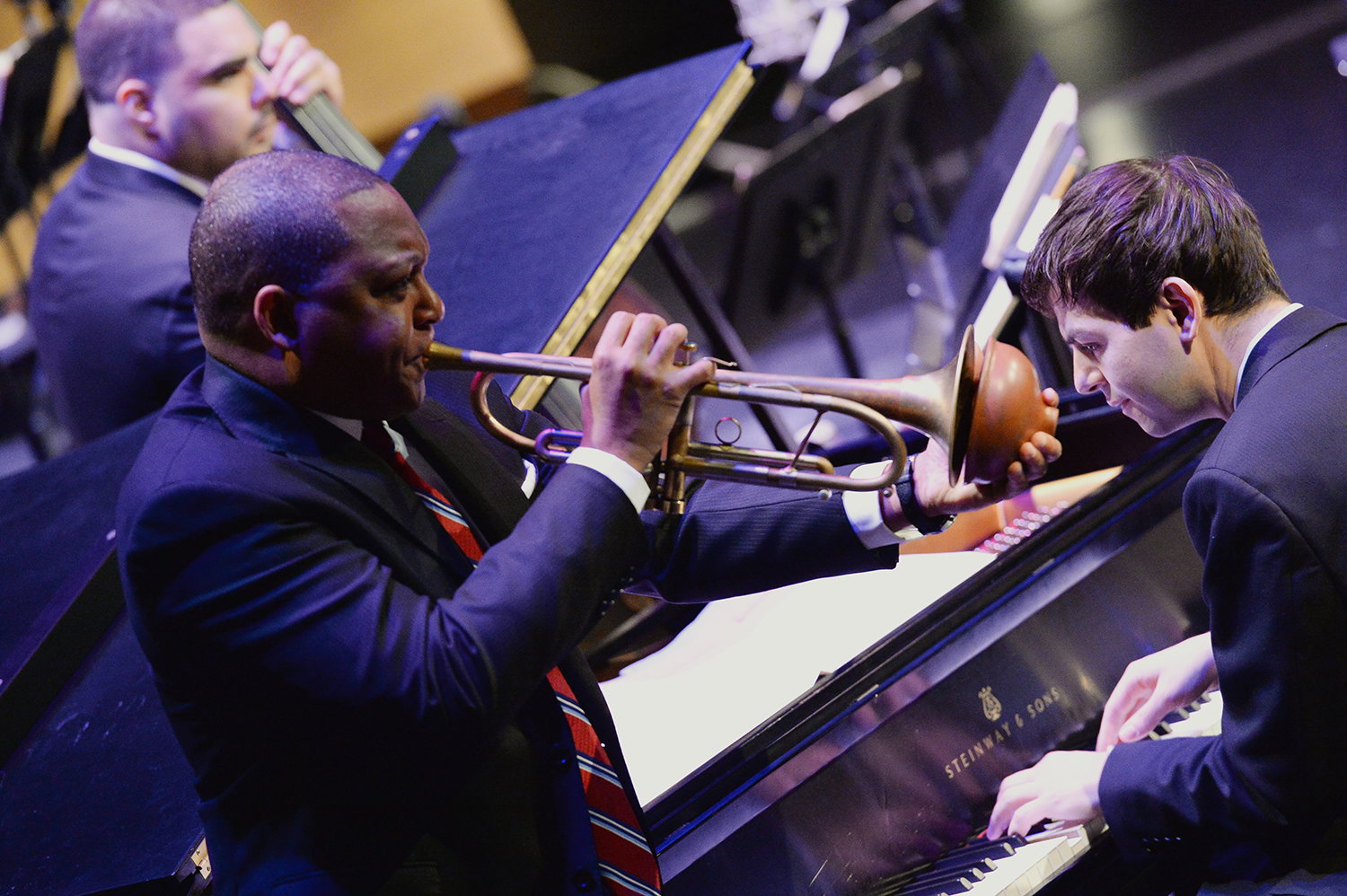
Photograph courtesy Frank Stewart
Asked to describe what patrons will hear, Marsalis says it will be music they know—a melting pot of American sounds and influences arranged in a new and innovative fashion. He cites the blues, fiddle reels inspired by Celtic music, Afro-Latin grooves, hymns, church-choir-like chants, and the optimistic feeling of a New Orleans march and ragtime jazz.
“It’s the impulse of those things,” says Marsalis. But, like the enduring search by science to find the smallest possible particles, Liberty is part of his lifelong pursuit of the “DNA of our music, what are our metaphors and mythology?” In what he describes as “these dark times of democracy,” Marsalis says he wondered if he would land in a pessimistic state while writing Liberty. “But I still ended with the optimism I have, because sometimes pessimism is self-indulgent.”
Marsalis says his relationship with the audience is always front of mind as he writes music. “I’ve been blessed to have sold out or largely sold out venues across all of these years, playing music that’s not always in the public ear-space,” he says. “When I’m writing pieces I’m always thinking about the audience: This big crescendo is going down to this small part, and we need to have this vamp—can they follow this melody here? I’m just trying to entertain people with music, not with extra things that take you away from the music. Music is very specific from an emotional standpoint. Words are not as specific as music.”
The October collaboration is another happy reunion for the pair who immediately bonded when they met more than 10 years ago over their shared musical lineage as sons of large musical families. Macelaru says he’s performed every piece Marsalis has written for orchestra, and the men share the 2020 Grammy Award for Best Classical Instrumental Solo with violinist Nicola Benedetti, who will perform Bruch’s Violin Concerto No. 1 on the night of Liberty’s Cincinnati debut.
“For me it’s not just a celebration of America’s 250th—‘happy birthday everyone, go happy’—it’s so much more,” says Macelaru. “This is really an important moment where we can redefine the values we share and hope and dreams for the future.”
The maestro, who came to the U.S. from Romania as a teenager to pursue his musical dreams, notes that it would be a shame to waste an opportunity to celebrate all the things this country does so right while not also revisiting things we can improve on. “Wynton is the perfect person to do that,” he says.
Marsalis says Macelaru’s background prefectly complements his new work’s point of view. “Coming from Romania, Cristi also has a relationship with freedom and what’s required to sustain it and maintain it,” says Marsalis. “And he and his wife, Cheryl, who’s also a musician, worked for years in Houston, in the South, so we have a lot of different points of connection. I’ve been to his home in Romania, and his mama cooked for us and our whole band.”
In addition to his warm relationship with Macelaru, Marsalis says he has a lifetime of good memories from previous Cincinnati visits, including his 1986 gig at Bogart’s with his jazz quartet as well as a 2008 Aronoff Center show with what was then called the Lincoln Center Jazz Orchestra. The latter included a master class for CCM jazz majors and local high school students in the Patricia Corbett Theatre and a memorable sit-in at the Blue Wisp Jazz Club that Marsalis says he still thinks about to this day.
The CSO’s Jazz at Lincoln Center Orchestra Festival continues October 3 with Marsalis’s Violin Concerto and Mussgorsky’s Pictures at an Exhibition and concludes October 4 with a full program jazz performance by the Lincoln Center Orchestra.