


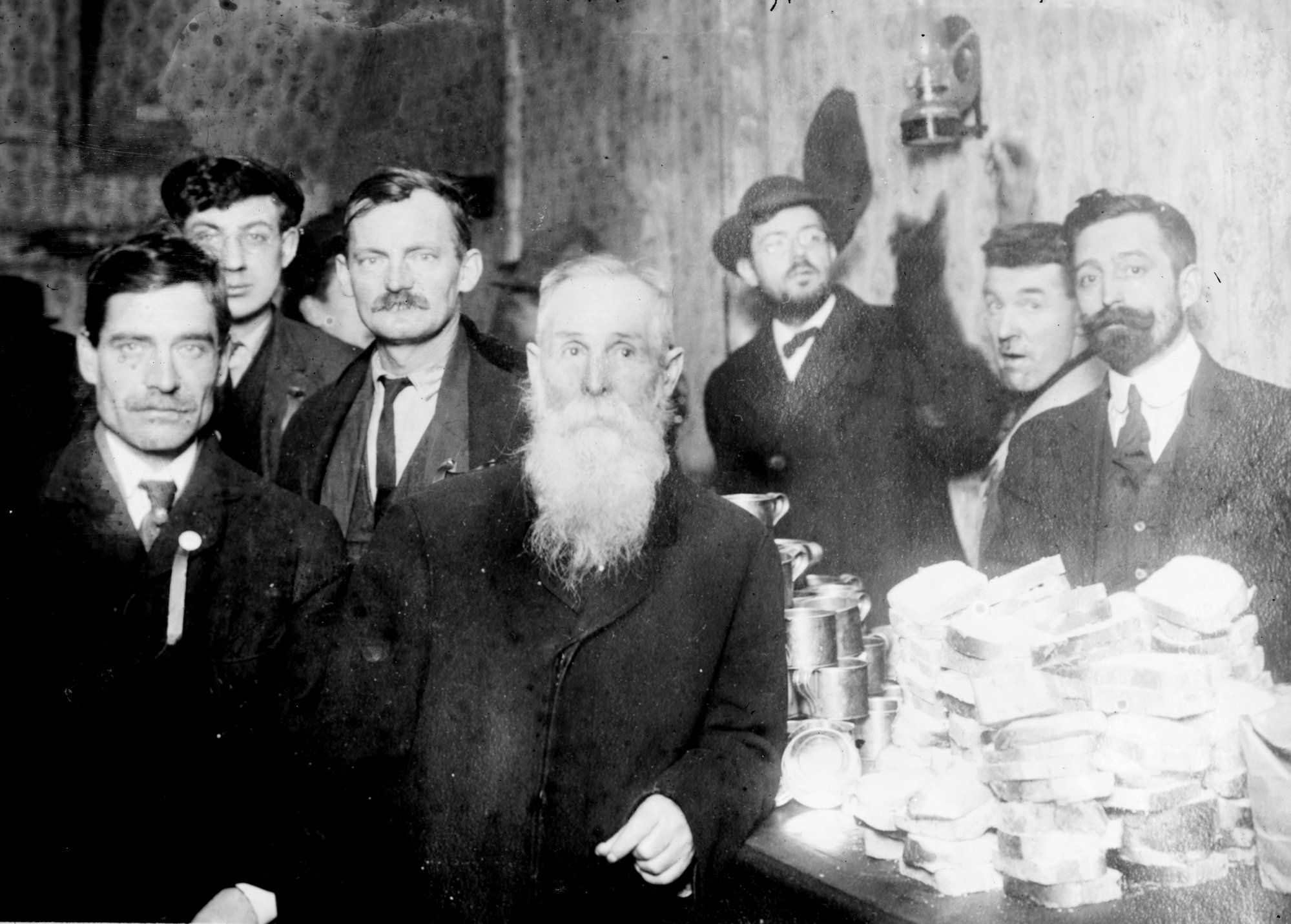
Photograph from Library of Congress
The Panic of 1910-11 was a minor blip compared to many other recessions and depressions in United States history. The economic damage that year was largely confined to stock portfolios. Unemployment remained almost steady. Still, there were a lot of people out of work and, as the Panic eased in 1912, hundreds of those unemployed men descended on Cincinnati, seeking jobs and better working conditions.
Because they were unemployed and traveling to look for work, they were called hobos. They called their gathering a Hobo Convention. Cincinnati Mayor Henry Thomas Hunt, known, at age 33, as the “Boy Mayor” wanted the hobos out of his city. According to the Cincinnati Enquirer [Jan 31, 1912]:
“’What’s this? A hobo convention! Not if I know it!’ Mayor Hunt told Police Chief William H. Jackson. ‘Chief, you will see to it that these people do not meet in this city. If any of the delegates arrive for this affair, you will see that they are given proper transportation to the workhouse, where they may convene to their heart’s content. This city has already too much of this class and we want no more, even if their leader is a reputed millionaire.’”
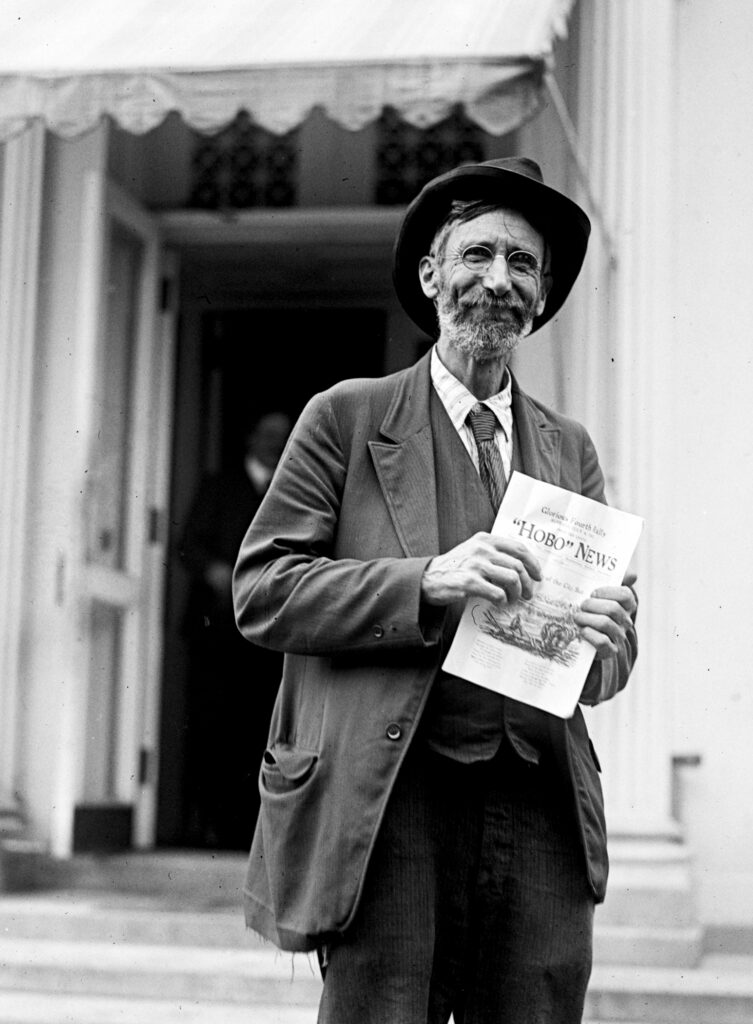
Photograph from Library of Congress
A millionaire hobo? It was true. The organizer of the 1912 Cincinnati Hobo Convention was James Eads How (1874-1930), scion of a wealthy St. Louis family. (The Eads Bridge over the Mississippi was built by the family patriarch.) Mr. How, even as a child, rejected the comforts of the family fortune, of which he said, “It is not mine. I did not earn it.” How studied theology at a Unitarian college, attempted to found a monastic order at Harvard, joined George Bernard Shaw’s Fabian Society while studying at Oxford, became a life-long vegetarian and studied medicine in New York.
Eventually How decided to assist the hobos, the migratory unemployed (mostly) men wandering America, as a proper outlet for his efforts to improve society. According to sociologist Nels Anderson, who has written about How’s hobo projects, How saw hobos as a class of people that was crucial to American industry but marginalized from society. How became known as the “Hobo King” because he spent most of his time living among the hobos in an effort to understand them and gain their trust. How decided not to give money to hobos, but to help them in other ways. He created many short-lived “hobo colleges,” founded communal houses providing shelter and food, started a hobo newspaper, and tried to organize them at hobo conventions like the one in Cincinnati.
By Jan 30, 1912, there were reports that the vanguard of the convention, formally known as the National Convention of the Migratory Unemployed, had arrived in Cincinnati.
“It is a plan of the National Chairman,” the Enquirer reported, “to have headquarters established in every city for the unemployed, which shall be a home for them where they can be kept away from the saloons and be taught to save their money when they obtain employment.”
Nicholas Klein, How’s attorney, issued a statement questioning the Mayor’s orders in light of Constitutional protections for the right of free assembly, and framing the convention in words that ring familiar today:
“Is it a crime to be homeless and starving, because no labor of any kind may be obtained? ”
By February 2, 1912, there were more than 600 hobos in Cincinnati, conducting meetings “in a very organized and business like manner” in temporary quarters at 309 Sycamore Street (a four-story brick building that still stands today).
“There are hobos of all kinds,” the Enquirer reported, “And yes—there are some ‘bums,’ for the members of this unusual convention think there is no disgrace attached to the name ‘hobo,’ nor yet to ‘tramp,’ but ‘bum’ means the ‘Weary Willie’ kind.”
We need here to clarify that hobos are not synonymous with tramps or bums. H. L. Mencken, in his The American Language (4th ed., 1937), outlines the distinctions:
“Tramps and hobos are commonly lumped together, but in their own sight they are sharply differentiated. A hobo or bo is simply a migratory laborer; he may take some longish holidays, but soon or later he returns to work. A tramp never works if it can be avoided; he simply travels. Lower than either is the bum, who neither works nor travels, save when impelled to motion by the police.”
Among the characters who attended the Cincinnati convention was Harry Wilson, a printer from Chicago, distributing buttons to the delegates that read, “I am an undesirable citizen.” Jack London, the writer (The Call of the Wild, The Sea Wolf) who sometimes lived as a hobo “for experience sake” attended. Pioneer social worker Jane Addams, of Chicago’s Hull House, sent regrets.
Rev. Boyd Edwards, assistant rector of Cincinnati’s Christ Church, welcomed the convention to the city. His kind words almost made up for Police Chief Jackson’s greeting committee of newly recruited railroad “bulls,” who arrested anyone riding the rails within city limits.
Among the elected officers of the convention was Mrs. Cora D. Harvey of Oklahoma City, the only woman in attendance, who was known as “Queen of the Hobos.” She had a thing or two to say about income inequality:
“The real hobos were the young Goulds, Vanderbilts, Astors, Huntingtons and others of the millionaire class, and the difference between them and the members of the convention was that they get their handouts through the front doors of capitol buildings in the form of special legislation and the hobos get theirs from the back doors in the form of pies and sandwiches.”
By Saturday, February 3, 1912, the Enquirer reported more than 1,000 “tramps” in Cincinnati for the convention. After two days, the convention had passed resolutions supporting the removal of all restrictions on voting for citizens of legal age, establishment of a national eight-hour workday law, a national child labor law prohibiting employment by anyone under 16 years of age, and the establishment of national employment bureaus in all post offices. The conventioneers also voted to march silently to City Hall to urge Mayor Hunt to find employment for Cincinnati men out of work, and a couple hundred hobos did so, stomping single-file through a substantial snowstorm.
Before the convention formally closed on Saturday evening, all in attendance gathered for some songs. The Enquirer reported:
“Tears stood in the eyes of many of these homeless men when the strains of ‘Home Sweet Home’ were sung, and a hushed silence fell upon the assembly at the close.”
After the conventioneers split town, Sarah Silberberg, owner of the building in which the hobos convened, discovered that her guests had availed themselves of a cellarful of jams and preserves she mistakenly thought she had sufficiently secured.