


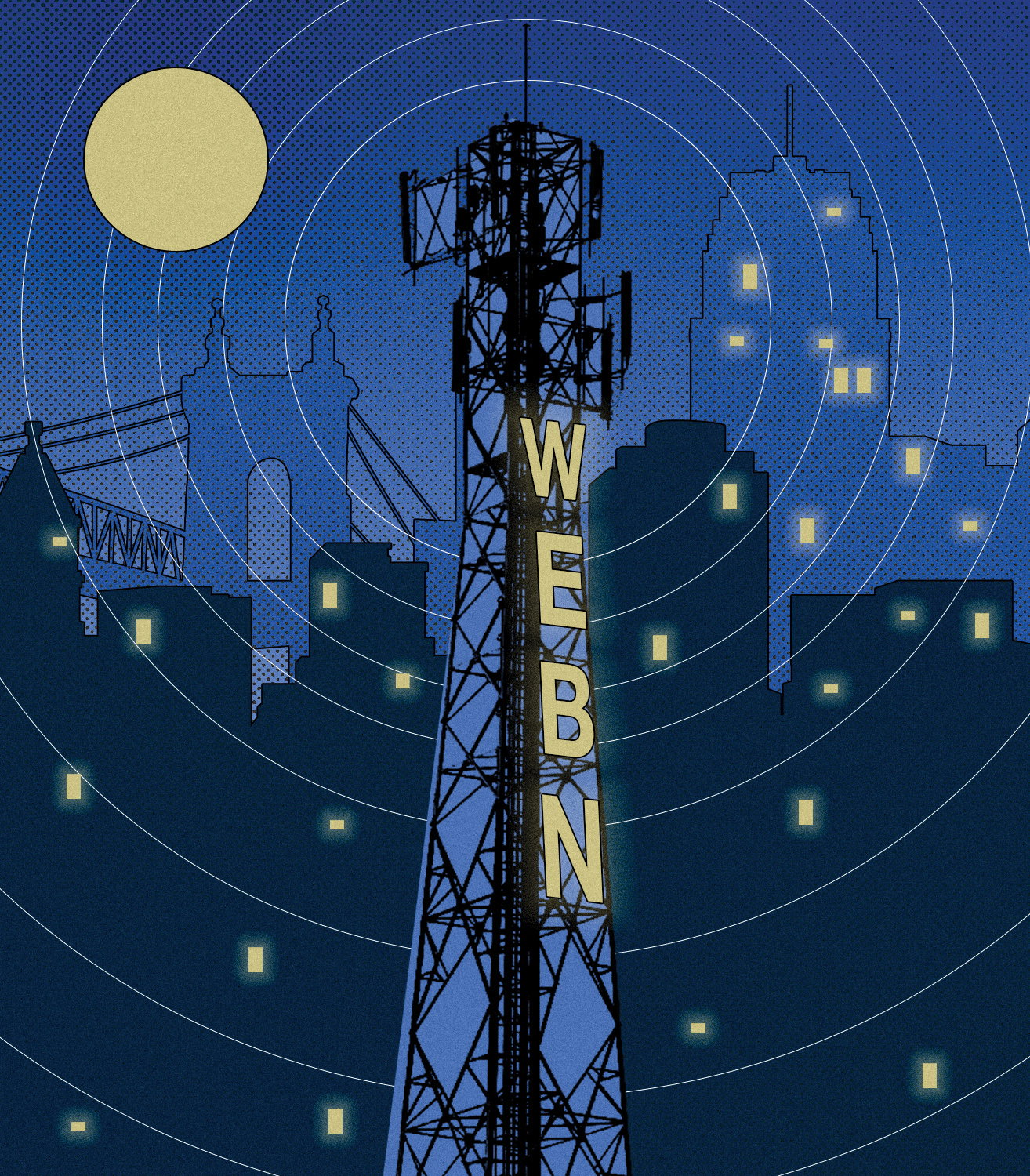
Collage by Carlie Burton
America’s bicentennial was even wilder than this year’s craziness. For me, anyway.
I want you to stop reading this Living in Cin column at the end of this opening section. More words are obviously waiting down below that point, but ignore them for now. Just stop when I tell you, and here’s why.
Half a lifetime ago at WEBN, Cincinnati’s historically rebellious radio station, I took part in an audio project that became one of the best—hell, maybe it’s the very best—piece of work of my career. But almost no one has ever heard it. I’m frustrated. The work was so connected to a specific moment in history that it was broadcast in its entirety only once: on July 4, 1976, for the U.S. bicentennial. After all that sweat, just one frigging time! At midnight!
Now, 50 years later, a brief window has opened for you to appreciate this work. The timing is good, because we’re currently going through much the same orgy of patriotic excess in 2026 as happened a half-century ago. Back in 1976, though, WEBN was staying true to its reputation as a rebellious brat by aggressively avoiding that year’s circus. We aired no bicentennial events, sketches, or contests.
It felt good being an oasis from the craziness, but toward the end of June we realized that we ought to do something for America’s 200th birthday. How about making a soundbite collage celebrating our favorite things about the nation, lasting five minutes or so? Fine, we said, let’s do it.
And then, as we began, something weird happened. We couldn’t stop. We became possessed for more than 72 sleepless hours. Snippets of recording tape flew around like we were making a U.S. flag out of confetti. Simultaneously, we raced around town searching for the countless iconic soundbites we needed. That’s right, kids: Today you can download iconic soundbites in seconds, but in 1976 we had to walk five miles in the snow for them. In July.
And now, the punchline: The finished piece turned out to be more than three times as long as our original concept. More than 15 head-spinning minutes. It would have been even longer had the clock not run out and forced us to broadcast it at exactly midnight on July 4, 1976. Here, then, is the story of our marathon to create a tribute to America and of the American ingenuity that got it done. But first—right now, dammit—you must hear this thing. Dim the lights. Silence the phone. Stop reading. And listen here.
Thanks for listening. It’s a lot, I know. Depending on your age, you perhaps didn’t recognize that old Pepsi commercial or that Chuck Berry song or the Mexican outlaw saying he ain’t got no stinking badges or WEBN’s original musical logo at the end. (If you didn’t make it to the end, that’s OK. Try again later). That’s why I am hereby providing you with a playlist identifying every single soundbite in the collage. You’re welcome.
Using today’s resources, you can now assemble the whole thing yourself in hours instead of days, or simply get an AI agent to scoop up the soundbites and finish everything in 20 minutes (including all of the same subtle crossfades instead of blunt edits, you lazy bastard).
It took three people four days and nights to create “The WEBN Bicentennial Collage,” which we nicknamed “Life, Liberty, and the Purfuit of Happineff.” Most of the work came from WEBN’s production guys, Tom Sandman and me. Jim Cavanaugh, a member of our news department, also contributed in a significant and unusual way which I’ll explain in a bit.
Why couldn’t we stop at five minutes? What made the three of us keep adding stuff? Part of it, I think, was almost biological. We’d chosen careers as audio professionals because the media sounds we heard since childhood are forever swirling in our heads. It’s not a choice for people like us; those earworms are always playing. We were born to do this.
WEBN had thousands of records, so grabbing the clips from songs was easy, with certain exceptions. A rock station doesn’t have artists like Frank Sinatra, Merle Haggard, or John Philip Sousa laying around, and we wanted to drop in those kinds of surprises. Various WEBN staffers brought us records from home, as did family and friends who were understandably annoyed at having to search for LPs while planning their big holiday weekend. I don’t think we had to stoop to visiting a record store, but maybe I’ve suppressed the memory.
The truly steep mountain was finding audio from movies and TV shows. That’s right, kids: Hollywood didn’t start selling video cassettes until 1977, so we had almost nothing. If Thomas Jefferson had put off writing the Declaration of Independence until 1780, our job would have been so much easier! WEBN’s library did have some spoken-word LPs with pieces we needed, but our biggest stroke of luck was Cavanaugh, who had a part-time job at WCPO-TV.
Back then, a lot of late-night and weekend TV consisted of old movies, and WCPO had a large film library. Was Jim willing to sneak in there, thread up the relevant reels on their 16-millimeter projector, record the soundbites, rewind the reels, and bring the audio back to us? Do you have to ask? Have I mentioned that the three of us were possessed?
I haven’t even brought up the most obvious obstacle we faced: our regular jobs. Radio newscasts and commercials don’t write and produce themselves, you know. (Well, now they do, but they didn’t back then.) And, for me personally, topping all that stress was the fact that I was about 10 weeks away from becoming a father. No pressure.
Sandman and I, with ideas spewing like a firehose, installed ourselves in separate studios wrangling records, turntables, tape machines, and splicing equipment. Hanging strips of tape around the room like decorations. By the way, I’m lying about the “separate studios” part. WEBN had only one production studio in 1976, forcing the two of us to figure out ways of working independently in the same room.
We re-routed certain equipment to send audio to just Tom’s headphones and other gear to send audio to just mine. Two guys recorded and edited alone, feverishly, while never more than two feet apart. Our only communication was the occasional Excuse me as we climbed over one another.
Cavanaugh worked across the hall in the even smaller WEBN news studio, assembling about one-quarter of what you hear in the collage and providing almost all of the movie soundbites stolen from WCPO. I wanted to get ahold of Jim to share memories for this article, but I couldn’t find him. Anybody know if he’s still around?
As darkness fell on July 3 and midnight approached, we had to let go. Razor blades down. Thread it up. Roll tape. One broadcast, and that was it.
I worked various jobs at WEBN for 38 years, longer than anyone. My thousands of radio shows are mostly gone, but lots of fake and real commercials, song parodies, Fools Parades, and random oddities still exist. Some of it—the early stuff—I would never, ever let you hear now. “It has not aged well” is an understatement.
But this one piece from 50 years ago? Sandman and I agree that it remains one of our proudest achievements. We remember what we went through to get it done. If Jim is still out there, I’m sure he feels the same way. We were three guys who slugged away for days at something that nobody had ordered us to do and worked God-knows-how-many hours without sleep, never expecting a dime of extra pay. That must mean we were working at Cincinnati’s WEBN, the luckiest jobs of our lives, celebrating America’s 200th birthday by doing the most American thing possible: flying freedom’s freak flag for no other reason than because we wanted to.
Thanks for adding yourself to the still-tragically small number of people who have heard our forgotten masterpiece. Without a doubt, you missed some of our clever juxtapositions the first time through. Listen to it again!