



Photograph by Timothy E. Black
Around 1883, Harvard archaeologist Frederick Ward Putnam arrived among the lush, rolling hillsides of southwest Ohio, intent on restoring a mysterious earthen mound. It was located on a plot of land he’d bought from a local farmer with financial help from a group of Boston ladies, among them an “Indian enthusiast.”
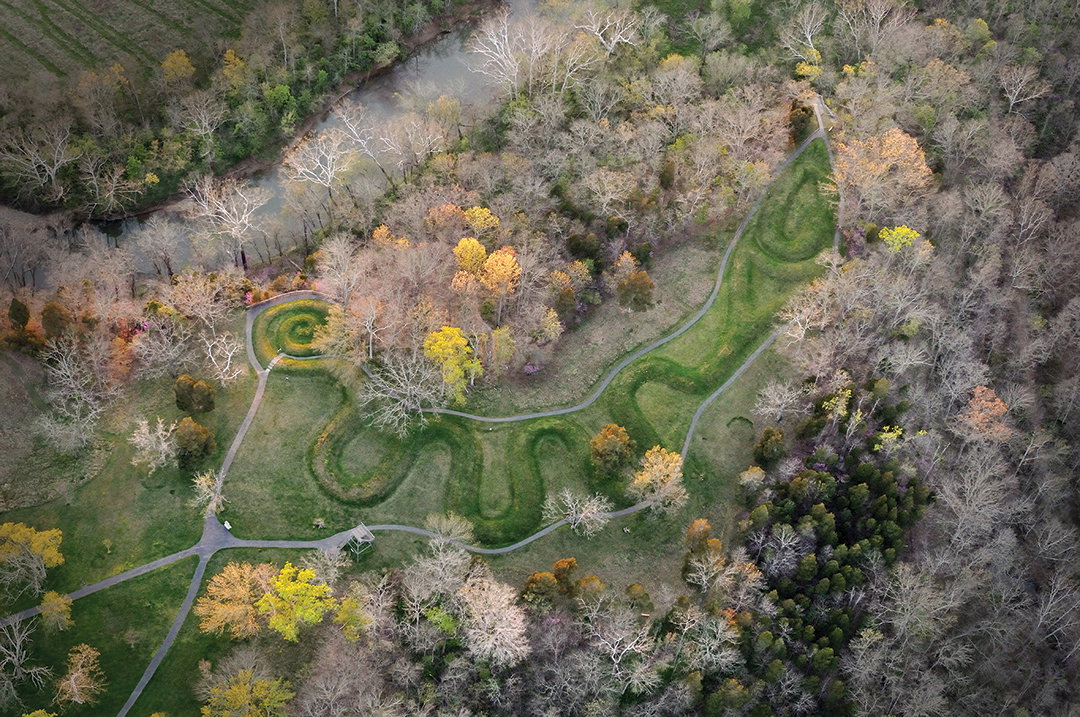
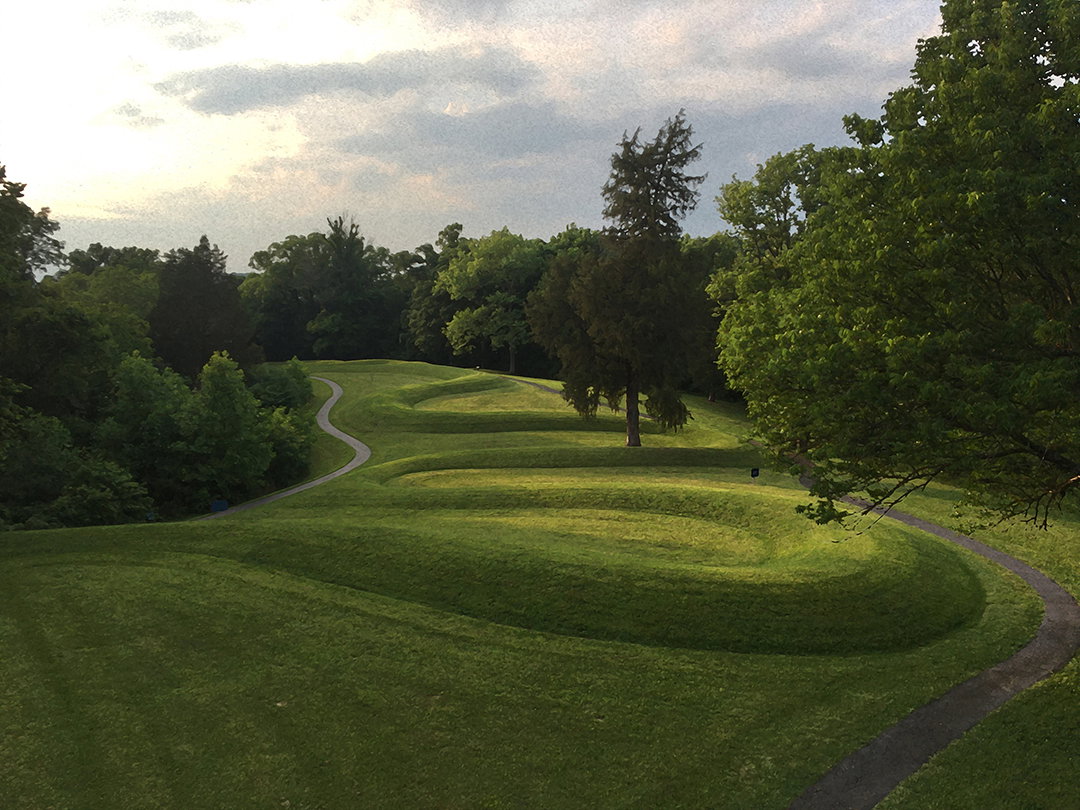
Shaped like a giant serpent with a precisely coiled tail, seven rolling humps, and an open mouth surrounding a giant oval, the effigy stretched more than 1,300 feet from end to end at the edge of a rock bluff overlooking Brush Creek. When Putnam arrived, the mound was part of a working farm and in danger of disappearing. Cattle trod alongside it daily. Farmers tilled over it to plant crops.
Putnam lived on-site in a canvas tent for three years as he excavated, explored, and rebuilt Serpent Mound. With no oral or written records to assist, he tried to figure out who so meticulously built the giant effigy and why, but he also sought to preserve it. What he found was indeed mysterious: a giant dirt snake holding no bodies or artifacts; three surrounding hill-shaped mounds containing Native American remains and artifacts; and the remnants of a Native American village.
The findings ignited more than a century of questions, theories, and interpretations, some of which strain credulity. Is the Serpent Mound the Garden of Eden, a spiritual mecca, a portal to another world? A marker for an alien refueling station? Was it built by biblical giants? An extinct race of technically advanced humans? Or the ancestors of Native Americans living in the Ohio River Valley?
The only evidence on record actually recovered from the site points solely to Indigenous inhabitants, including the bones and artifacts Putnam found, which he extracted and shipped off to Harvard’s Peabody Museum, where they remain today. He also sealed up the village, intact, before Harvard transferred ownership of the site in 1900 to the nonprofit Ohio State Archaeological and Historical Society “for perpetual care as a free public park,” per the original granite sign on site. In 1964, Serpent Mound was designated a National Historic Landmark. Later, the group overseeing it was renamed the Ohio History Connection (OHC).
Meanwhile, science kept advancing, and new technologies enabled archaeologists to more accurately date the earthen structure; researchers also confirmed that the head of the serpent was nearly perfectly aligned with the setting sun on the summer solstice and the tail with the setting sun on the winter solstice. Geologists learned that Serpent Mound was built on the edge of a 200-million-year-old asteroid impact crater full of magnetic anomalies.
In short, this mysterious place continues to inspire questions rather than provide answers. Add in that archaeology is, by nature, an inexact and ever-changing science and the fact that the only ones who might have known what Serpent Mound was—the Native Americans who lived here before us—were forcibly removed by the U.S. government in a near mass-extinction event, and it becomes clear that those trying to study the land today have an uphill battle.
Photograph by Brad Lepper
every person interviewed for this piece, in fact, admits that their theories, though often backed by decades of research, lived experience, and/or detailed study, are nothing more than hypothesis or educated conjecture. Still, there are some things we do know about Serpent Mound.
For starters, the land Putnam spent three years excavating wasn’t always farmland occupied by settlers. Native Americans of various cultures and tribes had been living in the Ohio valley for thousands of years, well before Ohio became a state in 1803—a theory supported by remains and artifacts archaeologists have extracted from Serpent Mound, including a roughly 13,000-year-old Clovis spear point. “People, from the beginning, have been walking on that landscape,” says Brad Lepper, senior archaeologist for OHC’s World Heritage Program since 2021.
But as the fledgling United States expanded westward, settlers conflicted regularly with Native peoples. President Andrew Jackson felt the only solution was to sign the Indian Removal Act into law in 1830.
On paper, the act allowed the U.S. government to negotiate with Native Americans in the southeastern part of the U.S. for land; in reality, it sparked a decade-long mass removal event known as the Trail of Tears that, under Jackson’s successor, Martin Van Buren, ultimately culminated in the relocation of more than 50,000 Eastern Native Americans to new “Indian Territory” west of the Mississippi River. Several thousand more died on or after the journey.
As the Indigenous people left, settlers took over millions of acres of land. By the time Ephraim Squier and Edwin Davis first published information about Serpent Mound in 1848, no one living there had any idea why it was built or by whom.
Putnam’s work on site in the late 1800s led him to believe the mound was built in what’s now known as the Adena Period (1000 BC/BCE through 100 AD/CE, according to OHC). But since the mound itself contained no artifacts or bodies, only soil, that theory was based more on educated opinion than anything else.
A mysterious colleague with the surname MacLean visited the site during Putnam’s tenure and documented by map a wishbone-shaped structure he believed was located just above the egg-shaped mound. Lepper imagines “it was confusing to [Putnam], apparently,” because no one ever rebuilt it, and believes the wishbone mound is now hidden somewhere beneath the asphalt path surrounding the oval. More on that later.
In an OHC article co-authored by Lepper and Shawnee Tribe Chief Ben Barnes, the pair state that archaeologists who have studied the site agree that: “Ancestors of American Indians built the mound.” Lepper and Barnes say this is because every shred of evidence found on or near the site is what they each call “anthropogenic,” originating in human activity.
But what they and other archaeologists can’t seem to agree on is which specific Native Americans, and when. Lepper has been thinking about Serpent Mound since he started at OHC in 1988 as curator and site archaeologist for the Hopewell-built Newark Earthwork. He was instrumental in getting the site inscribed on the UNESCO World Heritage List, which includes more than 1,200 properties worldwide that, per the organization’s website, have “outstanding universal value.” He is hopeful the same will happen for Serpent Mound, which is already on a list of sites for consideration.
The evidence Putnam obtained from the burial mounds and village on-site shows Indigenous human presence during three distinct periods: Adena, Hopewell (100 BC/ BCE through 400 AD/CE), and Ft. Ancient (1000–1650 AD/CE).
In 1991, Lepper set out to settle once and for all when Serpent Mound was built by using radiocarbon dating on charcoal only—the “gold standard” in archaeology, he says, because it shows evidence of human activity (i.e., fires)—from three different spots in the same section of the mound Putnam had excavated, so as to do “the least possible damage to the intact portion of the mound,” he says. Two of the samples “yielded identical AMS radiocarbon dates” of between 801 and 1,028 years old, which would place the mound’s building between 990 and 1225 AD, a time when the Ft. Ancient people were prevalent in what is now known as Ohio, he says. But because Lepper and his team were sometimes unsure where the mound fill ended and the undisturbed soil beneath it began, the third core sample ended up coming from a depth that Lepper later determined was more than 70 centimeters below the base of Serpent Mound, so it dated much older—to 1068 BC. Because of the incorrect depth, he set the outlier aside and instead focused on the other two samples.
His assessment stood until 2012. That year, William Romain, an archaeologist specializing in archeoastronomy (the study of how ancient cultures related to and understood the sky), obtained permission from OHC to further explore the mound. A research associate at Indiana University (IU), he’s managing editor of the Journal of Astronomy in Culture and a recipient of the Robert Converse award for outstanding contributions to Ohio archaeology.
Romain’s interest in Serpent Mound began in 1987 when he first mapped it; in 2011, he and a team of experts utilized both soil core samples and several new technologies to map the land inside and beneath the serpent, including ground penetrating radar; aerial LIDAR, a technology similar to radar that uses laser light pulses to measure or map areas or objects; ERGI, electrical resistivity ground imaging, a means of mapping below ground by measuring variations in electrical resistivity; and magnetic gradient surveying, measuring changes in the Earth’s magnetic field, which can indicate the presence of buried features or artifacts. Among his team was Bill Monaghan, former director of IU’s Glenn A. Black Laboratory of Archaeology, “one of the top geophysicists in the world,” says Romain.
The team extracted samples from 17 different locations across the serpent’s entire body and recovered datable materials from seven. They didn’t test just soil that included charcoal, as Lepper did, but also extracted bulk sediment samples, where carbon was mixed in with the soil. The samples were then sent to a lab, Beta Analytic, Inc., “who advised me that the samples ‘provided plenty of carbon for an accurate measurement,’ ” says Romain.
In addition to staying clear of the areas where Putnam, and later Lepper, had excavated, Romain took great care to gather samples from areas of the mound where Monaghan could clearly distinguish between the base of the mound and areas below it.
Romain’s results stood in stark contrast to Lepper’s. His results showed that Serpent Mound was constructed between 381 and 44 BCE, with a median date of 321 BCE, placing it back in line with Putnam’s theory that it was built in the Adena period.
Romain also notes that there were “absolutely zero” pieces of charcoal or artifacts from Lepper’s proposed Ft. Ancient time period at the bottom of the mound. “Nothing, not one flake, no trace of Ft. Ancient materials,” he says. “Zero.” Lepper’s research was flawed, Romain speculates, because Lepper and his team did not sample at the base of the mound. Romain believes the younger dates Lepper obtained are real; he just thinks they’re reflective of subsequent restorations or occupations of the mound.
“I don’t see any evidence of that,” says Lepper on the restoration theory. In response to Romain’s work, he published a detailed paper to argue why he believes his method of dating is superior and why Romain’s was unreliable and likely skewing older. He also notes, “If you look at symbolic objects used by the Adena, there are virtually no representations of serpents. If you look at the Ft. Ancient culture and the broader Mississippian culture, of which the Ft. Ancient were a part, there are serpents on everything: pendants, tablets, rims of pottery.”
There are also thousands of other effigy mounds built in the upper Midwest between 700 and 1100 AD, Lepper says, including Alligator Mound in Licking County, another Ohio effigy mound Lepper excavated, which has charcoal embedded in the soil that dates to the Ft. Ancient culture. “If Serpent Mound is Adena,” he says, “it’s a bizarre outlier, since every other effigy was done during this later period.”
Frustrated by the conflicting research and not wanting to further excavate the mound, Lepper began thinking about the site in relation to other Native American artworks from similar eras and communities. When he came across a book about Missouri’s Picture Cave—a now privately-owned Osage site with a cave full of nearly 300 ancient wall drawings—he noticed that one of the panels showed a serpent next to a big oval next to a splayed leg figure. The authors, he says, believe the three images were painted by Dhegihan Sioux to represent a creation story involving “first woman,” who, through a sexual act with the serpent, acquired its power to create life on Earth. Instantly, Lepper thought of the mysterious wishbone-shaped mound MacLean drew in his own map of the site and wondered if the wishbone was actually the legs of “first woman.” Was Serpent Mound telling a similar story?
To the untrained eye, the cave drawings and Serpent Mound look nothing alike— the cave drawing oval is much larger, hairier, and nowhere near the serpent, plus its “serpent” is more of a slightly squiggly line. Yet the serpent piece of the story has loose roots in Native American tradition. Indeed, Barnes confirms, “Shawnee history incorporates serpents in many forms.” An Indian Country Today article quotes him saying, “The great serpent is present within our Shawnee traditions and religious practices today; this is our umbilical, our connection to the world below.”
And not just Shawnee, either. Hopewell, Pawnee, Cherokee, Arapaho, Chickasaw, Blackfoot, Peoria, Ojibwe, Aztecs, and others all have traditions involving serpents.
Lepper agrees that Serpent Mound is “a gigantic shrine to the serpent of the Beneath World,” noting that “the serpent had immense spiritual power that could be invoked through prayer.” But since he also thinks MacLean’s wishbone-shaped mound could originally have been part of the structure, he believes the oval shape between the woman’s legs and the serpent could represent a female vulva and would have served as a portal to the Beneath World for ancient cultures, where leaders made “offerings of supplication and thanksgiving to the powers of that other world in return for the power needed to save their world.”
Romain has always believed the mound was built to reference the Serpent of the Beneath (or Other) World and that Indigenous people felt the entire Serpent Mound area served as a portal. He’s looked to other sites to try and place Serpent Mound in context, but his search focused primarily on the more than 70 other earthworks and mounds peppered throughout Ohio, many of which are also somehow aligned with the sun, moon, or stars. His theory is that some of the Ohio earthworks, when examined together, tell different parts of a story about the journey a soul takes when a Native American dies.
Regarding the wishbone above the serpent’s mouth, Romain doesn’t think Mac-Lean’s map carries much weight given that the LIDAR, magnetic gradient surveying, and other survey images he took of the site show no remnants of such a structure. Besides, he notes, “There is no way it could fit on the promontory above the oval. It would hang over the end of the cliff.”
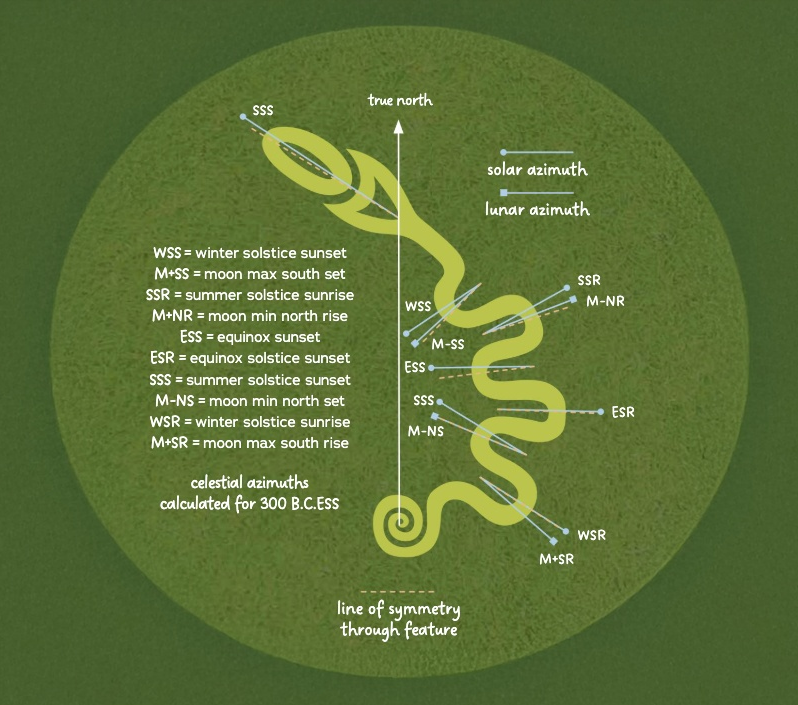
Illustration by Emi Villavicencio
According to Romain, Serpent Mound is an ancient burial ground and can be considered the terrestrial equivalent, or metaphor for, the Realm of the Dead. “It makes sense,” he says, “because the serpent represents the guardian and protector of the dead. This area is the portal to the other world in my view—and what else is a grave site, except the entrance to another world?”
Despite the fact he’s spent years studying the mound’s age and defending his research, Romain also admits that figuring out exactly who built the mound is never really going to happen. Muddying the waters, the Shawnee, who the OHC consults with in its management of the site in the absence of any federally recognized Ohio tribes or reservations, claim Serpent Mound is likely their ancestral land. “Our ancestors may well have built the serpent,” Barnes says in a 2022 Indian Country Today article. That could be true, given they definitively lived in this region, but it’s far from confirmed.
“People want to attribute Serpent Mound to one tribe or another for political reasons,” says Romain. “To me it’s obvious to say it was built by Native Americans. But to say which specific tribe built it 1,000 or 2,000 years ago is pretty much an impossible task. The Miami could have been in southwest Ohio, the Shawnee could have been in Southwest Ohio, and even the Cherokee, whose territory extended within 30 miles of Serpent Mound at the Ohio River.”
Photograph courtesy Ohio History Connection
If Lepper and Romain have each spent decades trying to understand Serpent Mound, Thomas Johnson has spent just as much time exploring the impact crater next door. The paleontologist moved here in 1978 to study Ohio’s state fossil, worked through the Smithsonian studying Ceasar Creek, and loaned the institution one of his Trilobite fossil collections for exhibit between 1985 and 2011. Today, he owns House of Phacops Rock Shop, roughly four miles from Serpent Mound.
Johnson has a theory that Serpent Mound’s impact crater is the only place on Earth where an asteroid has hit on a fault line. “I think it created a field of energy,” he says. “It isn’t written in science, but it’s observed.” As a result, he says, people who live near the crater regularly experience magnetic anomalies affecting computers, cars, batteries, compass needles, and even weather.
A 2003 report published by five researchers on behalf of Ohio’s Department of Natural Resources notes the many fault lines in the crater and acknowledges there is an angled line of “magnetic anomaly” running through essentially the center of Serpent Mound. The report does not, however, discuss any effects the anomaly might have on people who spend time near it.
Was Serpent Mound built purposely beside the impact crater, or perhaps inspired by it? On this, Lepper and Johnson sort of agree. “The Indigenous people certainly recognized it was a unique, jumbled geology,” says Lepper, “but there’s very little way ordinary people walking around would recognize it was a crater.”
Johnson, too, believes the crater and Serpent Mound “just happen to be next to each other.” That said, “The connection is the energy. People who are into energies can feel it in their bodies. They can tell you exactly where that fault line is because that’s where they want to do ceremony. Because Native Americans work with ground energy, they recognize areas and fields of energy and gravitate toward that.”
He then adds a verbal asterisk: “Who knows? It’s not written.”
Indeed, because there is no written or oral record, “Serpent Mound attracts more craziness,” says Lepper, which led him and Ohio State University’s Roth Cook to write a paper debunking various theories, which over time included the Garden of Eden, Nephilim, “Harmonic Convergence,” and alien theories—which caused an uproar after OHC allowed the show Ancient Aliens to film at Serpent Mound. Barnes expresses frustration at the seemingly ever-emerging theories. “How come it’s easier to believe that giants, ancient aliens, Nephilim, or any other fantasy built this site than it is to believe Indigenous people built it? It’s so improbable and impossible for people to think Indigenous people could have been so curious, industrious, and genius to have built places like Hopewell or Serpent Mound that we have to subscribe some fantastical idea.”
In the U.S., 27 places are already UNESCO World Heritage sites, ranging from Yellowstone to the Everglades, Grand Canyon, Statue of Liberty, and Mammoth Cave. Since 2023, the list also includes Ohio’s Hopewell Ceremonial Earthworks, eight 1,600–2,000-year-old “earthen enclosure complexes” along central tributaries of the Ohio River aligned to cycles of sun and moon. Lepper was instrumental in getting Serpent Mound considered for the UNESCO list; unfortunately, says Johnson, “The site was initiated and went through all the protocol but didn’t make the final draw because they couldn’t agree on the date.”
For now, says Barnes, the long-term goal is simpler: “Create a buffer around Serpent Mound and protect it for future generations.” That began this spring when the Shawnee purchased acreage adjoining the Serpent Mound site.
In an interview for Ancient Art Archive, Barnes notes that “these places need to be protected. And if we don’t advocate, fight for the beautiful things of this world, those things will be consumed.”
Indeed, says Johnson, “If it wasn’t for a group of women in Boston, who knows what Serpent Mound would be today? I also give OHC credit for preserving the place and taking care of it.”
More than a historical place, Serpent Mound—whatever it’s meant to depict—is a deeply beautiful and spiritual place. “As chief of the Shawnee tribe, I’ve gotten to travel to a great many places,” says Barnes, who was raised Catholic by his parents. “Only two have made me feel a deep connection: [Serpent Mound and sites associated with the Shawnee people around Red River Gorge]. The feeling I get at Serpent Mound is akin to arriving at Notre Dame Cathedral and knowing you’re standing on sacred ground.”