




Photograph courtesy Megan Mary Moore
In her debut novella The Girl in the Pipes, Cincinnati-based writer Megan Mary Moore dissects feminine dread in light of what it means to be a woman with a body. Haunting and succinct, the novella laces together the lives of two women from across the country: Marley, who is temporarily disabled following a car accident, and Dani, a plus-sized influencer grappling with a chronic illness that puts her career on the line.
Published by Unsolicited Press and released October 13, The Girl in the Pipes also features a disembodied voice beckoning to the two women from the drain of their bathroom and kitchen sink, respectively. There’s also Marley’s boyfriend, Michael, a literal-and-figurative clown who performs at a big-top circus by day and moonlights as a thirst-trap-loving influencer.
Throughout the novella, the mysterious voice from the pipes promises a world without men. The novel is underscored by sapphic curiosities, though not explicitly stated. “I see the girl in the pipes as a sort of urban siren,” says Moore. “When sirens seduce men, they do so with the promise of sex. When sirens seduce women, they do so with the promise of freedom.”
An MFA graduate in poetry from Miami University, Moore is also the author of Dwellers, a book of poems. Her work has appeared in Rattle, Grist, and Contemporary Verse 2. While her writing often draws from horror-related imagery, Moore’s persona is that of a pink-tinted fairy princess.
“In poetry, you learn the magic of brevity, and how keeping things short is not only the simplest and sweetest way, but it sometimes leaves an impact when you cut the fat,” says Moore. “Immediately, I knew this was not going to be a long book because all of the fat is cut. Everything you absolutely need for the story is there and that’s it.”
The book rings in at 134 pages. Moore says she knew that a novella would be a hard sell in today’s publishing world, but points to classics like Of Mice and Men and Animal Farm, both of which have similar page counts but stood the test of time.
“I wrote [The Girl in the Pipes] scene by scene,” says Moore. “When I was working at the Montessori Center Room on recess duty, I had a notepad. I would observe the children. Every so often, there was a lull. Everyone was quiet… And I sat with the notepad and I would write out by hand a scene that I knew I wanted.”
She would then transcribe the scenes before heading to work the following morning. Eventually, Moore had a document filled with scenes she could massage into a cohesive narrative. But the seed for the story happened long before. In 2015, Moore was in a car accident similar to Marley’s in which she fractured her pelvis and was on bedrest. Unlike Marley, who was cared for, poorly, by Michael, Moore was still in undergrad and stayed with her parents while healing.
“They did a much better job than Michael did. That was not my experience. That was not my reality,” says Moore. “But the accident made me rethink my relationship with my body. Up until that point, I was a dancer and I was very conscious of how my body looked.”
Both Marley and Dani’s arcs examine mental health in relation to bodily autonomy and the United States’s perilous healthcare system.
“The accident really made me realize the burden of a body,” says Moore. “There was one moment when I was in a shower chair. It was the same deal [as Marley]: I was very excited to shower now that my stitches were out. For a moment, I felt at peace and wanted to escape my body more than anything else.”
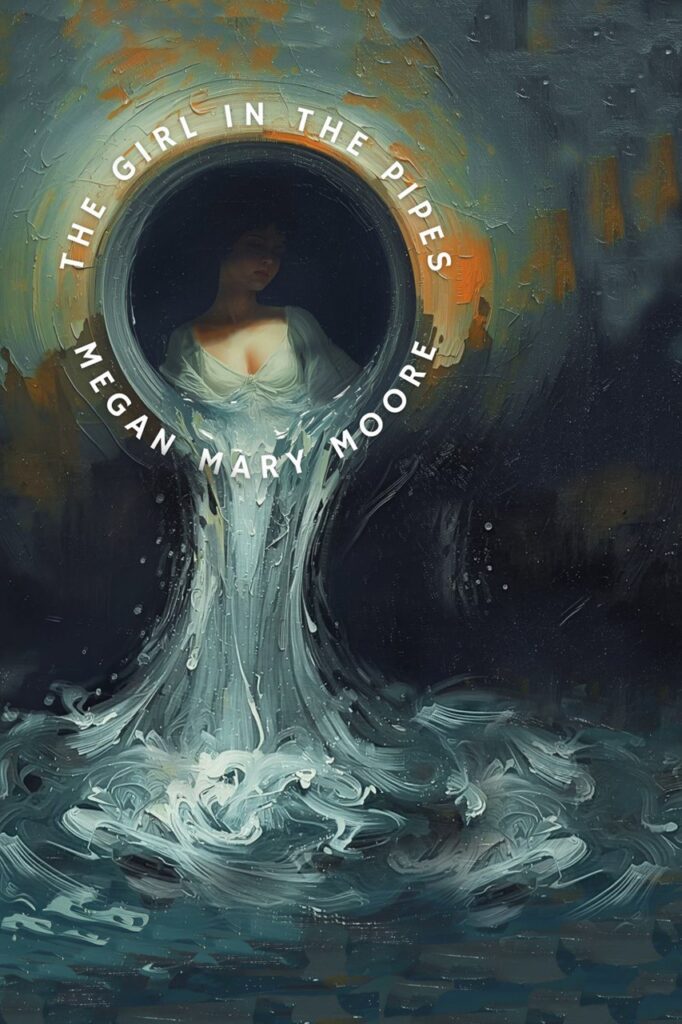
Image courtesy Megan Mary Moore
In that moment Moore imagined slipping down the shower drain and going elsewhere with her consciousness. Formed over a decade ago, the daydream became the basis for The Girl in the Pipes.
Moore didn’t set out to write a piece of body horror fiction but says that several readers came away from The Girl in the Pipes with that impression. And it’s evident why: the story situates itself on pain, the limitation of broken bodies, and how people, especially women, are often at the mercy of their own bodies.
“When [Marley] is seen as someone who needs to be cared for instead of the caregiver, things fall apart in her relationship because of those expectations,” says Moore. “Dani’s story hurts more because she thinks she has it figured out.”
Dani is characterized as being confident in her body and knowing how to leverage that to her career’s advantage. When she falls ill and isn’t able to obtain proper healthcare, Dani finds herself in a state of revolt. And then there’s Michael.
“Michael is an amalgamation of a lot of men that I’ve known and that I don’t know, but have seen,” says Moore. “He’s kind of the stand-in for how society reacts to a woman whose body is breaking down… Also, it shows how hypocritical he is and how hypocritical the expectations of women are.”
Moore’s approach to shaping both Marley and Dani was to be honest about their flaws, which she hopes makes them all the more human. She made the decision to move The Girl in the Pipes forward with an indie publisher because she didn’t want her work sanitized.
“I wanted it to be exactly as it was,” says Moore. “I didn’t want to have to go through and scrub it clean for it to do well. And I would have to. I think that’s the trap a lot of authors who want to get a big publishing deal fall victim to is sanitizing.”
When reaching out to authors to blurb her The Girl in the Pipes, Moore recalls one who declined to blurb the novella due its implication of suicide. Moore notes that if all fiction that discusses suicide was censored, we’d lose stories like Romeo and Juliet, Death of a Salesman, and Things Fall Apart.
“I’m not willing to lose those stories, not to mention the ones not yet written,” says Moore. “Hearing hesitation from other authors to acknowledge literature that discusses suicide makes me that more determined to write about it.”
Perhaps the real tragedy of The Girl in the Pipes is that Marley and Dani never physically meet. Instead, they’re pitted against one another by American society.
“It’s only without their bodies that they’re able to connect in the first place,” says Moore. Neither woman is a complete stand in for Moore, but she says she thinks they represent the dichotomy of womanhood well.
“I hope that most women are able to see parts of themselves in both,” says Moore. “When writing Marley, it was so sad and depressing. And with Dani, I was able to be a little more playful and fun. I think my voice came out, whereas my poetic voice definitely drove Marley.”
The Girl in the Pipes can be purchased through Unsolicited Press.