


Image from "Cincinnati Post", April 1, 1916
Judge Alfred Kano Nippert of Westwood was a popular and respected jurist—until he wasn’t. His reputation was demolished in the anti-German hysteria that swept Cincinnati in 1917.
Forward-thinking, humane and innovative on the bench, Nippert was acclaimed for such novel ideas as finding jobs for convicted felons, seeking treatment for drug addicts and for supporting women in domestic disputes. That reputation was sullied as the United States lurched inevitably into World War I. Almost overnight Nippert became known as a traitor or, at the very least, suspected of questionable sympathies with the evil “Hun.”
Nippert’s crime? Raising funds to support relief efforts for the German people displaced and suffering as war swept over Europe. For the first three years of World War I, the United States was officially neutral, so Nippert’s efforts on behalf of East Prussia (now largely split between Poland and Russia) were entirely legal.
The Judge was born 1872 in Frankfurt am Main, Germany, and remained a proud son of Deutschland for his entire life. Emigrating as a lad to the United States, Nippert worked hard, earned his law degree and married Maud Gamble, daughter of the president of Procter & Gamble. As the Wilson administration edged toward entering World War I, Nippert gave many speeches opposing war with Germany. He repeatedly called upon German-Americans to resist the war-mongering of English-Americans in Washington. Nippert raised funds for German reconstruction while the war was still going on and traveled to Germany to plan rebuilding efforts. He met with the Kaiser himself and tried to get U.S. media to portray the emperor as a human, not a monster.
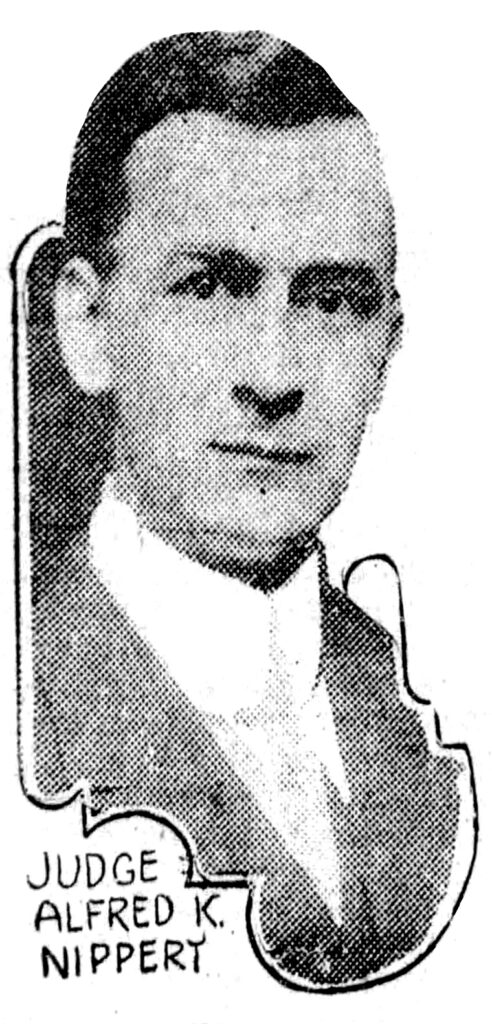
Image from "Cincinnati Post", April 1, 1916
It was all in vain. Although Nippert gave anti-war and pro-humanitarian speeches for several years, the situation changed completely in 1917. With swelling pressure to enter the war against Germany, Nippert’s allegedly neutral talks and travelogues were suddenly portrayed as Hunnish propaganda. Cincinnati’s elite dropped the Judge from invitation lists. He was asked to resign from several organizations including the University Club and the Business Men’s Club. Attorneys circulated petitions to have him removed from the bench.
The stain on Judge Nippert’s reputation lasted for decades. When his son, James “Jimmy” Nippert, died from injuries incurred while playing football for the University of Cincinnati Bearcats, the Judge—a UC alumnus—was named chair of a committee to raise funds for a memorial stadium. Donations stalled, with some suspecting a lingering distrust of the Judge as a factor, until Alfred Nippert’s father-in-law, James N. Gamble, stepped in to close the funding gap.
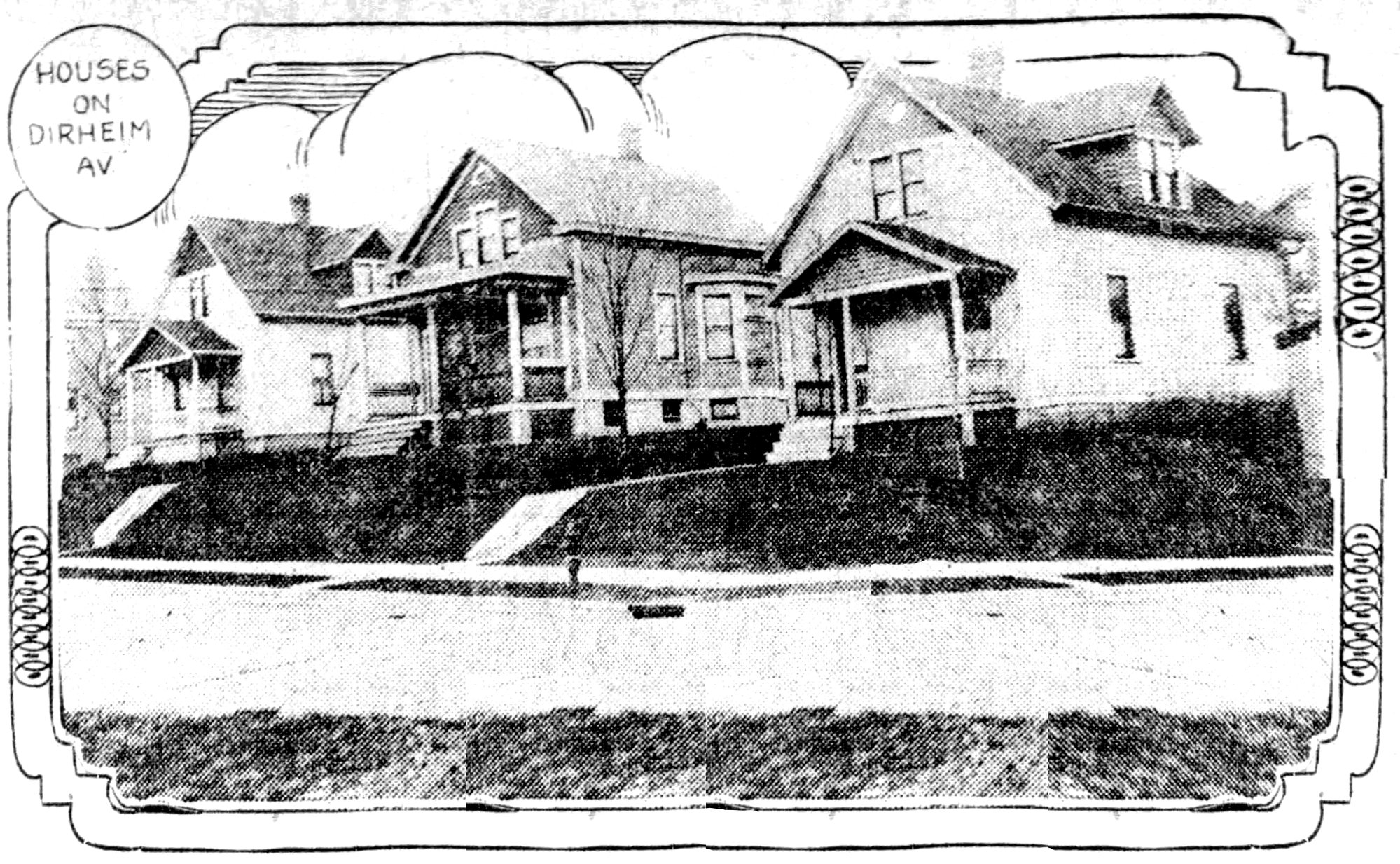
Because of this controversial episode in his long career, it is largely forgotten that Nippert wanted to rebuild Germany in the image of Westwood, specifically on the model of Dirheim Avenue, which he considered to be an “ideal American street.” Dirheim abuts the north side of the estate owned by Nippert’s father-in-law, James N. Gamble. Nippert and Gamble’s daughter, Maud, lived south and west of the Gamble estate in a house at the corner of Ferguson and Werk. It is certainly conceivable that the Judge found his ideal American street during a post-prandial stroll.
On April 1, 1916, the Cincinnati Post report on Nippert’s enthusiasm for Dirheim’s charms, under a headline of “Germans Will Be Guided By Model Street.” According to the Post:
“Dirheim-av. is in Westwood. It is one or those lovely. quiet places where one can sleep late peacefully on a Sunday morning. On any bright spring day the street is bathed in sunlight on both sides between 1 p.m. and 4:30. It is a street that never before has got into the papers. Its children use subdued ball-bearing skates. The robins like to sing on Dirheim-av because there is no noise.”
The newspaper reported that a convention was scheduled in Berlin to discuss the best way to rebuild towns and villages in East Prussia which the Russians destroyed early in the war. The chairman of the meeting was to be Paul Ludwig Hans Anton von Beneckendorff und von Hindenburg himself, known as General von Hindenburg and commander of Germany’s imperial army.
The Post reported that Judge Nippert had been commissioned as the sole delegate from the United States to represent German-Americans who have contributed $1,000,000 for rebuilding Ragnit (now Neman, Russia), one of the destroyed East Prussian towns.
“The Judge will ask that the architecture and the streets of the rebuilt town be made to look like American streets and the new homes like American homes. And then he will show a picture of a model American street with model American homes – and the street will be none other than Dirheim-av.”
Nippert told the Post reporter:
“I consider Dirheim-av. an ideal American street. Its houses are unpretentious, but comfortable; it is a clean and quiet street; it has a rustic charm about it. It is the type. of street we want in Ragnit with American money. One street in Ragnit is to be known as Cincinnati-st. I believe it ought to be a duplicate of Dirheim-av.”
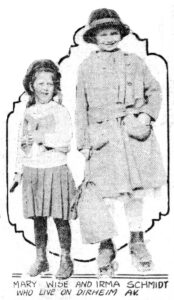
Image from "Cincinnati Post", April 1, 1916
In 1916, according to the Post, among residents of Dirheim-av were Edward Lampe, James Distler, William E. Weigel, Joseph C. Godar, Peter N. Zimmerman, John Poole; Joseph Gercken, John R. Wise, Minnie Schmidt and their families. Among the photos illustrating the story was a shot of two young girls, Mary Wise and Irma Schmidt.
Dirheim today is not much different than it was a century ago. The Gamble estate is now a Hamilton County park and Dirheim is among the few Cincinnati streets still paved with brick.
On another occasion, Judge Nippert related a story told to him by Kaiser Wilhelm himself. In 1916, on one of his relief missions, Nippert was invited to dine with the German emperor at a captured French chateau. On being introduced, the Kaiser remarked that Nippert was from Cincinnati and said that reminded him of a visit some years previous by Major General Leonard Wood of the United States Army. The Kaiser asked Wood if he had ever been to Germany before. Wood told the Kaiser, “No, but I have been to Cincinnati, Milwaukee and St. Louis.”
“Now,” the Kaiser said to Nippert, “wasn’t that clever?”
At the same dinner, Nippert corrected the Kaiser when he was described as a “German-American.”
“I am an American,” he said. “There is no such thing as a German-American.”
It was a sentiment, sadly, not shared by his adopted country.