



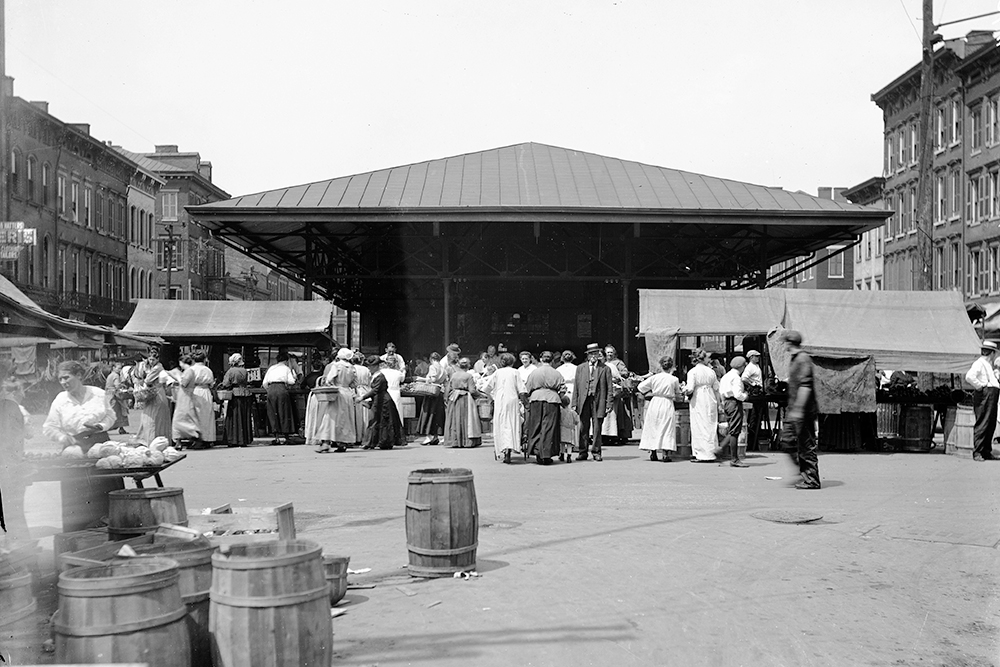
Photograph courtesy Kenton County Public Library
On any given day at Findlay Market, you’re likely to find a bouquet of flowers, a hot meal, a sweet treat, and just about everything you need to prepare food for your family for the week. It’s been that way since it opened its doors in 1855, back when German immigrants populated the densely packed neighborhood around it. And while much has changed the community it inhabits—population booms and declines, white flight, urban “renewal,” gentrification—the market has weathered many storms to continue doing what it’s always done: offer sustenance.
It’s a living testament to the forethought of city planners and preservationists who worked to have its history set in stone (the market was listed on the National Register of Historic Places in 1972) and the resilience of the area’s farmers and merchants, some of whom have worked in the market for generations.
Findlay Market has more than 50 full-time merchants selling products ranging from meat and fish to poultry and cheese as well as a lively farmers’ market, in addition to being surrounded by dozens of restaurants and independently operated markets like Dean’s Mediterranean Imports and Saigon Market.
“Jean-Robert chose Findlay Market for a reason,” says Annette de Cavel, wife of Jean-Robert de Cavel and owner of the deCavel Group, which operated her late husband’s bistro across the street from the market until it closed this summer. “He loved the relationships, the energy, and the way it brings food lovers together. It always held a special place in his heart.”
As the city’s only surviving public market from the glory days of the 19th and 20th centuries, it holds a special place for all of us.