



Photograph by Devyn Glista
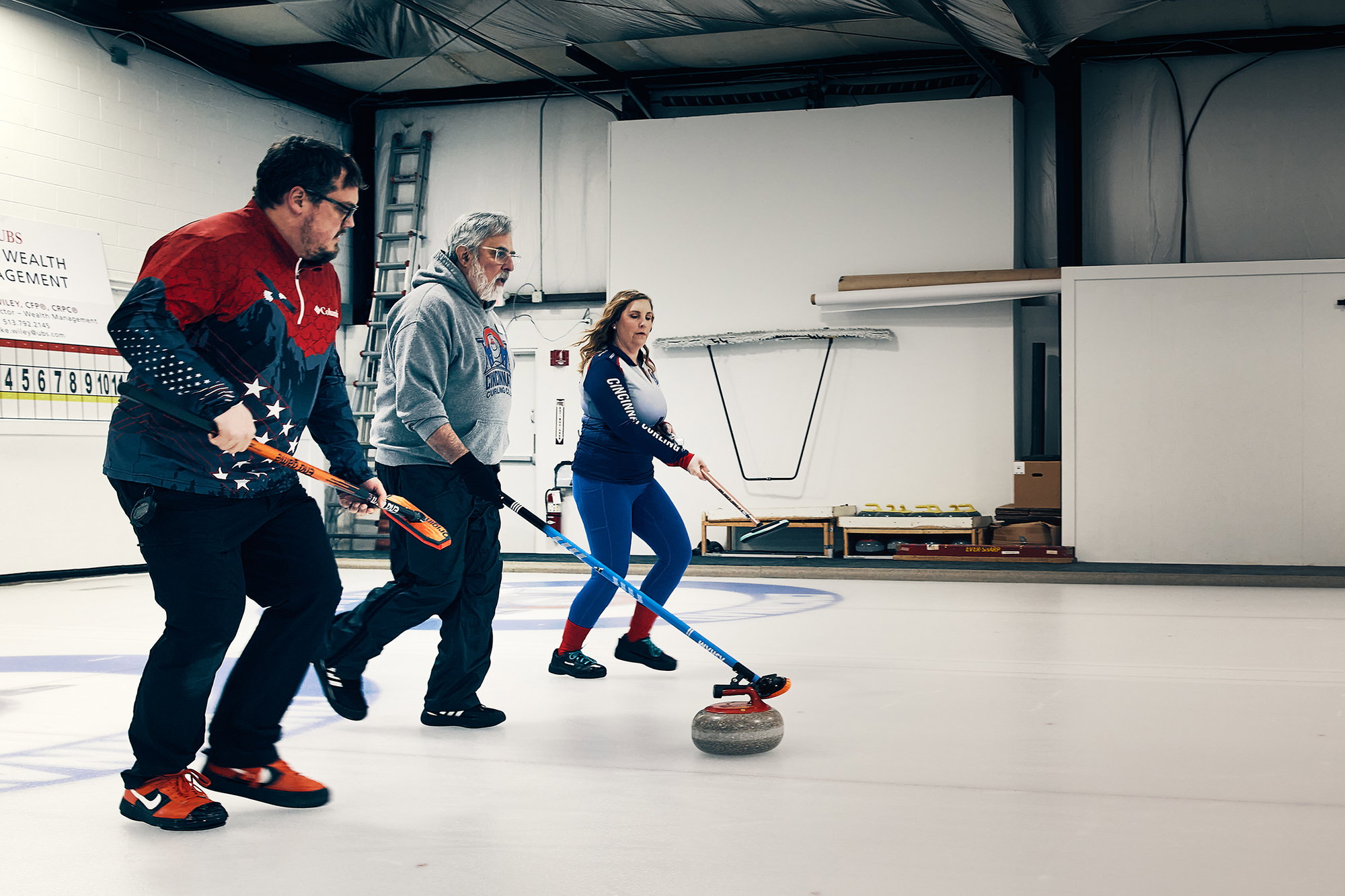
Reuben Schwartz carefully lines up his shot, curling stick in hand, and peers down 138 feet of gleaming ice, sparkling under bright fluorescent lights. He sort of resembles a shuffleboard player on ice.
The “skip,” his teammate down at the far end, points to the sweet spot just to the left of a large red ring surrounded by a larger blue ring and barks a quick order. The “house” resembles the face-off circle to the left or right of a hockey goalie, and the idea is to scoot your “stone” as close as possible to the white dot in the center of the red ring, known as the “button,” or even better, knock your opponent’s stone out of the house.
“I use a stick because I’ve got a bum knee,” says Schwartz, 68. “But the great thing about curling is it can be played by anyone. I can’t claim to be that good. Curling is easy to learn and easy to play, but it’s hard to be good.”
Photograph by Devyn Glista
Most of the nearly 200 members of the Cincinnati Curling Club don’t play with a stick. Instead, they push the 44-pound stone (some players call it a “rock”) down the sheet of ice with their bare hands, releasing it before reaching the “hog line,” which is located 10 meters from the “hack,” or starter’s block.
They get down low, one knee nearly scraping the ice, their lead hand gripping the handle connected to the top of the stone. As soon as they release it, two sweepers on the four-person team busily begin brushing the ice. The idea is to coax the sliding stone, which is made of solid granite imported from Scotland, to curl so that it lands in the sweet spot. The skip, who is on the far end of the sheet of ice, hovering over the house acts as sort of a quarterback, starting the delivery by pointing out the target to the “lead” and then directing the post-delivery sweeping activity. When the stone enters the blue ring, it’s in the house and the skip from the other team plays defense, using his broom to encourage the stone to go out of bounds.
Does this all make sense? It probably does if you’re a night owl and watched the live 3 a.m. curling contests from the recent Winter Olympics streaming on Peacock. Or maybe you’ve visited an unassuming warehouse off Duff Drive in Butler County and watched four simultaneous curling draws going on while you sip a cold beer in the club’s “warm room.” Or perhaps you’re one of that cohort of rubber-soles-on-ice fanatics enrolled in a two-hour Learn-to-Curl class, only to find yourself back the next weekend with friends and family.
That’s what happened to Audra Adams, an attorney with Dinsmore & Shohl. At the time, she worked at Wright Patterson Air Force Base and a coworker encouraged her to try the sport. “I’m a January baby, which means it’s hard to find anything to do,” she says. “It’s dry January, it gets dark by 5, everyone is broke after Christmas or on a diet, so my husband got me a curling lesson for my birthday.”
Adams was hooked. She and her husband moved up to a three-week instructional league and enrolled in a social league. Then the pandemic hit. “I was really impressed how the board worked hard to find a safe way to play in masks. The club was back pretty quickly,” she says. “So were we.”

Photograph by Devyn Glista
Greg Banks laughs about what he calls the legend behind the club’s founding. “It’s not quite right but, yeah, I guess I started it all,” he says. Now retired from a finance career with Procter & Gamble, Banks is a Canadian dual citizen, so it’s a compliment to say he has ice in his veins. He grew up curling and playing hockey, the latter sport being easier to find here in Cincinnati than the former.
On a hockey trip to Knoxville in late 2009, however, he was astounded to discover that the venue had a set of curling stones. That just isn’t done in Canada; hockey and curling don’t share ice.
Banks made a few phone calls and ended up speaking to one of the founders of the Columbus Curling Club, which had been in operation for a few years. A month later, Banks not only received some valuable advice on how to start a club in Cincinnati but also procured 32 used stones that Columbus no longer needed and Cincinnati desperately did. With help, he loaded his treasure trove, weighing more than 1,400 total pounds, into his Toyota Sienna for a pavement-hugging, tailpipe-clanging trip down I-71. Destination: The Indian Hill Winter Club, which was to become the first home of the Cincinnati Curling Club.
The club gained some quick attention when Cincinnati’s NBC affiliate, WLWT, came to film an early Learn-to-Curl class and a few pickup games. The 2010 Vancouver Winter Olympics were being broadcast on their network, so it was a good promotional opportunity for both Channel 5 and the curling club. Banks recalls the club gained several new members—a post-games boost it also saw after the Olympics in Russia (2014); Korea, where the U.S. men’s team won the gold (2018); and China (2022). Banks expects another spike in new memberships now following the Milan-Cortina Games.

Photograph by Devyn Glista
Brody White, clad in a windbreaker with a small tank filled with hot water strapped to his back, carefully shuffles along the ice, the nozzle of his sprayer pointed downward. When the hot mist contacts the ice, it refreezes and forms microscopic bumps, transforming the smooth-as-glass surface into what White terms a playing ground that’s more akin to an orange peel.
The technique is called “pebbling,” and it’s done before each match. It enables the concave-bottomed stone to glide and, importantly, curl the full distance of 138 feet to the target area. Without pebbling, White explains, friction would stop the stone well short of the mark. The pebbles also promote the curl as they slightly melt when the stone passes over them, forming a miniscule but important film of water that pushes the stone forward and allows the sweepers to guide it to the house.
There is a lot of science here, and plenty of math too. Good players—and there are several at the club—examine the ice as a surgeon would an MRI, calculate angles to determine what kind of spin they need to place on the stone before releasing it, and even hold stopwatches to evaluate when to release their stone based on ice conditions and opposing stones that have already been delivered to the house. It’s no wonder the sport is called “chess on ice.”
It’s also no wonder that curlers are really finicky about their ice. Cincinnati’s club is fortunate. Among their members is a world-renowned ice maker, Jonathan Penney, who’s so good that he’s made ice for the world curling championships and various national Olympic teams. Water quality, temperature, air flow, and, perhaps most importantly, humidity are keys to great ice, and Penney babies the frozen surface with a perpetual smile on his face. Club members can’t say enough about him.
“We wouldn’t be here without volunteers,” White says as he motions around the club’s warm room. The air temperature is 40 degrees on the ice (although on one Tuesday night a player who started in a sweatshirt and pants stripped down to shorts and a T-shirt), but it’s a comfortable 70 in the warm room, where you can watch the action either through thick glass or on a closed-circuit TV. “We’re fortunate that our members have a lot of expertise in plumbing, HVAC, carpentry, general contracting, and other professions that have saved us tens of thousands of dollars and continue to do so.”
White started curling in Columbus and is now vice president of the Cincinnati club. “Volunteers designed and built the bar,” he notes, motioning to the mammoth, well-stocked venue that’s larger than most in Over-the Rhine. Several large round tables are scattered around the space, and here is where the ancient tradition of “broomstacking” takes place.
Think of broomstacking as curling’s 19th hole. It’s the almost-mandatory social hour where the winners buy the losers a drink and friendships are formed. The tradition goes all the way back, so they say, to when the Scots invented the game in the 16th century and finished the day by stacking their brooms by the roaring fire as they hoisted a strong ale. White calls broomstacking “the equivalent of coaches and players shaking hands at the end of a game.” It’s so integral to the sport that, when the pandemic hit and members couldn’t socialize inside, many took the party outside into the cold, dark winter night and ’stacked under the stars.

Photograph by Devyn Glista
In a world that’s become socially isolated, curling has been like discovering a new family for many of the members. There are several social leagues at the club that encourage young and old, male and female, and even kids to simply have fun. No stopwatches. No hands-on-knees examination of ice pebbles. More laughs than deep strategy discussions. “I’m not that competitive, so I’m just happy if it stays in play,” says Beth Pratt, an early retiree from property management and new home construction from Liberty Township who spends multiple evenings at the club and is in charge of scheduling the private and corporate events that provide some income for the club.
Beth Swaney, a self-described introvert, first saw curling on TV during the 2018 Olympics and was intrigued. She did a Google search, and something clicked. She went to a Learn-to-Curl class by herself and has never looked back. “That was so out of character for me,” she says, still marveling at her audacity. “But now I have a wide variety of friends from all over Cincinnati that I can call on, and it’s definitely changed me.”
She credits her curling cohort with “just being there when you need them.”
Then there are the serious players—the ones who emit so much competitive heat that they can turn the ice to slush. Clay Hampton, a relative newcomer to the club, drives all the way from Troy to play and, even though he’s been at it for just two years, has formed a travel team that’s been to Alaska twice and to Seattle, North Carolina, Dallas, and Arizona to curl against teams from all over the country. Donning Canada’s official Olympic jacket, he’s American through and through. He just likes our northern neighbor’s jacket, highlighted by a large red maple leaf.
Hampton’s goal is for his team to qualify for the 5U pool (players who have curled for five or fewer years) so they can compete in the nationals. “I don’t care if we win the nationals, I just want to get there,” he says, noting the prize is simply winning a patch that shows the world his blood runs cold. Hampton and his teammates still have three years to win a major sanctioned curling tournament—in that unique curling language, they’re called “bonspiels”—and one of them was right here on Cincinnati Curling’s home ice in late January.

Photograph by Devyn Glista
For the first seven years of its official existence, curling club members wandered like polar bears on the tundra, first playing in Indian Hill, moving to the now-demolished Cincinnati Gardens, and finally using Evendale’s Sports Plus before they found what they wanted: a building large enough to curate their own pure, virgin curling ice. No hockey, no free skating—in fact, no skates at all.
They leased a 12,000-square-foot West Chester warehouse in 2019, and the club’s volunteers went to work. More than 15 miles of pipe that would carry Glycol, the chilling chemical necessary to facilitate “good ice,” were laid and three curling lanes plus a viewing area were built. Last spring, the club was able to lease the adjoining space, adding about 6,000 more square feet and the warm room to host those lively broomstacks. The former viewing area was turned into a fourth curling lane, allowing the club to host major bonspiels.
Today, inspired by the Olympics and word of mouth, website traffic is booming and the club’s phone lines are fielding a growing number of “cold calls.” Curling season pauses at the end of this month, and then volunteers will complete work on the warm room while the club takes its summer break. (Curling starts up again in September.) White says he won’t be surprised if the club’s membership includes more than 200 men and women when the new season opens. “We’re growing, and, as you’ll see when you talk to people here, they’re hooked.”

Photograph by Devyn Glista
Schwartz is definitely hooked, and so is his red-topped stone as it slides down the icy ramp, curling gently left as the skip urgently barks out orders to his sweepers frantically scrubbing the ice. The skip wants the stone not just in the house but coming in on an angle that will bump his opponent’s yellow-topped stone out of bounds.
Curling can be as much like billiards as it is chess, just noisier. Like cornhole, the life of a well-placed stone can be as short-lived as a shot of Scottish whiskey over a blazing broomstacking fire.
“That’s the fun of the game,” says Hampton, aspiring champion of the curl. “When you deliver the stone where the skip points and it lands right in the middle of the house and everyone is cheering, you’ve caught that high.”