


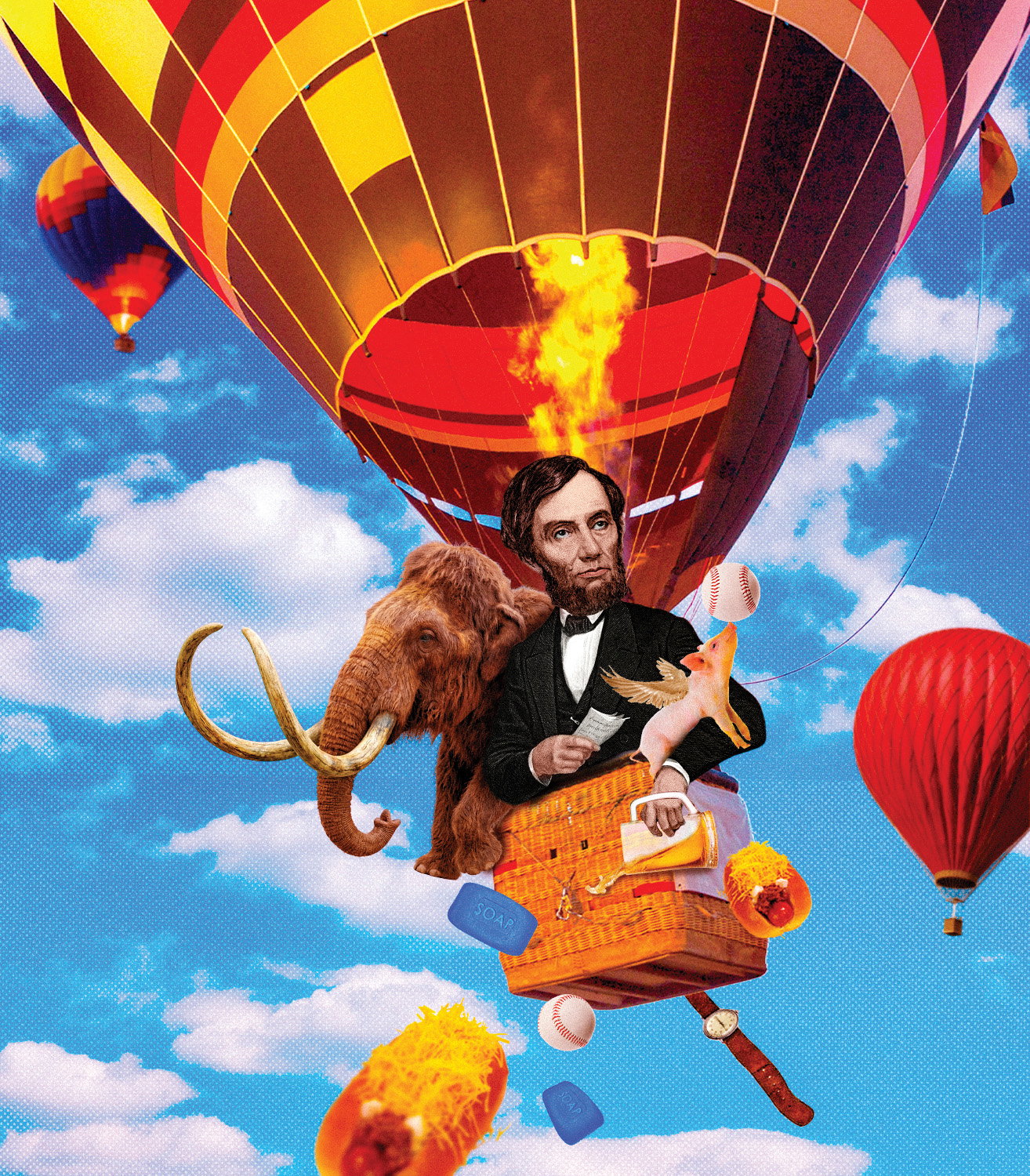
Collage by Carlie Burton
Cincinnati history has some gloriously weird but forgotten chapters. Here is one.
In this month’s issue you’ll find several fascinating stories about our wonderful town from back before our wonderful town existed. As you read them, remember that some depend on archaeological evidence that is, let’s be honest, mixed with conjecture. We don’t really know, for example, whether the wooly mammoths on Cincinnati’s east side looked down on the wooly mammoths from the west side, but it’s a good guess. Things around here don’t evolve all that much.
The story I present here, though, comes from a much later period. By this time, Cincinnati had lost all of its mammoths and not a few of its marbles. Our city’s historical highlights are well-known: beer and pigs and soap and beer and canals and baseball and goetta and beer and weird-ass chili. We shall now catch up on a Cincinnati contribution to the world that’s been forgotten: hot air ballooning.
Yes, that was a thing. Its pioneers were called “aeronauts,” and they launched some of ballooning’s early milestones directly from the streets of Cincinnati.
One such milestone happened in 1861, just as the United States was starting a major war with the most formidable enemy it had ever faced: itself. The Southern states had begun seceding even before president-elect Abraham Lincoln took office, making his train ride from Illinois to Washington, D.C., for his inauguration a jittery one. It was feared that angry Confederate hotheads exhibiting LDS (Lincoln Derangement Syndrome) might try to assassinate him.
Abe rode for two nervous weeks, including an overnight stay in Cincinnati. Shortly after he left, a well-known aeronaut came to town and made a startling claim: “I could have shepherded Mr. Lincoln safely from Cincinnati to Washington overnight, in my homemade hot air balloon!”
He called himself a “professor”—anybody back then with a nice suit and snotty attitude could get away with calling himself a professor—and promised Cincinnati that he would soon rise into the clouds himself, traverse the heavens at unimaginable speed without even feeling it, and land the following day in the nation’s capital. He called his balloon The Enterprise. “To boldly go,” as it were.
This man’s name was (take a deep breath) Thaddeus Sobieski Caulaincourt Lowe. Whew. That mouthful of a name obviously made him develop a heavy case of BNSS (Boy Named Sue Syndrome), forcing him to grow up tough. Laughing at danger!
Make no mistake: Bottomless courage was essential for 19th century aeronauts. These guys regularly crashed into trees, ruptured their balloons, and plummeted to their deaths. Sometimes they floated up and simply vanished forever.
This gig took guts. Just imagine what kinds of Kalshi bets could have been made on aeronauts.
Just before dawn on April 20, 1861, Thaddeus Lowe launched The Enterprise from a field on Western Row (take that, east side!). Catching a swift upper wind, he raced above the clouds for hundreds of miles through the day and night, then slowly returned to Earth and landed softly. But despite his experience and skill, Lowe still found himself facing the prospect of imminent death. That’s because he had landed among a group of people who couldn’t wait to kill him.
Lowe had overshot his intended target of Washington by 500 miles and touched down in rural South Carolina, not very far from a place called Ft. Sumter. Those of you who paid attention in history class will recall the “firing on Ft. Sumter” that officially began the Civil War. Unfortunately for the professor, this event had happened just a week earlier. Not good timing or aiming.
About half of the mob who gathered was certain that Lowe was a Yankee spy and wanted him dead. The other half was just as certain he was Satan bringing the End of Days, so they also wanted him dead.
Lowe remained calm. He passed around copies of the previous day’s Cincinnati newspapers, which proved where he’d been 13 hours earlier and even contained articles about his upcoming journey. This approach worked, and they let him go. Lowe eventually returned to a hero’s welcome in Cincinnati, subsequently publishing his entire story, from which we will share an amusing moment.
After a night racing among the stars, Lowe was unsure where he was when the sun began to rise. He partially descended, saw a farmer plowing his field, and shouted, “What state is this?!” The startled farmer looked in all directions—except up, of course. Up had never been an option around these here parts. Lowe shouted his question again, and the nervous farmer yelled to no one in particular, “Virginia!”
When the guy finally looked up and saw a man in a giant laundry basket hanging beneath an enormous bulbous bag, he ran away. Lowe tossed out some sandbags, rose again, and continued toward his mistaken rendezvous with the Fightin’ Friends of Ft. Sumter.
After landing in South Carolina, Lowe eventually got to Washington by train. There he met Lincoln and demonstrated how a properly navigated balloon could advise Union generals about Confederate troop movements. Lincoln immediately appointed him to create and head the Union Army Balloon Corps.
Lowe’s platoon must have enjoyed snitching on Confederate troops and luring them into shooting at the too-high balloons, wasting ammunition.
After the Civil War, Lowe and many other aeronauts used Cincinnati as a base for sharing their knowledge and conducting more voyages. Why Cincinnati? Because the town had already been a magnet for balloon nerds as far back as the 1830s. For that we can thank Clayton’s Balloon Store, an establishment at the corner of Sycamore and Second streets. Aeronaut pioneers made Clayton’s Balloon Store a popular destination, even though it neither manufactured nor sold hot air balloons. It specialized in watches, clocks, and assorted silver and gold jewelry. Huh?
Richard Clayton had moved to Cincinnati from his native England. Already well-to-do, he opened Clayton’s Wholesale House, an upscale jewelry business on the east side of downtown (where, of course, all the better-appointed wooly mammoths lived). But he was also famous as a passionate hot air balloon nerd, with the money, time, and resources for building his own airships. In 1835 he skyrocketed to international celebrity after traveling more than 300 miles in less than 10 hours—a world record for distance, time, and not being killed.
That daring adventure and later journeys (Clayton is credited with the world’s first airmail delivery) helped make Cincinnati a gathering place for innovative hot air ballooners. His name became so synonymous with ballooning that his jewelry and watch store became known as Clayton’s Balloon Store.
You may remember that famous Apple TV commercial saluting “the crazy ones.” It said that “the people who are crazy enough to think they can change the world are the ones who do.” Thaddeus Lowe and Richard Clayton definitely belong in that club. They never achieved their craziest dreams; both had hoped to whoosh across the Atlantic Ocean to Europe. Lowe also wanted to create a 19th century FedEx, making overnight deliveries between American cities. Hot air balloons, alas, took too long to develop solutions for pesky things like gravity and unpredictable weather (not to mention their tendency to explode).
The Wright Brothers eventually showed the world a better way, turning hot air balloons into a niche amusement. But when the Dayton boys held their first major air show in 1910, they went to the trouble to invite the elderly Thaddeus Lowe. They knew—as should we—that Lowe and Clayton and all their aeronaut brethren provided an important assist to changing the world. The anchor from which they changed it was Cincinnati, Ohio.
As the old song goes: East side, west side, all above the town.