



Photograph by Patrick Tehan
Magdala sings with joyful abandon every Sunday morning at the Haitian Creole service in Springfield, Ohio, praising God in the same gorgeous mezzo soprano voice that fueled her career as a gospel singer in her native country. Her 3-year-old son toddles up to her in the middle of her solo, wrapping his arms around her leg like human Velcro. It’s as if he can’t bear to be parted from his mama for even a few minutes.
Magdala feels the same way. “I am so close to my family, I couldn’t bear to be separated from them,” says the stay-at-home mother who spends her days chasing her “trois petits”—three young boys, two of whom were born in the U.S. She speaks French to me through a translator. (Like other Haitians I spoke to, Magdala asked me not to use her last name.)
Yet the threat of deportation and family separation looms over Magdala’s family and the estimated 10,000 to 15,000 Haitian immigrants who have moved to Springfield in recent years, reviving the city’s faltering economy and inadvertently igniting a political firestorm. “If we put out an ad looking for people to move to Springfield, the Haitian people would fit the bill perfectly,” says Springfield native Sally Edgington. “They are hard workers. They’re family people.”
When Haitians first arrived in Springfield, a town of 60,000 northeast of Dayton, many businesses, city leaders, and residents welcomed them like an answered prayer; they filled vacant jobs and spruced up abandoned homes. That was before neo-Nazi groups marched down Main Street brandishing rifles and swastika banners. Before Donald Trump infamously declared during a 2024 presidential debate, “In Springfield, they’re eating the dogs, the people that came in, they’re eating the cats.”

Photograph by Patrick Tehan
The controversy stirred the city’s better angels as well, mobilizing hundreds of volunteers to fight on behalf of their Haitian neighbors. “It was gut-wrenching to drive through my hometown and to see Nazis marching down the street,” says Edgington, a retired nurse who volunteers with Springfield Neighbors United, which works with the local St. Vincent de Paul Society. “I felt like I needed to do something.”
Few Haitians have been deported to date from Springfield, but immigration attorneys and advocates for the community say the danger of family separation is real. The Trump administration ended temporary protection status for Haitian immigrants in the U.S. in December, two months earlier than the scheduled 18-month window that was supposed to end February 3.
Family separation policies from the first Trump administration are now being enforced everywhere, says Katie Kersh, a managing attorney in the Dayton office of Advocates for Basic Legal Equality (ABLE). Her office has fielded numerous calls about children being thrown into local foster care systems when their immigrant parents are detained by Immigration and Customs Enforcement (ICE), even for such minor offenses as a traffic infraction.
“In general during the first Trump administration, law enforcement in the interior of the U.S. was hesitant to separate children from their parents,” says Kersh. “They would usually leave one parent there to care for the children, but that isn’t happening now. The federal government has demonstrated that it’s absolutely willing to separate children from their parents. I have heard of few coordinated efforts from the federal government to promote family unity or the rights of children and the well-being of children who are being affected.”
In other words, she says, “If ICE knocks on your door or pulls you over after you drop off your kid at school, there is no opportunity any more for you to be reunited with your kid.”
A handful of the town’s Haitian residents have self-deported to other countries or more immigrant-friendly states. Some have attempted to self-deport and apply for asylum in other countries but were forced to return because they cannot do so while under pending asylum in the U.S. Most have opted to stay and to pray for a change in
the national climate. Since the temporary protection status ended, Springfield has become a Rorschach test for the soul of America, a referendum on the question of whether we’ll continue to live up to the motto etched onto the base of the Statue of Liberty: “Give me your tired, your poor, your huddled masses yearning to breathe free.”

Photograph by Patrick Tehan
As she cradles a 3-month-old baby in her arms, Edgington asks quietly, “What is going to happen to you?”
Edgington shakes off her tears like raindrops off an umbrella. She needs to get back to work, assisting the parents with a passport application for their newborn. “We are prone to crying around here,” she acknowledges sheepishly. “But I need to stay positive for these families. They have been through so much already.”
The infant is one of an estimated 1,200 Haitian children in the Springfield area born in the U.S. The local St. Vincent de Paul Society offers the so-called “baby passport” program as a way of making it easier for these children to follow their parents if they’re deported—ideally to a third country—and less likely they’ll become lost in the U.S. foster care system.
From the beginning, Springfield’s Haitian immigrants flocked to SVDP, a familiar charity in their heavily Catholic native country. In the past, they lined up by the dozens outside the front door every morning, looking for translation services and help with housing and immigration paperwork. As work permits are revoked and jobs lost, they now come in greater numbers seeking food assistance. The charity is busier than ever, with the food pantry alone serving an additional 300 additional families per month. But they arrive in staggered numbers, afraid of being picked up by ICE agents.
Like many of the volunteers and activists working with her city’s immigrants, Casey Rollins has learned to deal with her own brand of fear. As executive director of Springfield’s St. Vincent de Paul Society, she’s been targeted and doxxed on neo-Nazi websites, which have posted personal information about her as well as photos of her home and her friends. “There are a lot of Americans who are very angry with us for helping immigrants,” says Rollins. “But I have to live with myself. I can’t answer to angry Americans. I’m going to answer to my maker.”
Even the decor of the SVDP community center illustrates how smoothly the two cultures have blended, showcasing classic Catholic statuettes side by side with Haitian art. A Haitian rendering of the Last Supper overlooks a 1950s-era statue of the Virgin Mary.
Rollins stops to chat with one of her employees, Joseph, whose strong English language skills landed him a job helping his fellow Haitians navigate local services and the legal system. On a busy October morning, he’s assisting a young father with paperwork for an upcoming court date.

Photograph by Patrick Tehan
The young man proudly shows off photos of his daughters, ages 5 and 18 months, before describing his dueling fears of being torn from his family by ICE or being returned to potential violence in his native country. “Haiti isn’t safe or stable right now, and if I went back I might be a target because they would think I had money,” he tells Joseph.
He doesn’t let his little girls know how worried he is, wanting them instead to enjoy a carefree childhood. “My biggest fear is being separated from my family,” he says.
It’s a pain that Joseph understands only too well. “We all would rather be in our home country, but we’re here looking for a better life,” says the father of two children who live in Haiti with his wife.
At first, that better life seemed elusive. Upon arriving in Springfield in 2021, Joseph shared a two-bedroom apartment with 15 people. “I wanted to cry living like that,” he recalls, “after leaving my beautiful home in Haiti.”
But his wife encouraged him to stay strong and to remember he was in the U.S. to support his family back home in Haiti. “We came here to work,” Joseph says. “And we grew Springfield. We rent homes, we work, and we are strong. We are working so hard.”
While on the job, Joseph never feels lonely. During the weekend, he confesses, he counts the hours until he can return to work and serve the poor. “When I am here, it is like coming to my second family,” he says. “When I am here I am always happy. When I am home, I feel alone. I can’t wait to come to work to see my other family.”
When they talk over the phone, Joseph’s 14-year-old son asks, “When will you be home, Daddy?”
“I am coming, my son, don’t worry,” he replies. “But I need to be working here now to take care of you.”
“I miss you,” the boy says.
“I miss you more,” the father says.
The U.S. Department of Homeland Security promises a $1,000 exit bonus and a free plane ticket to their home countries if immigrants will self-deport. But Joseph has not forgotten the many times he woke up in Haiti to the sight of bodies lying in the street, gunned down by roving gangs. “You could be self-deporting to your death,” he says.
Joseph’s immigration attorney assures him that his pending asylum application will protect him from deportation, but he isn’t alone in worrying whether past precedent will hold. “With Donald Trump, we just don’t know,” he says. “I’ve heard that you can have pending asylum status and ICE can still pick you up.”
Several local advocates, speaking off the record, say they’ve been warned by Homeland Security officials that immigrants with asylum status will not be spared. Department officials did not return requests for comment.
Such threats, if they’re being made, are scare tactics that aren’t legally enforceable, Kersh says. She informs her clients at ABLE that they generally can’t be deported if their asylum application has been approved, but she recommends carrying proof of their asylum approval at all times. The big problem, she says, is that very few if any Haitians have actually been approved for asylum; she hasn’t met a single Haitian in Springfield who’s been approved yet.
Those with pending asylum applications can be detained, Kersh says, but the law says they’re entitled to a hearing determining whether it’s safe to return to their home countries. “That’s what the law says, but that’s not what is always happening,” she adds. “I’m aware of people being moved to third countries that have had their asylum hearing and didn’t get approved. They are moved to countries like Mexico, and then Mexico sends them back to [their home country]…. Right now, it’s an open legal question as to whether or not that is a violation of our legal obligations. The government is gearing up to remove asylum seekers to third countries before their hearings. They have used the Illegal Alien Enemies Act to remove Venezuelans who have pending asylum cases. I haven’t heard of that happening to Haitians, but they could use it in the future.” For Kersh, treatment of the Haitians immigrants seems like a string of broken promises. The U.S. government revoked the humanitarian parole many had been granted through 2026.
“I work with folks every day who come to this country without permission, and being separated from their kids is something they know in the back of their minds is a possibility because they know they don’t have status here,” says Kersh. “But the Haitians came here legally and were promised this status, and now I have to talk to them about making a plan if they’re detained. And the look of sheer horror and shock on their face is hard to describe. You’re telling an anesthesiologist from Port au Prince that they may have to go to jail after they entered the country lawfully, haven’t broken any laws, have worked, and own a house. It’s like someone came to me and said, You might go to jail tomorrow. This isn’t what our country is supposed to stand for.”

Photograph by Patrick Tehan
Haitians began arriving in Springfield in 2017, drawn by word of mouth as well its designation as a welcoming town and the familiarity of having a St. Vincent de Paul in their home country. At first, the problems seemed mostly logistical; Rollins was proud of how her community organized to meet the needs of the Haitian newcomers, from translation services to transportation to healthcare to housing. “We have discovered that we really know how to come together in the face of an emergency,” she says.
After the first wave arrived, local nonprofits and faith groups, led by the United Way and the local Health Department, banded together to create the Haitian Coalition to connect them with community resources. Over time, new Haitian residents formed another service agency, the Haitian Support Center. The agency’s executive director, Viles Dorsainvil, fled Haiti in 2020 when kidnapping cases started to escalate. “The Haitians have been through a lot, from the social chaos back home to starting a new life in America,” he says. “They are tired, and they want to be in a place where they can peacefully go to work and send their kids to school and live their lives and become part of the community.”
There were growing pains, of course, and concerns about language barriers, cultural differences, and strained resources. Tensions started to escalate after an unlicensed Haitian driver caused a tragic school bus accident that claimed the life of 11-year-old Aiden Clark and injured dozens of others. Members of the Haitian community became more wary and more mindful of where they went or what they did, fearful of becoming scapegoats for the tragedy.
After the accident, Rollins recalls, Springfield City Commission meetings turned into inquisitions—anyone serving the immigrant community was viewed by some as anti-American, probably warranting prosecution. Aiden’s father, Nathan Clark, pleaded with politicians and the public not to invoke his son’s name to persecute immigrants.

Photograph by Patrick Tehan
Pastor Carl Ruby was getting ready for bed one night when a congregation member called and told him to tune in to the live broadcast of the Springfield City Commission. “I was appalled by what was being said about Haitians, and I felt that I had to go downtown and say something,” recalls Ruby, lead pastor for Central Christian Church. He made what he considered a mild, well-reasoned statement, noting, “I understand there are some costs to assimilating a large group of people to a different culture, but there are some benefits as well, and these are good people.”
He hadn’t intended to be provocative, but the pushback was fierce and immediate. Someone posted on the City Commission website, “Carl Ruby is a POS coyote … he needs to be run out of town.”
The simmering unease went full Chernobyl during the second presidential debate on September 10, 2024, when Trump parroted baseless claims about Haitian immigrants. “In Springfield, they’re eating the dogs, the people that came in, they’re eating the cats,” he said. “They’re eating the pets of the people that live there.”
Denise Goode-Williams, president of the Springfield chapter of the NAACP, says she almost fell out of bed and demanded, “Did he just say that?”
The spurious rumor about Haitians killing and eating their neighbors’ pets— an all-too-common anti-immigrant stereotype—originated with a local Facebook post that was quickly deleted. Local officials denounced the rumors as false and Ohio Governor Mike DeWine decried them as “garbage from the Internet,” but the hoax went viral, amplified by right-wing influencers and then-Ohio Senator J.D. Vance. After Trump’s debate remarks, more than 30 bomb threats forced the evacuation of Springfield schools and government buildings and the deployment of state troopers to sweep school buildings for weapons every morning and evening.
Williams began fielding calls from panicked locals as well as journalists from around the world. “I can’t begin to tell you how bad it was,” she says. “The community was in an uproar, and the Haitians were fearful. They were afraid to come out for church services, afraid to go shopping.”
Williams needed extra security around her home and hesitated to invite her grandchildren over for fear of putting them in harm’s way. “I wasn’t fearful, because I had a job to do,” she says. “I take all my direction from God.”
The harassment grew so intense that the city of Springfield filed a lawsuit, joined by multiple city leaders including Rollins, in federal court alleging that the neo-Nazi group Blood Tribe “engaged in a months-long campaign of harassment and intimidation against the city of Springfield and its officials and residents who rebuffed the group’s persistent racist attacks against the local community.”
Yet for every instance of hateful rhetoric and for every threatening note pinned to a church door, the community found moments of grace. The NAACP was flooded with donations and messages of support from around the world. After Ruby appeared on CNN, Central Christian Church was showered with gifts and cards from church youth groups. New members were attracted to the church, telling the pastor, “This is what my faith is all about, following Jesus’s command to love thy neighbor as thyself.”
Throughout the turmoil, Rollins says she’s found new fellowship with both her Haitian neighbors and longtime Springfield residents. “I can’t believe the number of friendships and phenomenal loving relationships we have developed here, born out of this trauma and this tragic situation.”

Photograph courtesy Springfield
Like many in her community, Jen Casto is heartbroken and frightened by all the hateful rhetoric. The scenes in her city remind her of the dystopian novels she devoured as a kid.
Casto fears for her safety every time she speaks at City Commission meetings, but she refuses to back down. She wants to set a good example for her young children. “Whenever I set foot in City Hall, I feel like I’m putting myself at risk,” says Casto, a leader of Indivisible Springfield, the local chapter of the national progressive movement. “I do it because if I don’t stand up and the next person doesn’t stand up, our democracy is gone.”
She views the Haitian immigrant debate as a humanitarian issue, not a political one. “This is a failure of our shared humanity,” she says. “If even one mother is taken from her babies, if even one man is treated like a criminal just for trying to survive, then none of us are truly free. Their humanity doesn’t stop at a border.”
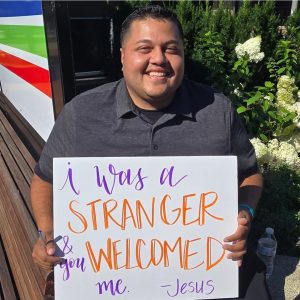
In early August, hundreds throng Springfield’s City Hall Plaza for a “Love Thy Neighbor” rally sponsored by Springfield G92, a broad-based coalition of churches “committed to the safety and dignity of our Haitian neighbors and friends.” The plaza is a sea of protest posters declaring, “We are the caring majority” and “No human is illegal” and “All of our neighbors are made in God’s image.”

Photograph courtesy Springfield
Casto once again summons her courage to address the crowd. “Our Haitian and immigrant neighbors didn’t come here to take,” she says. “They came here to live. To contribute. To belong. Many of them fled political violence, instability, and natural disasters most of us can’t even imagine living through. They came here with faith in a promise this country was built on.”
Many attend the rally because their faith compels them to be there, Ruby tells the crowd. “The Bible is very clear that one cannot honor God and dishonor immigrants and refugees,” he says. “Some claim to be Christians but then espouse immigration policies that dishonor the Christ they claim to follow. Cruelty and dehumanization are always wrong.”
Photograph courtesy Springfield
It is not merely the city’s minority residents who will suffer in the aftermath of mass deportation, Ruby warns. “All of Springfield will be hurt by the removal of our Haitian and many of our Latino neighbors, people who are helping to repopulate and rebuild this city. Our entire nation will be devastated if Homeland Security deports millions of our most ambitious workers.”
Community leaders harbor few hopes that the Trump administration has moved on from Springfield. On a recent Truth Social post, the president wrote, “They have stolen American jobs, consumed billions of dollars in free welfare, and turned once idyllic communities, like Springfield, Ohio, into Third World nightmares.”
“When he keeps saying things like that, it makes me fear he could seek to make an example of us,” says Ruby. “The president has spent a great deal of energy seeking to enhance his reputation as a peacemaker. There’s a wonderful opportunity for him to demonstrate his commitment to peace by changing the rhetoric on immigration and coming up with a policy that welcomes immigrants and protects the border, focusing on people who have committed violent crimes.”
Ruby devotes the majority of his time as pastor working with Haitian immigrants, a priority supported by the board of elders because it fits the mission of Central Christian Church. “It is all-consuming,” he says. “I have so much to do I don’t have time to be depressed. It helps me not to despair when I have the chance to do something to change the tide so that Haitians are embraced and kept in Springfield.”
Trump campaigned on a promise to deport “the worst of the worst,” but that isn’t what Edgington sees when she looks around her hometown. “I wish people could see how [Haitian parents are] so attentive to their kids,” she says. “They go places together as a family more than we do as Americans.”
After a recent service, Magdala greets visitors with an irrepressible smile and a warmth usually reserved for childhood friends. Longtime church members greet her as one of their own, and the message is clear: She belongs to the kind of family everyone would want for a neighbor, a friend, and members of their congregation.
Magdala is too preoccupied with the day-to-day tasks of raising children to worry much about the future. “It’s so much safer here than in Haiti,” she says. “I am leaving it up to God.”
She is sustained by her deep Christian faith, and she hopes the American people will come to understand one simple truth: “The Haitian people may have a different culture and speak a different language, but we are the same people in God’s eyes.”

Photograph by Patrick Tehan