



States and cities have official birds, and plants, and even rock songs, so why not fossils? Cincinnati is one of just two cities with official fossils (Fruita, Colorado, is the other). Our emblem is the quarter-sized starfish relative Isorophus cincinnatiensis. At the state level, the genus Isotelus, a group of large, centipede-like trilobites represents invertebrates, while the ancient fish Dunkleosteus terrelli became official in 2020.
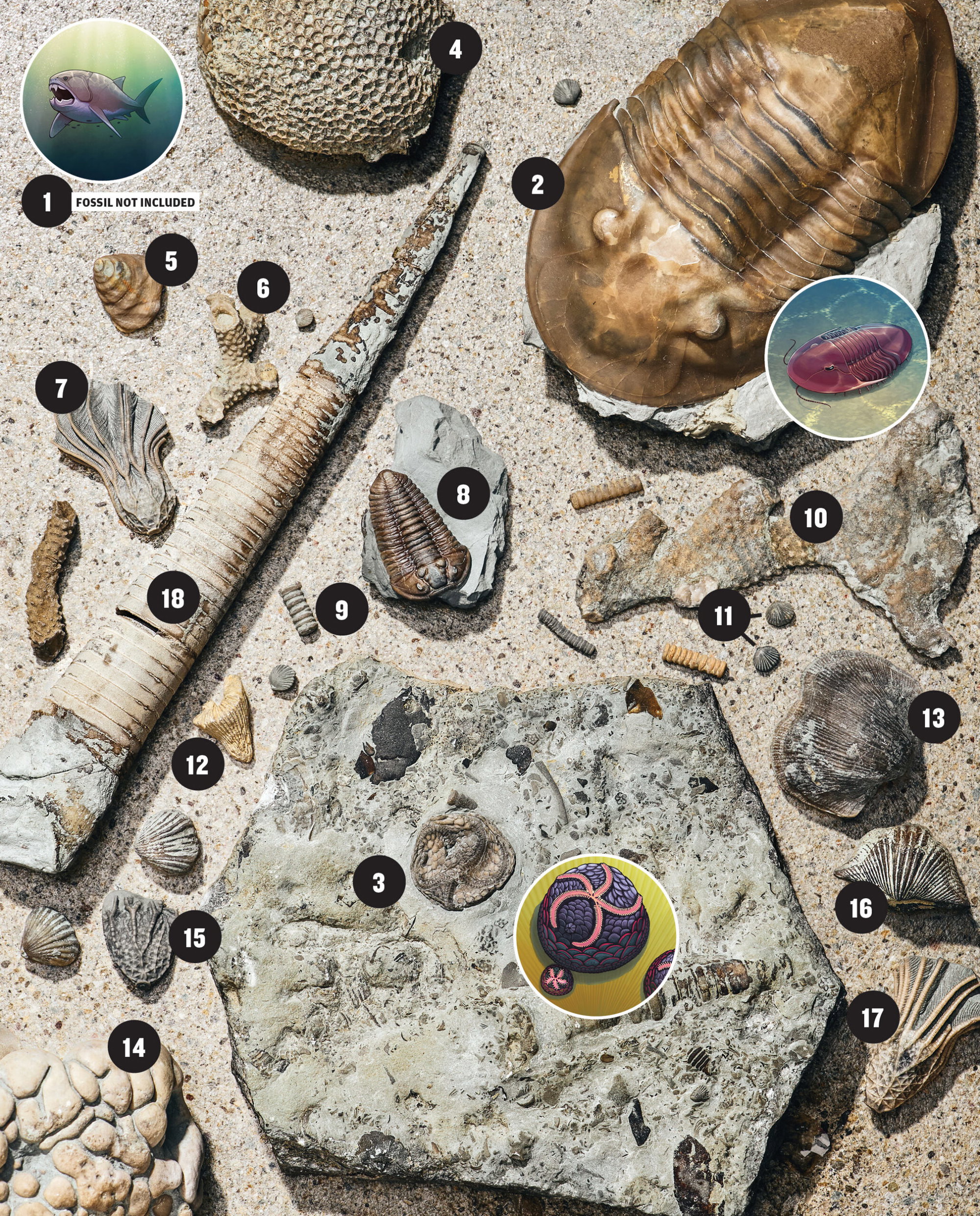
Photograph by Andrew Doench / Illustration by Kyle Hartshorn
1. Dunkleosteus terrelli: Instead of teeth, the jaws of Dunkleosteus terrelli were exposed bone, sharp enough to crunch through bony or shell-enclosed prey.
2. Isotelus maximus (trilobite): Seafloor predators, trilobites are distant relatives of horseshoe crabs. The name trilobite means “three-lobed animal.”
3. Isorophus cincinnatiensis: It was an obligate encruster, which means that it had to attach itself to a hard surface like a barnacle.
4. Favistina stellate (colonial coral)
5. Cyclonema sp. (gastropod)
6. Parvohallopora ramosa (bryozoan)
7. Pycnocrinus dyeri (crinoid)
8. Flexicalymene retrorsa (trilobite)
9. Crinoid stem
10. Constellaria florida (bryozoan)
11. Zygospira modesta (brachiopod)
12. Grewingkia canadensis (horn coral)
13. Hebertella occidentalis (brachiopod)
14. Solenopora sp. (sponge)
15. Pycnocrinus dyeri (crinoid)
16. Vinlandostrophia sp. (brachiopod)
17. Glyptocrinus decadactylus (crinoid)
18. Straight-shelled cephalopod