



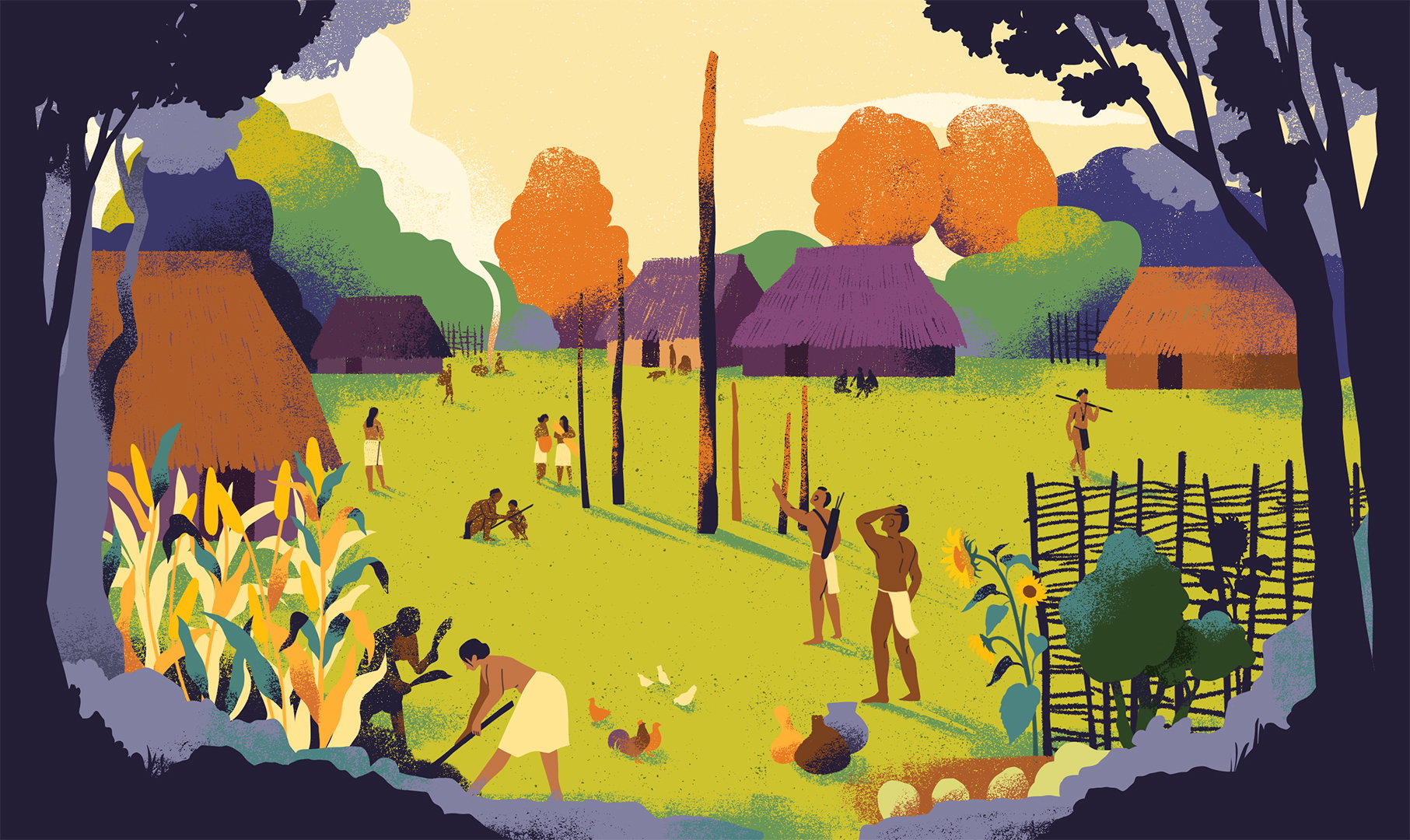
Illustration by Sandra Rilova
Archaeology collections manager and tribal liaison Tyler Swinney buzzes me into the Cincinnati Museum Center’s Geier Collections & Research Center. As we enter its catacombs, he cautions me. Here lie human remains, he says. If for any reason I feel I should not enter, I should stop. I take this in a sort of spiritual sense: Humble thyself.
While Swinney finishes a call, I check out a display of ancient artifacts made from once-living materials: bone, antler, and shell beads, flutes, fishhooks, projectile tips, and sewing needles. There’s a hoe made from a hand-sized mussel shell. But there are gaps where artifacts have been removed from display. I ask Swinney if these were taken for repatriation, per the Native American Graves Protection and Repatriation Act (NAGPRA) legislation passed in 1990, which mandates the return of human remains and sacred objects to tribal descendants. No, says Swinney, who is also the museum’s NAGPRA coordinator. They’ve been pulled for an upcoming exhibition.
Throughout the archive, flint, ceramic, and animal bone pieces are sorted on trays and examined. Many were found near Cincinnati. When I first met Swinney, he was standing neck deep in a dig at the Hahn Village Site in Anderson Township’s Clear Creek Park.
Sites throughout the region have been explored since the 18th century for clues about early America’s human inhabitants. The geometric earthworks and conical mounds created by the Adena, Hopewell, and Ft. Ancient cultures (contemporary designations for peoples known only through the archaeological record) inspired great curiosity. [Editor’s note: these designations are used by archeologists to distinguish different cultures, not to describe tribes or Indigenous communities. According to Urban Native Collective, “It is not appropriate to call the Indigenous Peoples by these names. The term ‘Adena’ is taken from the name of the farm of Thomas Worthington, who lived in Chillicothe, Ohio in the 19th century. Similarly, the term Hopewell comes from Capt. Mordecai Hopewell who ‘owned’ a farm that excavated and desecrated an extensive earthworks site in 1891 along the riverbanks here in Ohio.”] Just a few miles from the Hahn Village site stood the Turner Group Earthworks. This massive complex of chambers, hearths, and flues included symmetrical mounds linked with circles of stone. The site yielded painted figurines of the people who built the site, artworks of copper and mica, meteoric iron, and marine shells. Like many sites throughout the region, the Turner site was looted and hastily excavated, notably by Frederic Ward Putnam for Harvard’s Peabody Museum in the 1880s. It was ultimately obliterated by a gravel operation.
Humans have inhabited North America for more than 20,000 years, says Swinney. Fluted “Clovis” tips have been found in Ohio, as have butchering marks on extinct megafauna, including those of the Burning Tree mastodon, recovered near Columbus. But populations remained small into the beginning of the Archaic Period (8000 to 1000 BCE). As the climate warmed and hardwood forests replaced spruce, the archaeological record reflects increasing specialization in tools. Atlatl (spear throwers) and stone axes turn up. Somewhere between three and four thousand years ago, populations in Ohio and neighboring regions grew. Archaeological sites “become more common, and seem to show groups stayed at individual locations longer,” writes Ohio University Professor of Anthropology and field school director Joseph Gingerich in the recent multi-author collection Settling Ohio: First Peoples and Beyond.
Beginning around 400 BCE, during the “Woodland Period,” Indigenous peoples began to build earthworks. Burial mounds and ridges ran across the site of what became downtown Cincinnati. Earthen embankments, mistakenly thought to be fortifications, enclose hilltops in Hamilton, Mariemont, and Oregonia, the location of Ft. Ancient, which is also Ohio’s oldest state park and part of the recent UNESCO World Heritage Site designation given to Hopewell ceremonial earthworks across the state.
The wealth of pre-contact sites made the Ohio Valley the birthplace of American archaeology. Still, settlers struggled to see how the small bands of people they encountered could have built such monumental structures.
By studying the design styles and motifs of ceramics and tools, village layouts, the genetic fingerprints of maize, human remains, and even their domesticated dogs, archaeologists and anthropologists have increasingly mapped the complex, overlapping, and interconnected cultural tapestries of earthwork-building pre-contact cultures to contemporary American Indian groups. “They’re the same people,” Swinney says.
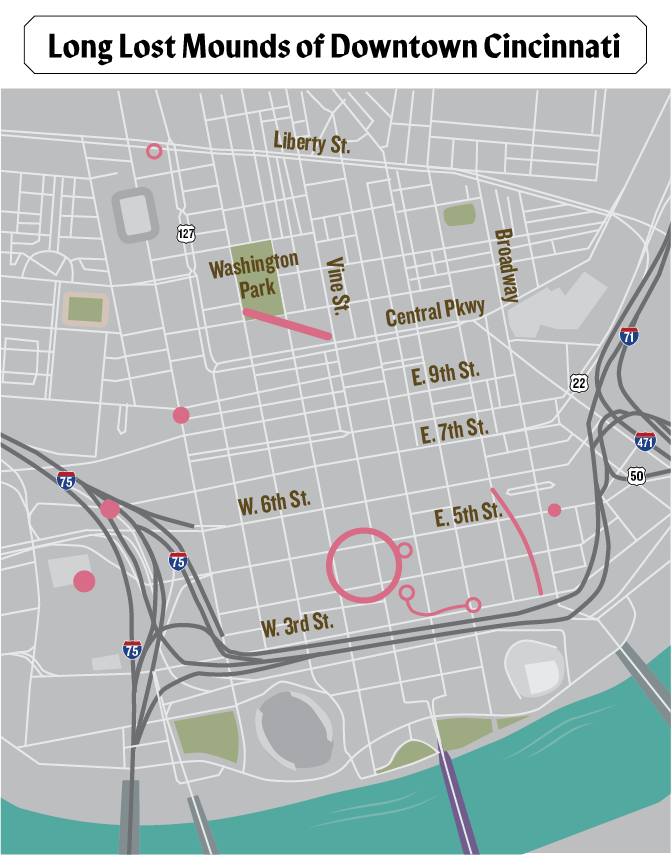
Map by Brittany Dexter, adapted from Greg Hand's annotations of Daniel Drake's 1815 map of Cincinnati
Growing up on an Eastern Shawnee reservation in Oklahoma, cultural interpreter and artist Talon Silverhorn participated in the ceremonies, hunting traditions, and arts of his tribe, who were forced from the Ohio Valley in the early 19th century. As cultural programs manager for the Ohio Department of Natural Resources, Silverhorn oversaw American Indian historical content in Ohio parks including the Shawnee Cultural Interpretive Center at Great Council State Park in Xenia. Silverhorn also makes hyper-real digital portraits of pre-contact peoples.
“We actually just got back from a bus tour that brought almost 60 tribal citizens to Ohio from here in Oklahoma,” he says. “On a grand tour of historic and cultural sites from really ancient, archaic history, all the way up through the Northwest Indian War.” For Eastern Shawnee people, “going back to Hopewell sites and walking among those things is like a modern day Roman driving his Vespa in front of the Colosseum.”
The material culture and the earthworks left behind by the Adena, Hopewell or Ft. Ancient culture “are a bridge for us to pre-contact,” he says. “Later Ft. Ancient culture is almost indistinguishable from early Shawnee culture, material-wise . . . the way that they designed things, the geometry, and relationships to celestial bodies makes sense for us today,” he says.
The Adena (800 BCE to 100 AD), Hopewell (200 BCE to AD 500), and Ft. Ancient (900 AD to 1550) peoples are believed to have been relatively egalitarian in social structure. Yet the individuals of which they were comprised coordinated annually across vast distances and generations to build and maintain some sites over a span of 2,000 years, eight times the longevity of our young republic. Earlier woodland people practiced horticulture, forest gardening. They managed the landscape with fire, maintaining openings in the forest to promote beneficial trees and plants. Rare pockets of Ohio prairie probably owe their survival to that practice.
While the arrival of maize agriculture from Mexico sustained larger, less nomadic populations, a more sedentary lifestyle was a tradeoff, Swinney says, increasing competition for land. There was an increase in warfare. Ft. Ancient village populations rose to as many as 500 individuals. They were building 300 foot long timber structures, Silverhorn says, but not necessarily to live in. “They’re participating in Hopewell through shared beliefs. But Hopewell isn’t necessarily one people or one genetic group. It’s not one tribe. It’s multiple languages and cultures and beliefs and genetic lineages all blending together in this shared belief system that gives rise to geometric mounds.” Charred corn recovered from some sites seems to have travelled immense distances, brought by people who helped to build them, he says.
“Ft. Ancient really shifts the paradigm. Because now, instead of living a lifestyle that’s almost unidentifiable on the landscape, people really settle into village living. . . . Ceremony begins to be internalized within the community. And this nucleates culture into a single place and into a group of people that now has the chance to be different and diversify from other groups.” With the shift to agriculture, he says, “Ft. Ancient begins to track the sun more than their ancestors who were more focused on the moon.”
Yet European explorers into the Ohio Valley found only small villages, often in stages of abandonment. European materials from De Soto’s entrada were found at a Ft. Ancient site in Mariemont, even though the conquistador only made it to Tennessee. His arrival and subsequent colonists brought diseases that spread quickly among villagers lacking immunity, decimating whole populations. War and economic struggles fractured native ways of life. Here and throughout North America, indigenous populations began to ebb and flow in response to European settlement. Beginning in the 1680s, writes historian Kathleen DuVal in Native Nations: a Millennium in North America, Ohio Valley peoples fled violence from the Haudenosaunee and French “Beaver Wars” to their north, and captivity in the slave trade from the south. The Shawnee moved east. But they remained united, DuVal says, “by a connection to their Ohio Valley homeland.”
In the 1700s, the Miamis, who are related to the Delaware, Ottawa, and Shawnee, became the most powerful tribe in Ohio. The Miami established a major center at Piqua. By the 1720s, in the relative peace that followed the Beaver Wars and a cessation in the Indigenous slave trade, the Shawnee returned to Ohio. A century later, they were finally forced west.
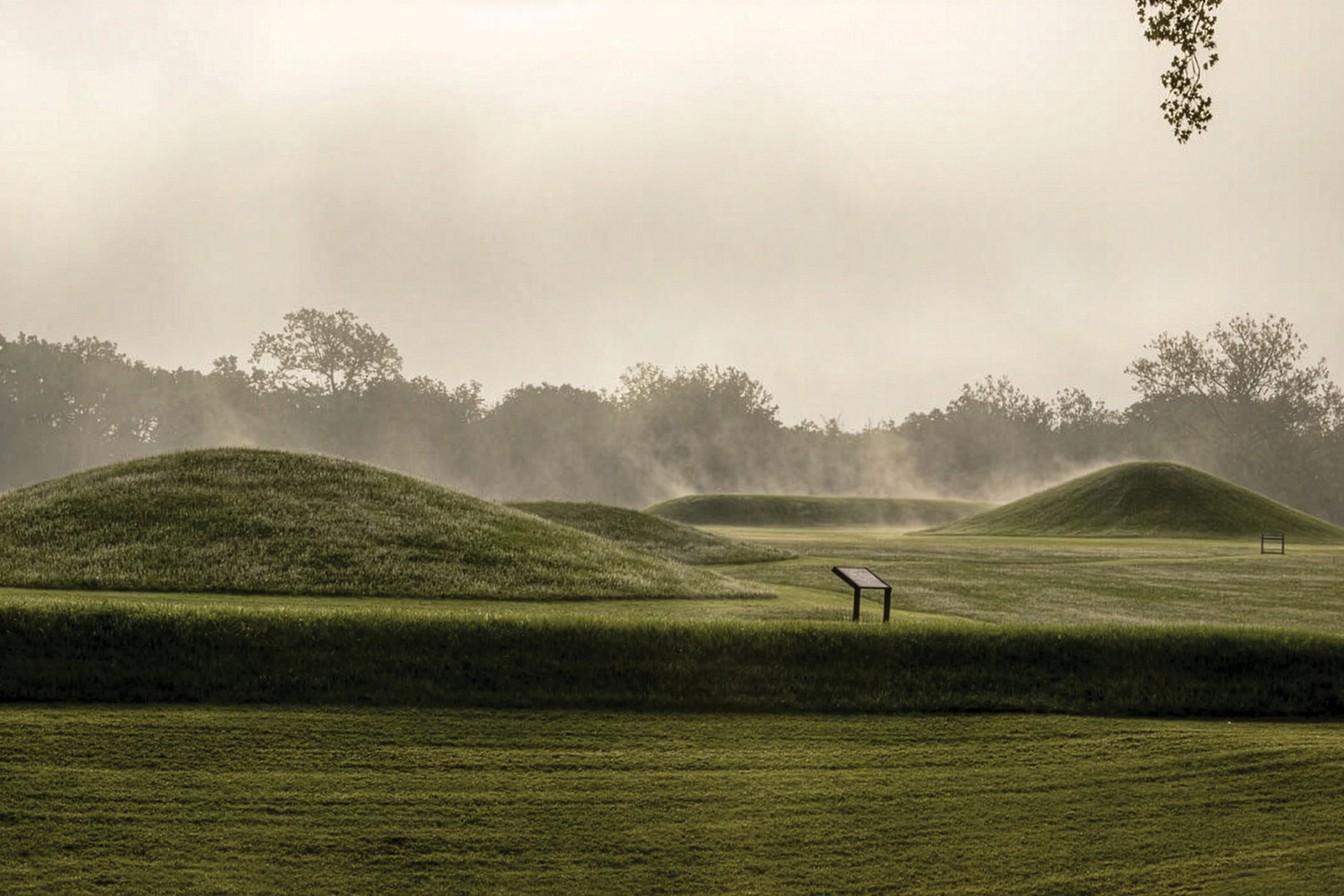
Photograph by NPS/Tom Engberg
Subsequent history is rife with broken treaties, forced relocations, and “re-education.” Archaeology, archaeologists will tell you, has been exploitative and destructive. But many archaeologists and anthropologists are working with native communities to document and reconnect them with their past, to protect graves and sacred sites. Swinney names a few: Robert Cook at OSU, Kevin Nolan at Ball State, Rebecca Wingo at UC, the Myaamia Center at Miami University.
“I think of our ancestors,” Silverhorn says. “We don’t know what language they spoke. We don’t know what they called themselves. We don’t know how they identified who was and who wasn’t part of this sort of shared experience. But I think the shared language that they’re using is something of science. Our ancestors would not be unfamiliar with the process of coming to conclusions. To, in some cases, digging up parts of the past.” But also, he says, “There are things we don’t know about the past because they were intentionally let go. Things that are intentionally buried.” This extends beyond human remains and objects, he says, to practices and ceremonies. “It’s OK for things to be forgotten, and it’s OK, I think, to relearn those things or to reawaken those things if they’ve simply just slipped from our memory. But for something to be intentionally broken and buried, for it to be put away—there was an intention for that thing to cease. The Native side of things says, ‘We understand that this is meant to go away, and we are respecting the wishes of those ancestors who made that choice’ . . . it’s like a deeper understanding. It gets to the heart of what humility and humbleness really, really are.”
It takes humbleness to push aside past misconceptions, to see the past in an objective light. New revelations add nuance to our understanding of the past; the future of archaeology will make the past more recognizable to the peoples of tomorrow.